AI-generated illustration
President Trump’s memorandum dated Oct. 7, 2026, and published in the Federal Register on Oct. 14 (91 FR 65435), creates a three-member “committee of inquiry” to examine allegations that Federal Reserve Governor Lisa Cook made false statements in connection with “one or more mortgage instruments.” The committee must recommend whether there is “cause” to remove her under 12 U.S.C. 242, after a closed, transcribed White House hearing set for Nov. 5, 2026.
TL;DR
- What it orders: three administration officials investigate and recommend; Cook gets a hearing of up to 4 hours and a Nov. 10 deadline for a final statement.
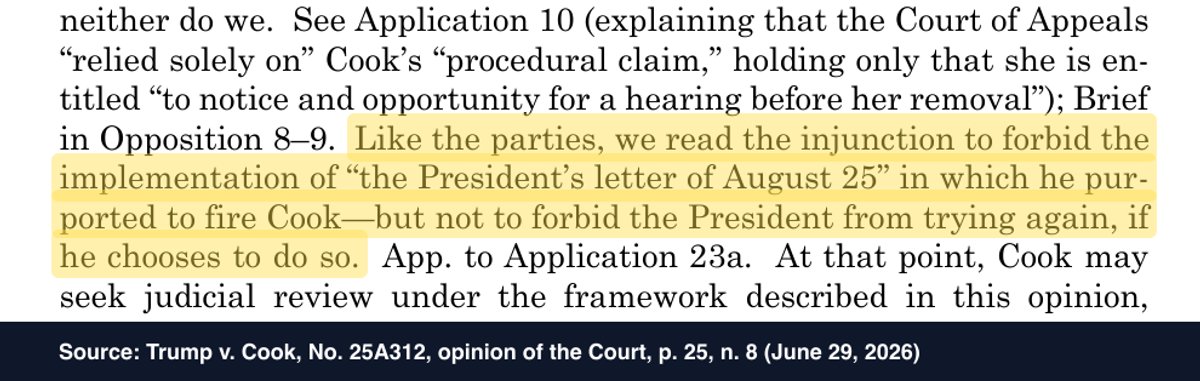
- Why now: on June 29, 2026, the Supreme Court voted 5-4 to leave in place the order keeping Cook in office. The majority called her 2025 removal “erroneous and void” for lack of process, but said the injunction did not stop the President “from trying again.”
- Reactions: Cook’s lawyers voiced “grave doubts” about the hearing; on Oct. 13 one wrote that she cannot attend on Nov. 5.
What does the Lisa Cook memo order?
Paragraph by paragraph, the two-page memo:
- Creates the committee. Its members are three of the five officials the Federal Register version is addressed to: the President’s assistant for economic policy, the EEOC chair and the head of the Office of Government Ethics. News reports identify them as Kevin Hassett, Andrea Lucas and Keith Sonderling, who is acting OGE director and also Labor secretary, according to CNBC and SCOTUSblog.
- Sets the question: whether there is “cause” under 12 U.S.C. 242, “as construed in Trump v. Cook.” It may consult other agencies, including the Justice Department.
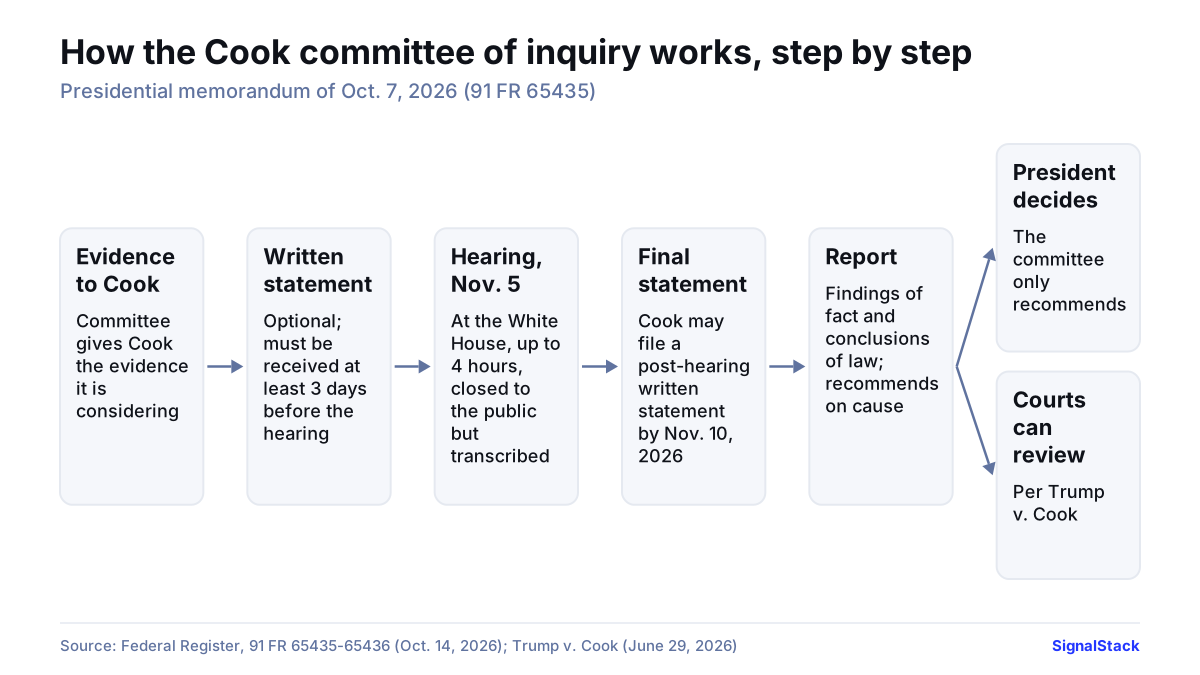
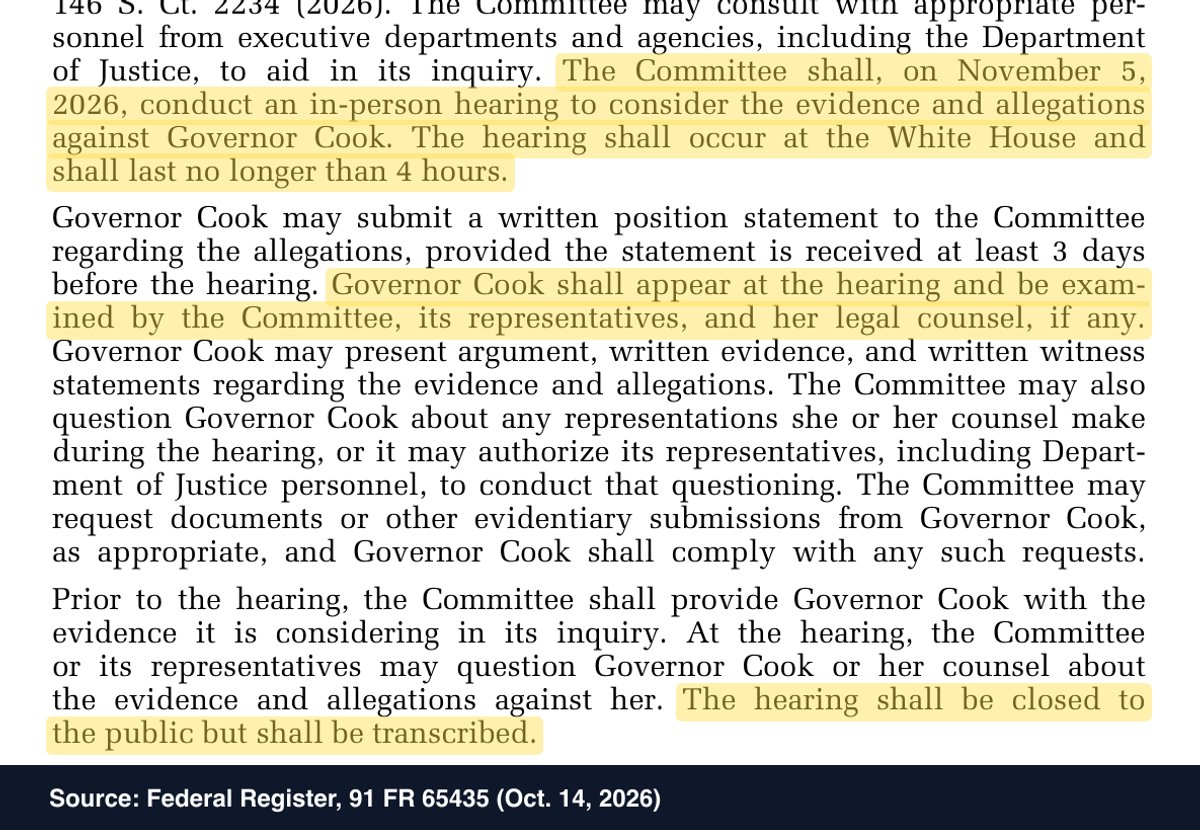
- Schedules the hearing: in person at the White House on Nov. 5, 2026, no longer than 4 hours.
- Gives Cook rights: a written position statement if received at least 3 days ahead; argument, written evidence and written witness statements at the hearing; a lawyer if she has one.
- Places duties on Cook: she “shall appear” to be examined and must comply with document requests. Justice Department staff may be authorized to question her.
- Requires disclosure: the committee must give Cook the evidence it is considering before the hearing.
- Closes the room: no public access, but the hearing “shall be transcribed.”
- Sets the end point: a post-hearing statement by Nov. 10, then findings of fact, conclusions of law and a recommendation “as soon as practicable.”
- Keeps flexibility: the committee may make “reasonable changes” with adequate notice to Cook.
The White House posted it on Oct. 9, CNBC and SCOTUSblog reported. CNBC noted it names no outside, independent arbiters.
What legal authority does it cite?
The memo invokes “the Constitution and the laws of the United States” and cites Article II, Section 3, the take-care clause, which in its words covers “firing subordinates who cannot be trusted to tell the truth and follow the law.”
The removal rule is in the Federal Reserve Act. Under 12 U.S.C. 242, a governor serves a 14-year term “unless sooner removed for cause by the President.” The statute does not define “cause”; the memo adopts the Supreme Court’s reading.
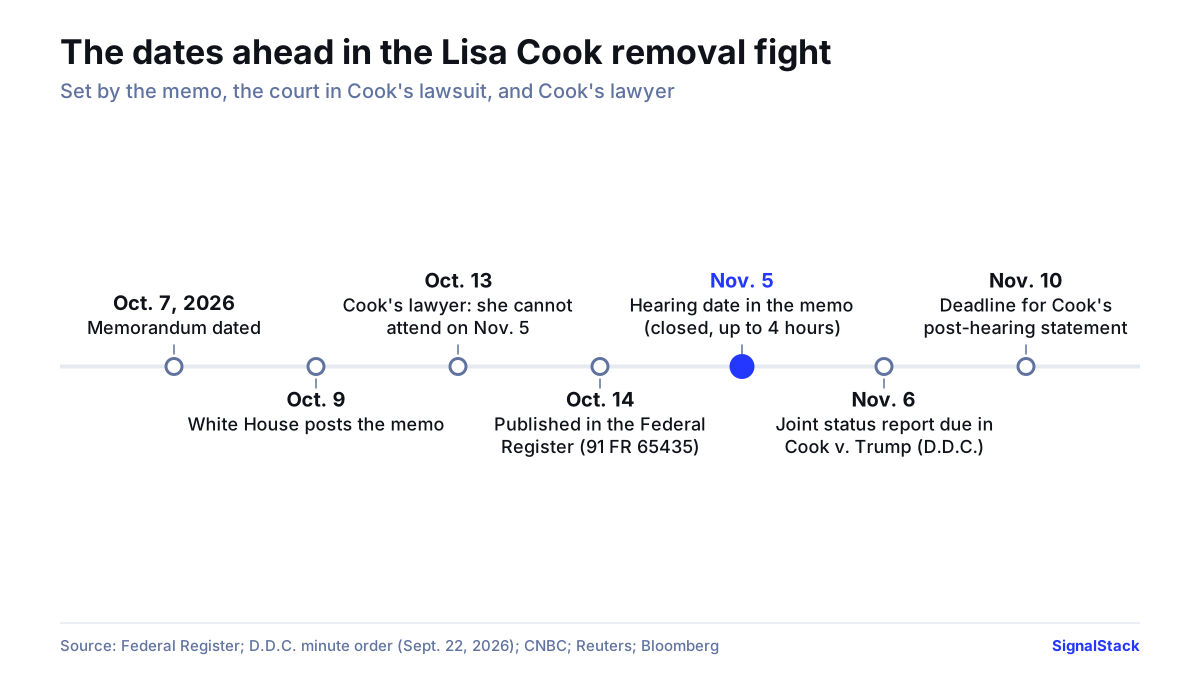
Key dates and deadlines
| Date | What happens | Source |
|---|---|---|
| Nov. 2 (our count) | Last day for Cook’s written statement to arrive (“at least 3 days before”) | Memo |
| Nov. 5 | Closed White House hearing, up to 4 hours | Memo |
| Nov. 6 | Joint status report due in Cook’s original lawsuit | D.D.C. minute order, Sept. 22 |
| Nov. 10 | Deadline for Cook’s post-hearing statement | Memo |
What the memo does not do
- It does not remove Cook. The committee recommends and the President decides. There is no fixed date for the report (“as soon as practicable”) or, CNBC noted, for the decision.
- It does not say the transcript will be released. An Associated Press report said one would be published; the text says only that the hearing will be transcribed.
- It does not mention live witnesses. It allows Cook written witness statements.
- It does not say whether Cook’s answers could be used in a criminal case, CNBC pointed out. She has not been charged with a crime, the AP reported.
How does it compare with the Supreme Court’s ruling?
Chief Justice John Roberts wrote that Cook was owed, “at minimum,” three things. Side by side with the memo:
| What the Court listed | What the memo provides |
|---|---|
| ”some explanation of the evidence at issue” | The evidence the committee is considering, before the hearing |
| ”some avenue for a response” | Written statements before and after, plus argument and written evidence at the hearing |
| ”a deadline by which a response would be due” | Nov. 10, 2026 |
The opinion added that a governor is not “entitled to an audience with the President or a full-blown judicial trial,” citing for comparison a “committee of inquiry” President Taft formed in a removal case.
The Court did not define “cause.” It said the answer turns at least partly on how serious the alleged misconduct is and how closely it connects to a governor’s official duties, and that the facts “have yet to be found.”
Background: the first attempt and the court record
According to the Supreme Court, Federal Housing Finance Agency Director William Pulte posted a letter on Aug. 20, 2025, alleging that Cook claimed two homes as her principal residence at once in 2021. On Aug. 25, the President’s letter purported to fire her, citing “reason to believe” she “may have made false statements on one or more mortgage agreements.” Cook sued on Aug. 28. Judge Jia Cobb kept her in office with a preliminary injunction, and the D.C. Circuit declined to pause it on Sept. 15, 2025.
On June 29, 2026, the Supreme Court denied the government’s stay application, 5-4. Roberts wrote for himself and Justices Sotomayor, Kagan, Kavanaugh and Jackson. Thomas, Alito (joined by Gorsuch) and Barrett dissented. The majority decided “on narrow grounds,” the missing procedure.
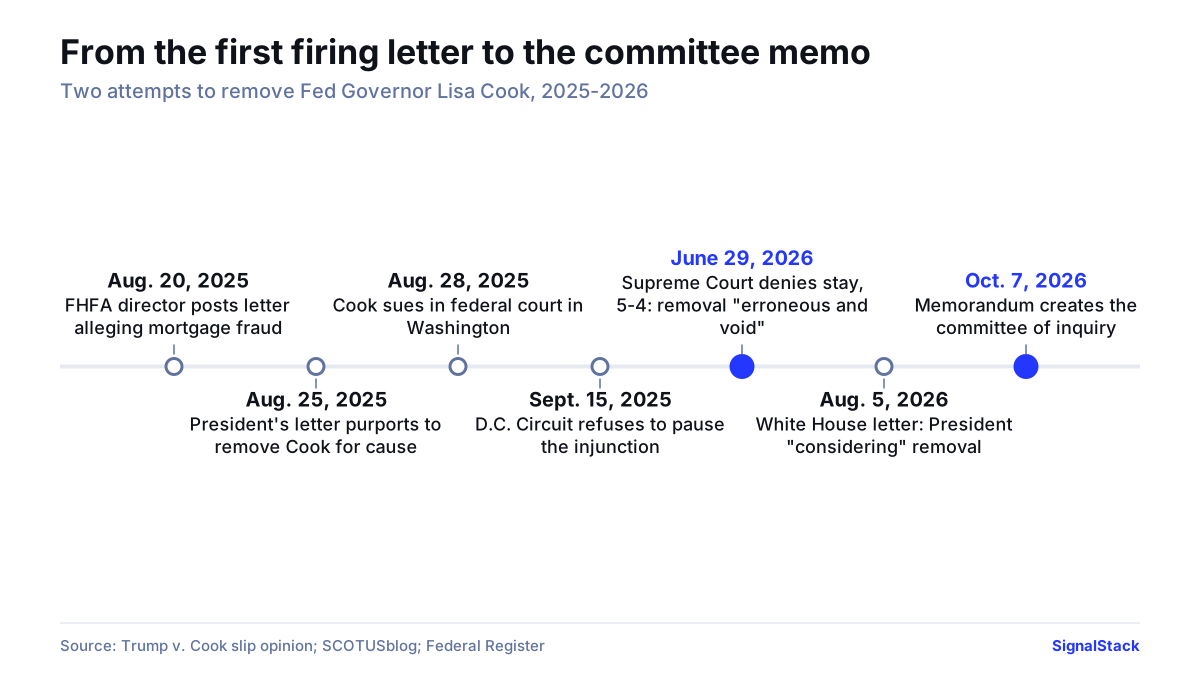
The second attempt began with an Aug. 5, 2026, letter from Deputy Chief of Staff Dan Scavino: the President was “considering” removal, with replies due Aug. 26, SCOTUSblog reported. Cook’s lawyer, Abbe Lowell, answered that the allegations “remain unfounded and untrue” and that her “apparent mistake” on a lender’s form was “unintentional, not criminal,” CNBC reported. On Sept. 22, Judge Cobb ordered a joint status report in the original case by Nov. 6.
Who said what
- Cook’s lawyers (Oct. 9): Lowell and Norm Eisen said they had “grave doubts” that the hearing is legitimate and lawful, citing the President’s repeated statements that he has already decided to fire her. They added that Cook “welcomes the opportunity” to clear her name.
- The Federal Reserve (Oct. 9): declined to comment, the AP and NBC News reported.
- Sen. Elizabeth Warren, D-Mass. (Oct. 9): the top Democrat on the Senate Banking Committee said Trump was “convening an illegitimate show trial.”
- Senate Minority Leader Chuck Schumer, D-N.Y. (Oct. 9): “It’s about Trump trying to seize control of the Fed,” he posted on X.
- President Trump: later told reporters he would proceed with firing Cook if the committee recommended it, Reuters reported.
- Lowell (Oct. 13): wrote to the White House that Cook will be at “financial and monetary policy meetings in Europe” on Nov. 5, that the earliest hearing would be after the Fed’s Dec. 8-9 meeting, and that Hassett “already has publicly insinuated” that the President has cause. The White House did not immediately respond, Bloomberg reported.
The coverage cited here quotes no Republican member of Congress on the committee. Former Fed chief counsel Scott Alvarez told the AP it is “an attempt to show” Trump is giving Cook “as much process as possible”; in the AP’s paraphrase, he said the allegations do not appear to meet the “for cause” standard.
Why it matters outside the U.S.
The Court called the Fed “one of our Nation’s (and the world’s) most important financial institutions” and said both the fact and the “appearance of independence” are key to its design. Cook is one of 12 voters on the rate-setting committee, the AP noted, and CNBC reported she is expected to vote on Oct. 28. See our guide to Fed rate decisions, the September 2026 rate hike and more politics.
What could go right / What could go wrong
For Cook:
- What could go right: she gets the evidence before any hearing, and courts can review a later removal.
- What could go wrong: the memo says she “shall appear,” and her lawyer has said she cannot on Nov. 5.
For the administration:
- What could go right: Fordham law professor Jane Manners told Bloomberg Law that Trump appeared to be complying with the Court’s expectations on Cook’s right to process.
- What could go wrong: Manners said the justices set a “high bar” for proving cause; the Court left “cause” undefined and said courts can then assess whether the charges are valid and sufficient.
FAQ
Q What is the Lisa Cook committee of inquiry?
A A three-member panel set up by a presidential memo dated Oct. 7, 2026, to examine the mortgage allegations against Fed Governor Lisa Cook and recommend whether there is "cause" to remove her.
Q Who is on the committee investigating Lisa Cook?
A The President's economic policy assistant, the EEOC chair and the Office of Government Ethics director. News reports identify them as Kevin Hassett, Andrea Lucas and Keith Sonderling.
Q When is the Lisa Cook hearing?
A The memo sets a closed White House hearing on Nov. 5, 2026, of up to four hours. On Oct. 13, Cook's lawyer wrote that she cannot attend that day and could attend only after the Fed's Dec. 8-9 meeting.
Q Can the committee fire Lisa Cook?
A No. It sends findings and a recommendation to the President, who decides. Under Trump v. Cook (June 29, 2026), courts can review a removal for cause.
Sources
- Memorandum of October 7, 2026: Establishment of a Committee of Inquiry To Investigate Allegations of False Statements by Lisa DeNell Cook (91 FR 65435)
- Memorandum, FR Doc. 2026-21061 (PDF)
- Presidential memorandum as posted by the White House
- Trump v. Cook, No. 25A312 (June 29, 2026), slip opinion
- 12 U.S.C. § 242 (Federal Reserve Board members' terms; removal for cause)
- Cook v. Trump, No. 1:25-cv-02903 (D.D.C.): docket, minute order of Sept. 22, 2026
- Trump establishes committee to investigate Federal Reserve's Lisa Cook in latest effort to fire her
- Trump appoints committee to investigate statements by the Fed's Lisa Cook
- Trump created a committee to dig into the Fed's Lisa Cook. What is it and what comes next?
- Trump establishes panel to probe Fed governor Lisa Cook in latest attempt to fire her
- Trump announces committee investigation of Fed Governor Lisa Cook
- Trump informs Lisa Cook that he is "considering" her removal (Aug. 7, 2026)
- Fed's Lisa Cook turns mortgage allegations back on Trump and his Cabinet (Aug. 26, 2026)
- Fed's Lisa Cook Puts Off White House Hearing Over Trump's Allegations (Oct. 13, 2026)
- Fed Governor Cook's lawyer denounces Trump's latest attempt to remove her (Oct. 13, 2026)
- US Fed governor unavailable for Nov 5 hearing ordered by Trump (Oct. 13, 2026)
- White House to Hold Its Own Hearing on Claims Against Fed's Cook