

AI-generated illustration
TL;DR: On Sunday, Oct. 11, U.S. District Judge Jennifer L. Rochon in Manhattan ordered the administration to stop using Department of Homeland Security funds on five TV ads featuring President Trump. The order took effect at 6:45 p.m. that evening and requires remaining placements, including that evening’s, to be cancelled. A 40-page opinion followed on Oct. 12. The court records add these details:
- Where the money came from: the $20 million came from the “commemorating” line of a 2025 border-security fund.
- How fast it moved: OMB approved it 95 minutes after the request.
- How it was bought: the contract rode on an existing Coast Guard recruiting-advertising agreement.
- What DHS said: it told the court about $19 million in airtime had been bought through Oct. 11.
The order lasts 14 days unless extended.
What the order does
The case is Common Cause v. Department of Homeland Security, No. 1:26-cv-08882, filed Oct. 7 in the Southern District of New York. The plaintiffs are Common Cause and three others:
- Robert Hunter, the Democratic nominee for Alabama House District 28
- SEIU Local 32BJ
- the union’s political action committee
Only Hunter, the union and its PAC asked for the emergency order.
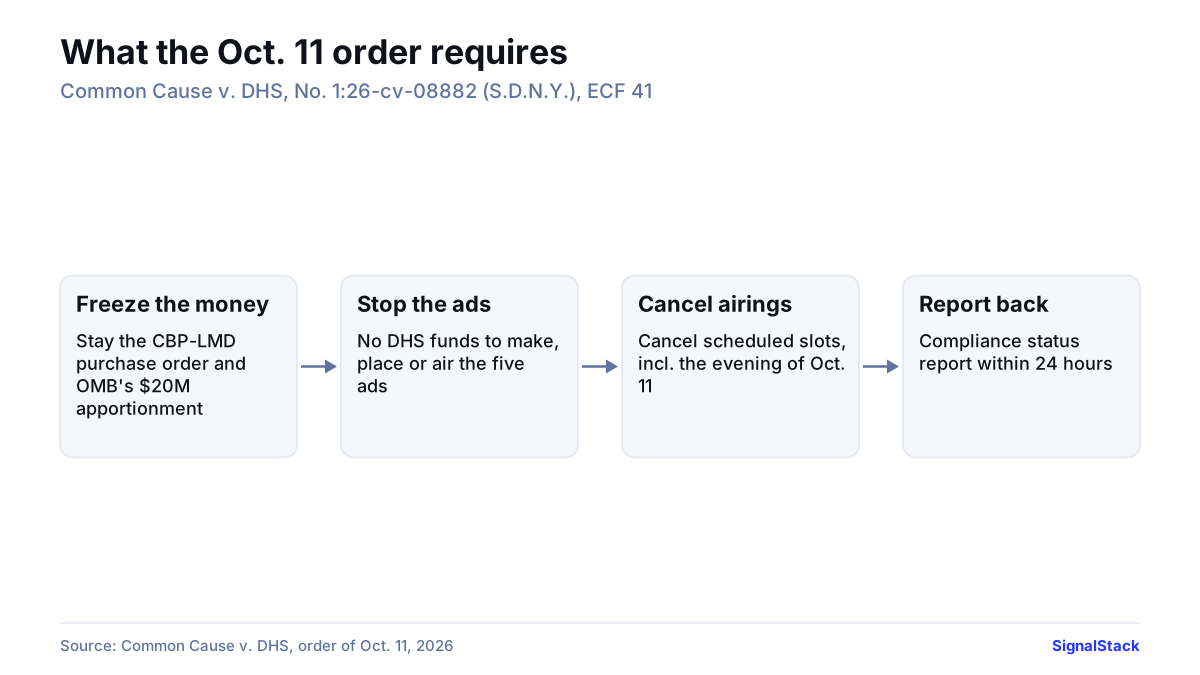
The four-page order of Oct. 11 does five things:
- Contract and money frozen: it stays the purchase order between U.S. Customs and Border Protection (CBP) and LMD Agency, Inc., including all future payments, and the Office of Management and Budget’s $20 million apportionment.
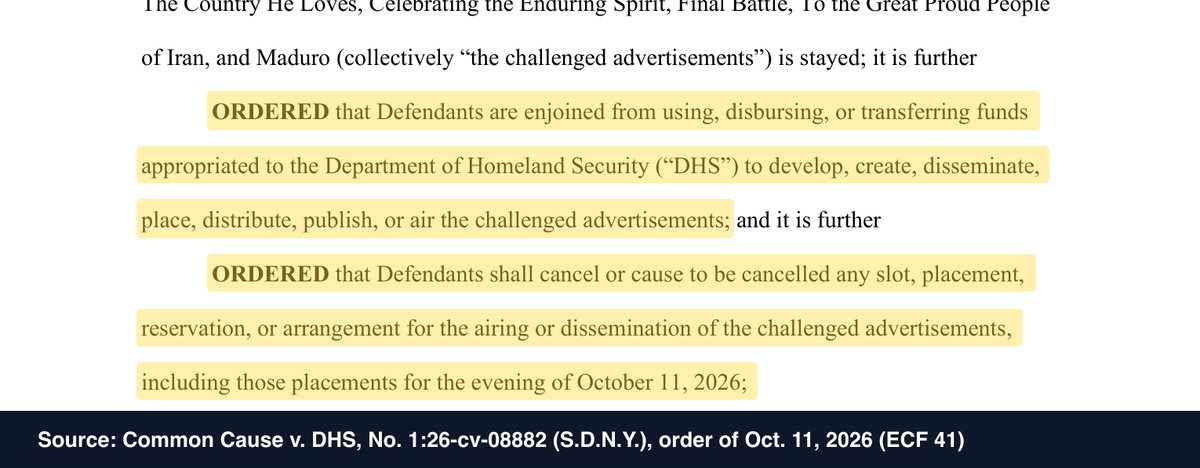
- No more spending: it bars the government from using, disbursing or transferring DHS funds to make, place or air the five ads. The order lists the five by title: Final Battle, Maduro, The Country He Loves, To the Great Proud People of Iran and Celebrating the Enduring Spirit.
- Airings cancelled: it orders any scheduled slot cancelled, including placements for the evening of Oct. 11, and bars new or expanded agreements for the ads.
- Contractor bound: LMD is covered too, as a contractor acting with the government.
- Report back: the government must report on compliance within 24 hours. No bond is required.
Where the $20 million came from
Declarations the government filed lay out the money trail:
- The fund: the money came from Pub. L. 119-21, the 2025 law that gave CBP a lump sum available through September 2029. One of its eight listed uses is “commemorating efforts and events related to border security.” OMB recorded the line as “OBBBA - Commemorative Events.”
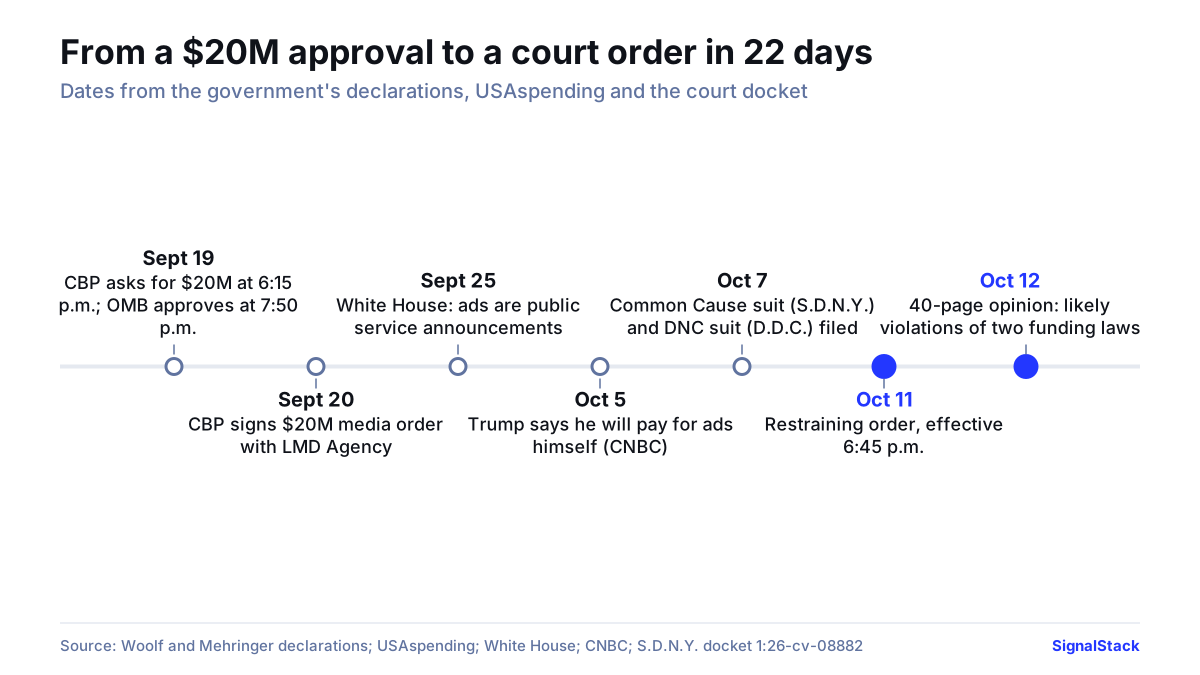
- The approval: an OMB official stated that CBP requested the $20 million at 6:15 p.m. on Sept. 19, 2026, and that he approved it at 7:50 p.m. the same evening.
- The contract: the next day, Sept. 20, CBP signed a $20 million “National Media Campaign” order with LMD Agency of Columbia, Maryland. Federal spending records show the order was placed under a 2023 Coast Guard agreement for recruiting-center advertising support.
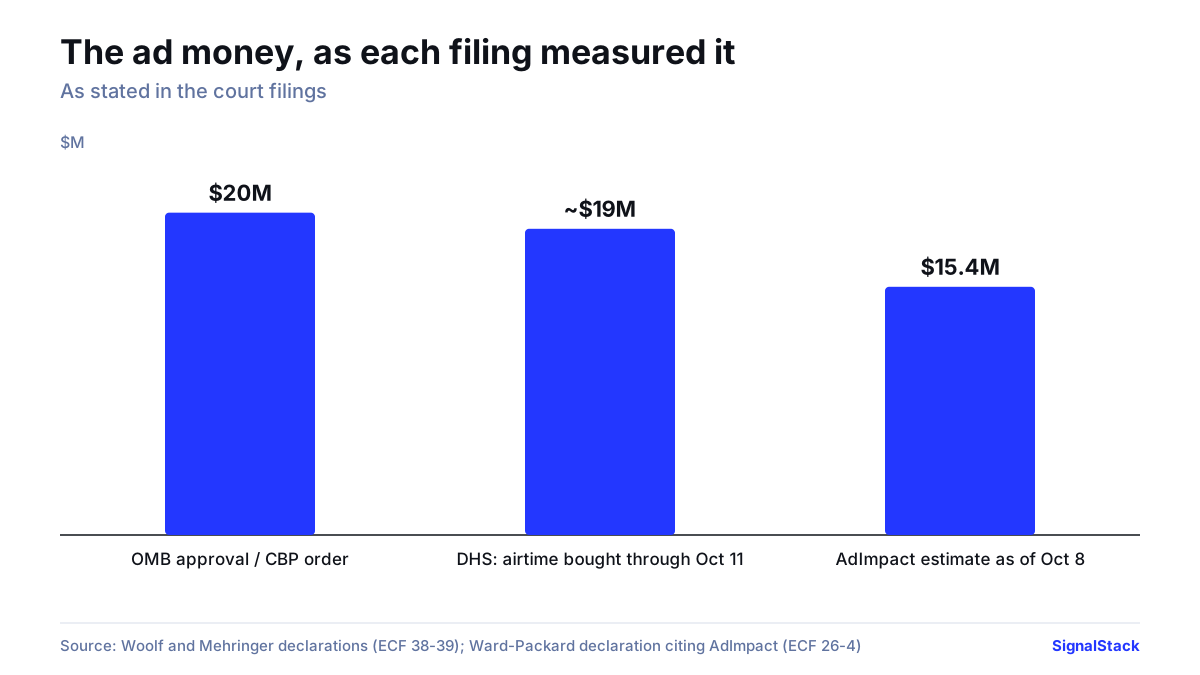
- What was bought: a DHS official, Holly Mehringer, who performs the duties of the department’s chief financial officer, told the court the order paid only for airing ads that already existed. She said about $19,000,000 in media had been purchased through Oct. 11, that the final invoice was still pending, and that any money left after the final invoice would be de-obligated (released from the contract).
The plaintiffs’ own filing put the scale another way. Citing AdImpact estimates, it counted at least 16,254 airings worth an estimated $15.4 million as of Oct. 8.
The law the judge applied
Two federal rules carry the case:
- The purpose statute: 31 U.S.C. § 1301 says appropriations may be spent only on the purposes Congress set.
- Section 718: this provision of the 2026 appropriations law bars any appropriated money from being used for “publicity or propaganda purposes” inside the U.S. unless Congress has authorized it.
The Government Accountability Office’s guide to appropriations law reads the publicity-or-propaganda ban, which has appeared in some form in annual appropriations acts since 1951 (in the 2026 law as Section 718), to cover three things: self-aggrandizement, covert propaganda and “purely partisan” materials.
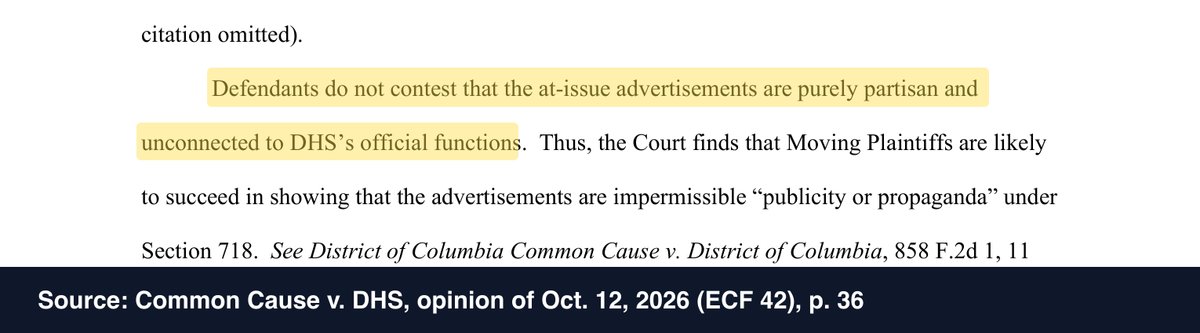
In her Oct. 12 opinion, Judge Rochon found the moving plaintiffs clearly and substantially likely to win their claims under both rules. According to the opinion, the government did not contest that the ads were “purely partisan” and unconnected to DHS’s official functions.
The opinion did not decide the complaint’s other claims, which include equal protection and ultra vires.
What each side argued
The government, in its New York filing, did not argue that the ads complied with the funding laws. Its main arguments were:
- The case was moot, because the challenged conduct would not continue past Oct. 11.
- The plaintiffs lacked standing, because they are not competing with President Trump, who is not running for office. In that argument it wrote that the ads attack “a generic list of ‘villains’” but do not address any specific race, candidate or party.
- If only Hunter had standing, Manhattan was the wrong venue.
It also called the requested order overbroad and asked for a bond. The judge rejected the mootness and standing arguments, said venue could be addressed later, found the order “not overly broad” and required no bond.
The White House had already given its defense in a Sept. 25 release. It called the spots public service announcements and said they are “very clearly not campaign ads,” since Trump is not on the ballot and the ads carry no call to action. The release pointed to earlier administrations’ public service campaigns, including the George W. Bush administration’s TV ads explaining the Medicare drug law. GAO found in 2004 (B-302504) that HHS’s TV and print ads about that law did not violate the propaganda ban. In a separate 2004 decision, it found that HHS’s prepackaged video news stories about the same law did violate it, because they did not identify the agency as their source.
On Oct. 5, Trump said in a social media post that he would “pay for them myself,” with money he raised for the super PAC MAGA Inc., CNBC reported. The White House later clarified that MAGA Inc. would pay for such ads going forward, not for ads that had already aired, according to CNBC. DHS Secretary Markwayne Mullin, pressed on CBS’s “Face the Nation” on Oct. 11 about whether the taxpayer money would be refunded, said he was “all about” public service announcements that “brag about America,” CNN reported.
The plaintiffs call the ads political propaganda aimed at the Nov. 3 midterm elections. In their brief they argue the commemorating money was meant for things like line-of-duty death memorials, agency anniversaries and ceremonies, “not campaign ads,” and that Final Battle is “almost identical” to an ad Trump ran as a campaign ad in 2024. Common Cause chief executive Virginia Kase Solomón said the group would not stop until the administration is “held fully accountable,” Reuters reported.
Background: two more lawsuits
- DNC case: the Democratic National Committee sued in Washington, D.C. the same day, Oct. 7 (DNC v. Trump, No. 1:26-cv-03506, D.D.C.).
- Wisconsin case: the Democratic Party of Wisconsin filed another suit on Oct. 9 (No. 1:26-cv-03547, D.D.C.).
- A different argument in D.C.: in its Oct. 11 opposition in the DNC case, the government argued the DNC was unlikely to win. It said “publicity” and “propaganda” are undefined, and it quoted GAO that restricting all materials with political content would curtail the administration’s legitimate authority to inform the public of its policies. It also said the ad buys would end Oct. 11.
For more political stories told from the court record, see our report on the DOJ’s antitrust probe of the TV pool and our politics section.
What could go right / What could go wrong
For the plaintiffs:
- What could go right: the court found them likely to win on both funding rules. The order also stops payments under the contract, not only future airings.
- What could go wrong: the order is temporary, 14 days unless extended, and the government argues the dispute is moot. The court adjourned its Oct. 13 conference and said it would reschedule it to discuss next steps.
For the administration:
- What could go right: in New York it argued that the funds had already been obligated and that staying the 2026 apportionment does nothing to provide redress; the judge did not accept that the order went too far. In the D.C. case it argues the DNC’s claims are unlikely to succeed on the merits, saying “publicity” and “propaganda” are undefined and that ultra vires review may not be available and is unlikely to succeed.
- What could go wrong: according to the opinion, it did not contest in New York that the ads were purely partisan, and the judge relied on that in her Section 718 finding.
FAQ
Q Why did a judge block the taxpayer-funded Trump ads?
A Judge Jennifer Rochon found the plaintiffs likely to show the ads broke two federal funding rules. One is the purpose statute, 31 U.S.C. § 1301. The other is the ban on using appropriations for "publicity or propaganda" (Section 718). According to her opinion, the government did not contest those points in her court.
Q How much did the DHS ads cost?
A OMB approved $20 million, and CBP signed a $20 million purchase order on Sept. 20, 2026. A DHS official told the court about $19 million in airtime had been purchased through Oct. 11.
Q Where did the money for the ads come from?
A From Pub. L. 119-21's border-security fund. One of its listed uses is commemorating border-security efforts and events. OMB recorded the line as "OBBBA - Commemorative Events."
Q How long does the order last?
A The temporary restraining order took effect at 6:45 p.m. on Oct. 11, 2026. It runs for 14 days unless the court extends it.
Sources
- Common Cause v. DHS, No. 1:26-cv-08882 (S.D.N.Y.): temporary restraining order (ECF 41, Oct. 11, 2026)
- Opinion and order (ECF 42, Oct. 12, 2026)
- Complaint (ECF 1)
- Defendants' opposition (ECF 37)
- Declaration of DHS official Holly Mehringer (ECF 38)
- Declaration of OMB official Woolf (ECF 39)
- Declaration of Ward-Packard with ad-airing estimates (ECF 26-4)
- Consolidated Appropriations Act, 2026, Pub. L. 119-75 (Sec. 718)
- Pub. L. 119-21 (Sec. 90004)
- 31 U.S.C. § 1301 (purpose statute)
- Principles of Federal Appropriations Law (Red Book), Ch. 3
- CBP purchase order 70B06C26F00001137
- Presidential public service announcements are nothing new (Sept. 25, 2026)
- DNC v. Trump: defendants' opposition (ECF 9, Oct. 11, 2026)
- Democratic Party of Wisconsin v. Trump, No. 1:26-cv-03547 (D.D.C.): complaint
- DNC v. Trump, No. 1:26-cv-03506 (D.D.C.): complaint
- Judge orders Trump to halt taxpayer-funded ads with hours left in administration's push
- Judge orders Trump administration to immediately stop taxpayer-funded TV ads
- Trump hedges on paying back government for ads that already aired (Oct. 5, 2026)
- Judge orders halt to taxpayer-funded ads featuring Trump
- Federal judge orders pro-Trump TV ads funded by taxpayers off air immediately




.jpg)