

AI-generated illustration
TL;DR
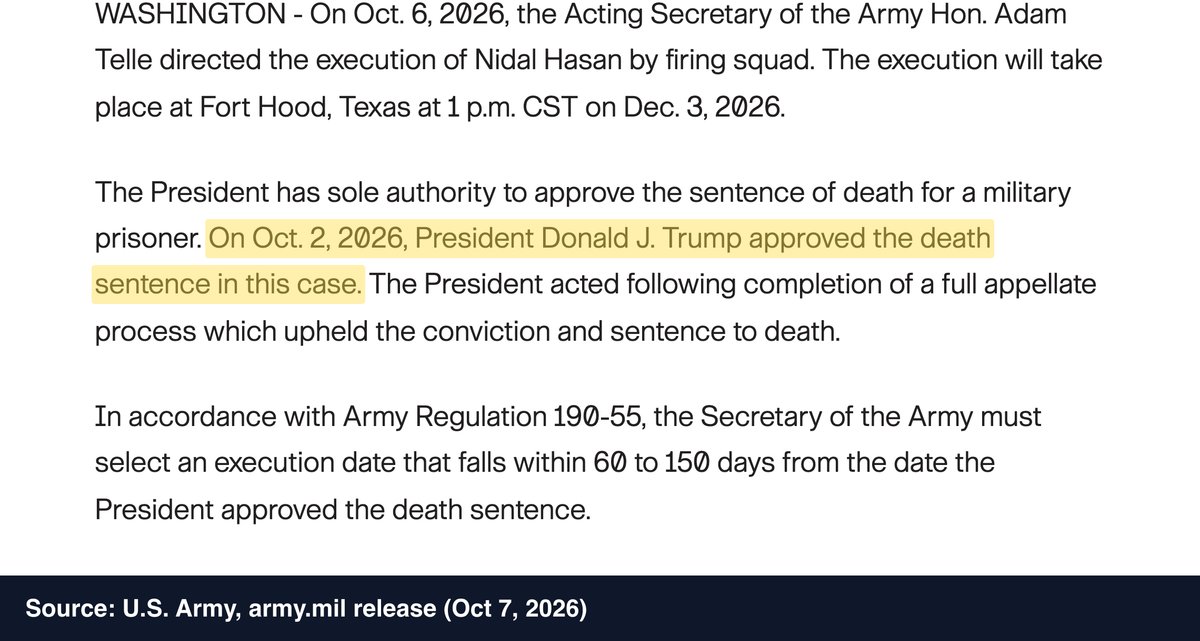
- The Army says President Trump approved Nidal Hasan’s death sentence on Oct. 2, 2026, and Acting Army Secretary Adam Telle ordered on Oct. 6 that it be carried out by firing squad at Fort Hood, Texas, at 1 p.m. CST on Dec. 3, 2026. Defense Secretary Pete Hegseth said the execution would be public, and the Pentagon told reporters it “will be livestreamed.”
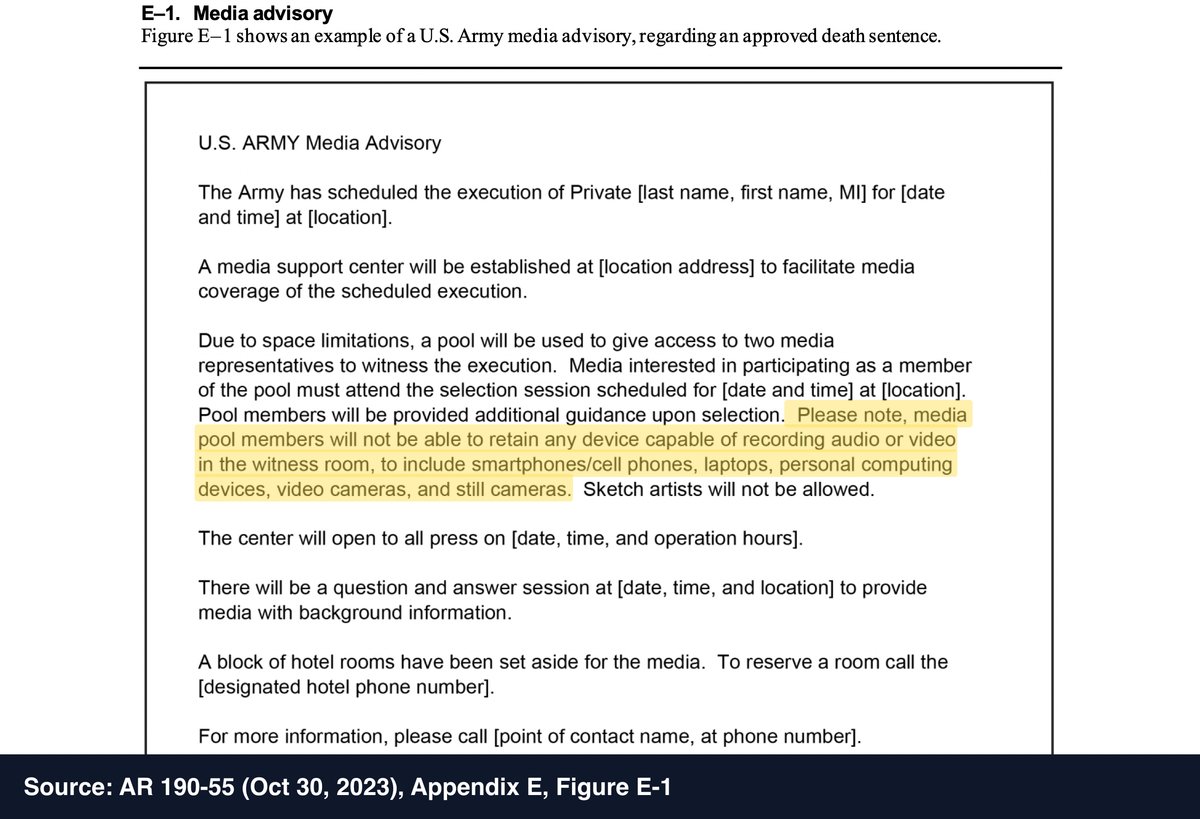
- The Army’s execution rulebook, AR 190-55, lets the Secretary of the Army choose the method and approve the place. A 2019 revision removed the words “lethal injection.” It lists who may witness an execution, including at least two media representatives. Its sample media advisory says media witnesses may not keep phones, cameras or other recording devices with them, and it has no rule on streaming or broadcasting an execution.
- The rule for federal civilian executions, 28 CFR 26.4(f), bans “photographic or other visual or audio recording.” That rule applies to death sentences from U.S. district courts, not courts-martial. On Oct. 10, Trump said: “I’ll make a decision ultimately.”
What happened
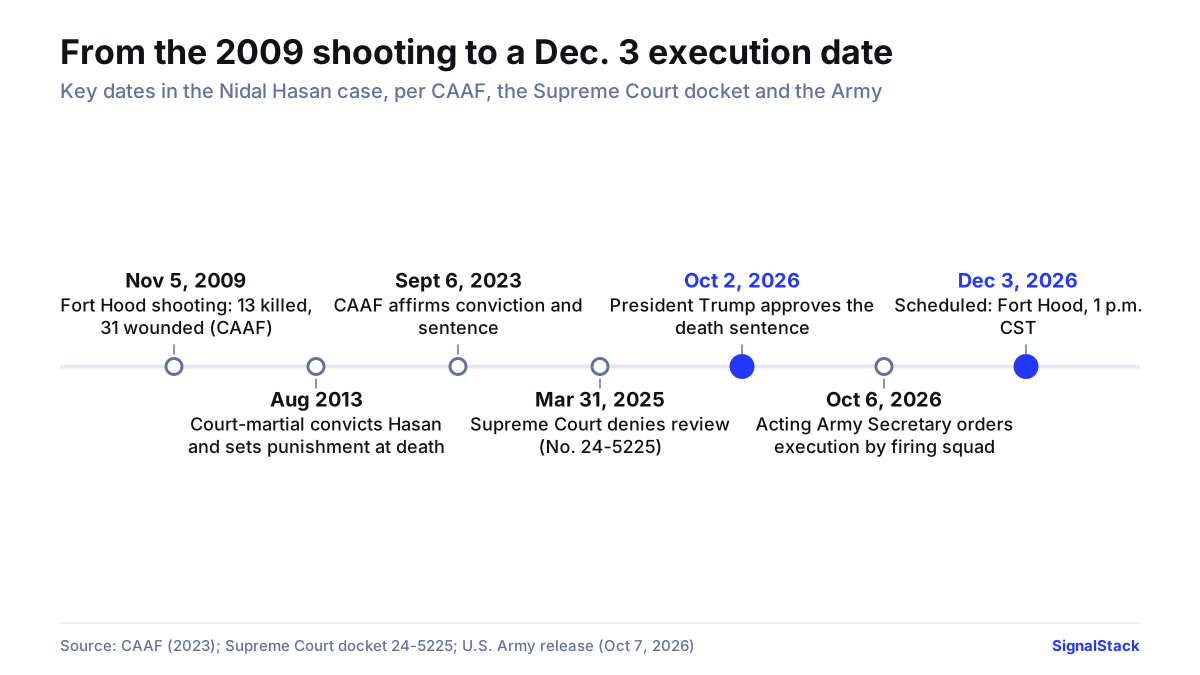
Nidal Hasan, a former Army major and psychiatrist, killed 13 people and wounded 31 others at Fort Hood on Nov. 5, 2009, according to the 2023 opinion of the U.S. Court of Appeals for the Armed Forces (CAAF); he was charged with 32 attempted murders because he also exchanged fire with an officer he did not hit. Parnell and several outlets give 32 wounded. A court-martial jury convicted him in August 2013 and set his punishment at death five days later.
On Monday, Oct. 5, 2026, chief Pentagon spokesman Sean Parnell announced that Hegseth had recommended, and Trump had approved, “death by U.S. Army firing squad,” Military Times reported. The Army’s own release of Oct. 7 dates the presidential approval to Oct. 2 and says Telle “directed the execution of Nidal Hasan by firing squad” on Oct. 6.
Hegseth then said the execution would be public. “We’ll make sure that people are able to watch it, that it’s public,” he said in a video interview with Real America’s Voice, according to NPR; CNN reports the interview was with podcaster Jack Posobiec aboard the USS Abraham Lincoln. The Pentagon confirmed the plan in a statement quoted by CNN: “The Secretary is correct. It will be livestreamed. Details will follow.”
CNN reported on Oct. 10 that the announcement “caught people across the Pentagon and the Army off guard,” citing three sources, and that it is “unclear where and if the execution will be streamed beyond the Pentagon’s own website.” NBC News reports that on Oct. 9 Trump said he “absolutely” approved the livestream plan. On Saturday, Oct. 10, he told reporters at the White House, according to NBC News: “There are two thoughts: don’t show it and show it. Cause you know, by showing it, maybe other people won’t be doing what he did. So I’ll make a decision ultimately.”
What the Army’s rules actually say
Three documents govern a military execution. The UCMJ sets who must approve it, the Manual for Courts-Martial repeats that rule, and Army Regulation 190-55 sets out the procedure.
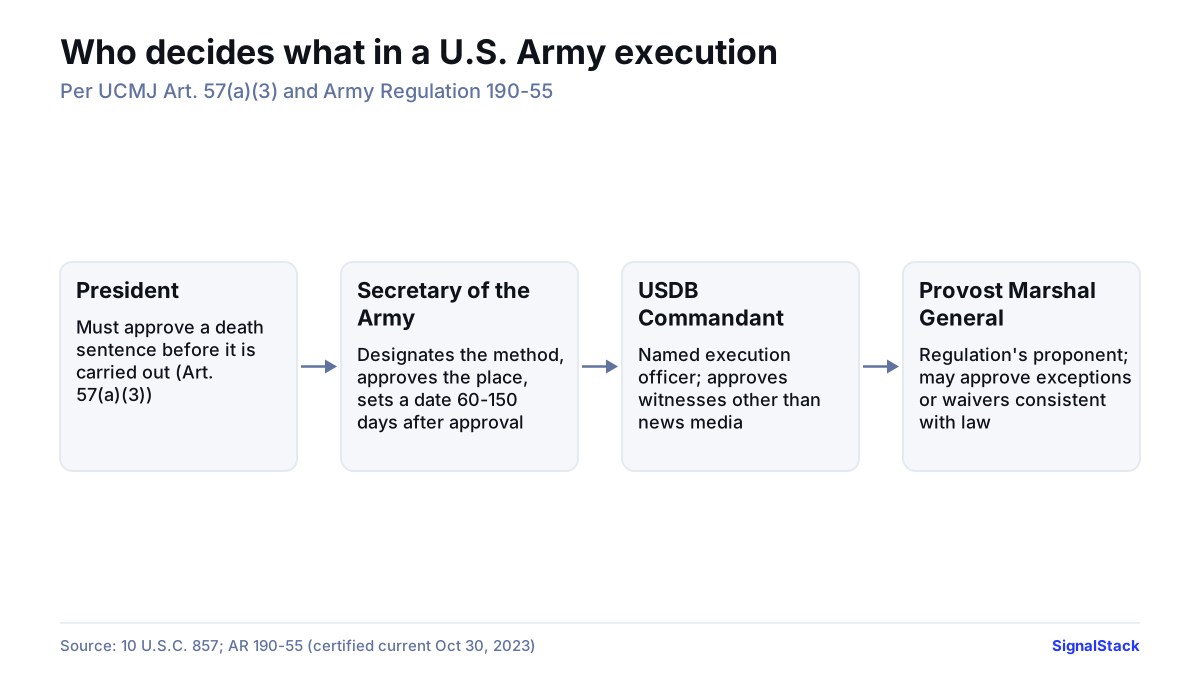
Who approves. Under 10 U.S.C. 857(a)(3) (UCMJ Art. 57), a death sentence “may not be executed until approved by the President,” who may commute or remit it; the statute adds that the death portion “may not be suspended.” Rule for Courts-Martial 1207 repeats the approval requirement. AR 190-55’s paragraph 1-4 still cites the older Article 71, which a 2016 law (Pub. L. 114-328) repealed; the approval rule now sits in Article 57.
Method. The 2006 edition of AR 190-55 said: “Military executions will be by lethal injection.” The current text, from an expedited revision dated March 5, 2019 and certified current on Oct. 30, 2023, says executions “will be by a method designated by the SECARMY” (the Secretary of the Army). Its summary of change says the 2019 revision “Removes the term ‘lethal injection’ (throughout).” The regulation does not mention a firing squad, and it does not rule one out.
Place and date. The Secretary of the Army approves the location, and AR 190-55 requires the execution order to name the Commandant of the U.S. Disciplinary Barracks (USDB) at Fort Leavenworth, Kansas, as the execution officer. The Army’s release says the date must fall within 60 to 150 days of the President’s approval. Dec. 3 is 62 days after Oct. 2.
Witnesses. Paragraph 2-5 lists who “are authorized to be present.” They include the USDB commandant, the execution team, the prisoner’s counsel and family if he asks, victims or their relatives, and “A minimum of two media representatives.” No one under 18 may watch, and the commandant approves the witness list, except for the media witnesses.
Recording. Paragraph 2-4 requires a media advisory “(see app E),” and the regulation’s sample advisory (Figure E-1) tells pool reporters they may not keep “any device capable of recording audio or video” inside the witness room, including phones and cameras, and that “Sketch artists will not be allowed.” The regulation contains no rule on streaming or broadcasting an execution. For news media access it also refers to a separate regulation, AR 190-47, which says prisoners “should not be photographed” except for medical, law-enforcement and identification purposes, and that official photography may be authorized when it “does not reveal the identity of individual prisoners and does not reflect adversely upon the Army.” Neither regulation says anything about the Army itself filming or streaming an execution. AR 190-55 also requires that the identities of the execution team “be kept confidential to the fullest extent permitted by law.”
Exceptions. The regulation’s proponent, the Provost Marshal General, “has the authority to approve exceptions or waivers to this regulation that are consistent with controlling law and regulations.”
| Question | AR 190-55 (Army) | 28 CFR 26.4 (federal civilian) |
|---|---|---|
| Media witnesses | At least two, from a pool | Up to 10 press representatives (26.4(c)) |
| Minors | No one under 18 | No one under 18 |
| Recording | Sample media advisory: media witnesses may not keep recording devices; no rule on streaming (AR 190-47 limits photographing prisoners) | “No photographic or other visual or audio recording” |
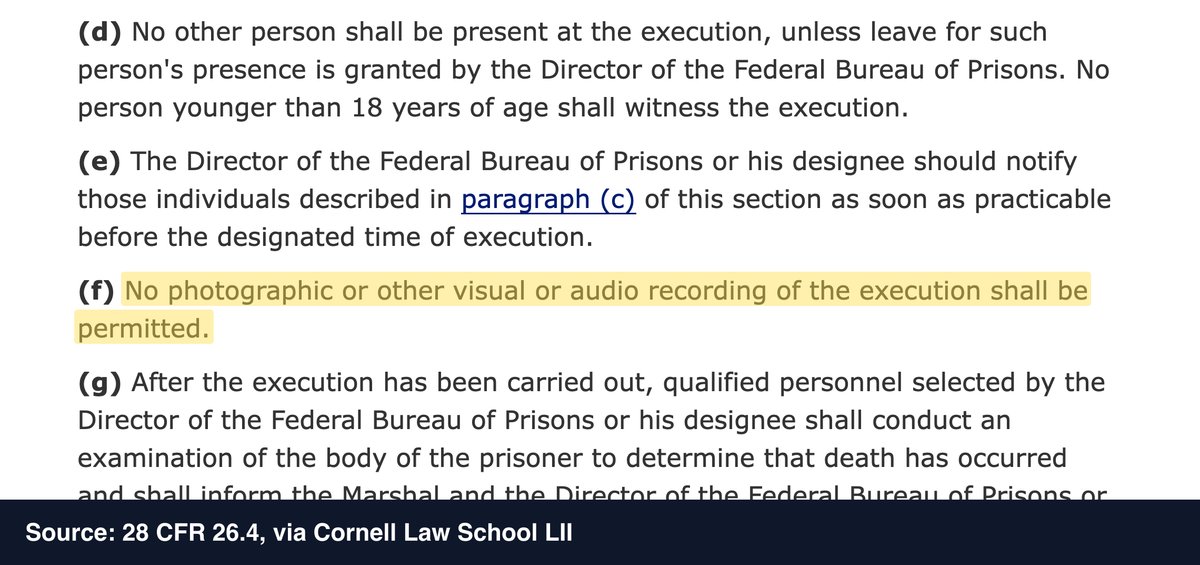
Experts quoted in the news say nothing in the rules authorizes a livestream. Gary Barthel of the Military Law Center, a former Marine officer, told Snopes: “If the Army wants to stream this execution they need to change the regulations to allow it.” He said officials could also seek an exemption from the Office of the Provost Marshal General. Robin Maher of the Death Penalty Information Center (DPIC) told NPR: “We’re not aware of any regulation or historical precedent” for a U.S. military execution to be livestreamed.
Who said what
| Who | What they said | Reported by |
|---|---|---|
| Defense Secretary Pete Hegseth | ”people need to understand that there’s serious consequences for these types of things” | NPR, CNN |
| Pentagon statement | ”It will be livestreamed. Details will follow.” | CNN |
| President Trump (Oct. 10) | “I know what the military would like to do, but I’ll make a decision” | NBC News |
| Sen. Thom Tillis (R-N.C.) | “Public executions are what oppressive dictatorships like Iran and Afghanistan do.” | NPR |
| Rep. Austin Scott (R-Ga.) | Supports the death sentence, but “live-streaming executions is what jihadists do” | NBC News |
| Rep. Matt Van Epps (R-Tenn.) | Said parents should not let children watch; the administration “is focused on accountability” | NBC News |
| Sen. Jack Reed (D-R.I.) | Called it “another stunt by Secretary Hegseth” | NPR |
| Survivor Alonzo Lunsford | Should be broadcast only to survivors and families | ABC News |
| Archbishop Paul S. Coakley (USCCB) | Called it “a barbaric promotion of a culture of death” | NPR |
| TikTok, Kick | TikTok pointed to its ban on showing “the moment of someone’s death”; Kick said a stream “would breach our Community Guidelines” | The Verge |
Background
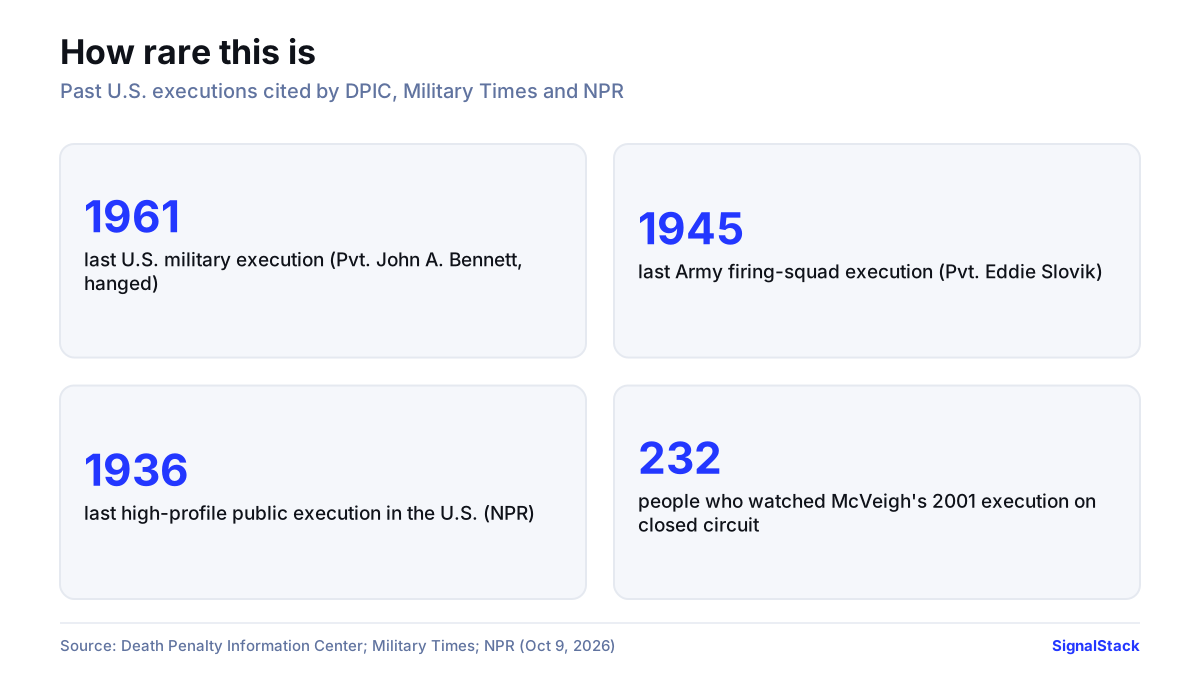
The U.S. military has not executed anyone since April 13, 1961, when Army Pvt. John A. Bennett was hanged, according to DPIC. The last Army firing-squad execution was that of Pvt. Eddie Slovik in France on Jan. 31, 1945, Military Times reported. NPR describes the 1936 hanging of Rainey Bethea in Kentucky as the last high-profile public execution in the U.S. Michael Radelet, a professor emeritus at the University of Colorado Boulder, told NPR the closest example was the 2001 execution of Timothy McVeigh; NPR reports that 232 survivors and victims’ loved ones watched a closed-circuit feed in Oklahoma City.
Hasan’s direct appeals are complete. CAAF affirmed the conviction and sentence in 2023, and the Supreme Court denied review on March 31, 2025 (No. 24-5225). The Army’s release says the President “acted following completion of a full appellate process.” NPR and Snopes report that Hasan could still file a habeas corpus petition in federal court, which, NPR reported, legal experts have said could delay the execution by years.

Two survivors who spoke to ABC News reacted differently. Alonzo Lunsford said it should be shown only to survivors and victims’ families: “I don’t want this to be viewed upon as a spectacle.” Dayna Ferguson said it was “not completely shocking, given that death and war have historically always been documented through photographs and video,” and that she “hadn’t really thought about if I agree with the decisions being made.”
For another policy story told through the documents, see Executive Order 14435 on diesel, and more in Politics & Government.
What could go right
- Hegseth says a public execution shows there are “serious consequences,” and Trump said that “by showing it, maybe other people won’t be doing what he did.” Van Epps told NBC News the administration “is focused on accountability.”
- AR 190-55 already provides for media witnesses, a news release within 7 days of the execution order and a media advisory at least 14 days before the execution, so some public reporting is built into the process whatever is decided on streaming.
What could go wrong
- Critics in both parties object. Tillis compared public executions to “oppressive dictatorships”; Reed wrote that it “only gives the shooter what he wants: more attention and more control.”
- A federal habeas petition could delay the execution by years, according to legal experts cited by NPR.
- Barthel told Snopes he would “anticipate that there is going to be some efforts to stop it.”
- The regulation requires the execution team’s identities to be kept confidential “to the fullest extent permitted by law.” CNN’s source said a livestream makes hiding the soldiers’ identities harder.
- Platforms may not carry it. TikTok pointed to its ban on showing “the moment of someone’s death,” and Kick said such a stream “would breach our Community Guidelines,” according to The Verge.
FAQ
Q When is Nidal Hasan's execution?
A The Army says Acting Army Secretary Adam Telle ordered the execution by firing squad at Fort Hood, Texas, at 1 p.m. CST on Dec. 3, 2026, after President Trump approved the death sentence on Oct. 2, 2026.
Q Will Nidal Hasan's execution be livestreamed?
A The Pentagon said in a statement quoted by CNN that "It will be livestreamed." On Oct. 10, Trump told reporters he would make the decision ultimately, NBC News reported. CNN reported on Oct. 10 that many details of the livestream had yet to be finalized; the Pentagon said "Details will follow."
Q Is a firing squad allowed under Army rules?
A AR 190-55 says executions "will be by a method designated by the SECARMY." Since a 2019 revision it no longer names lethal injection, and it neither names nor bans a firing squad.
Q Do military rules allow filming an execution?
A AR 190-55 has no rule on streaming or broadcasting an execution. It authorizes at least two media witnesses, and its sample media advisory says they may not keep phones, cameras or other recording devices with them. AR 190-47 says prisoners "should not be photographed" except for limited official purposes. The federal civilian rule, 28 CFR 26.4(f), bans any recording, but it applies to death sentences from U.S. district courts.
Q When was the last U.S. military execution?
A April 13, 1961, when Army Pvt. John A. Bennett was hanged, according to the Death Penalty Information Center. The last Army firing-squad execution was Pvt. Eddie Slovik's in 1945, Military Times reported.
Sources
- Army sets execution date for convicted murderer Nidal Hasan (Oct 7, 2026)
- AR 190-55: U.S. Army Corrections System: Procedures for Military Executions (certified current Oct 30, 2023)
- AR 190-55, superseded edition of Jan 17, 2006
- 10 U.S. Code § 857 (UCMJ Art. 57): Effective date of sentences
- Manual for Courts-Martial (2024 ed.), R.C.M. 1207
- AR 190-47: The Army Corrections System (Mar 17, 2023)
- 28 CFR § 26.1: Applicability (federal civilian executions)
- 28 CFR § 26.4: Other execution procedures (federal civilian executions)
- United States v. Hasan (C.A.A.F. 2023)
- Docket No. 24-5225, Hasan v. United States
- Fort Hood shooter: Pentagon plans public livestream of firing squad execution
- Army caught off guard by Hegseth's order to make firing squad execution public
- The U.S. last held a public execution in the 1930s. The Pentagon wants to change that
- Trump says he'll decide whether to livestream the execution of Fort Hood shooter Nidal Hasan
- Army sets date, location for execution of Nidal Malik Hasan
- YouTube, Meta, and Twitch won't say if they'll allow the US government to livestream an execution
- Fort Hood survivors speak out on Pentagon's decision to livestream Hasan's execution
- Military death penalty: facts and figures
- Hegseth says Pentagon plans to livestream Fort Hood shooter's execution. Is that legal?