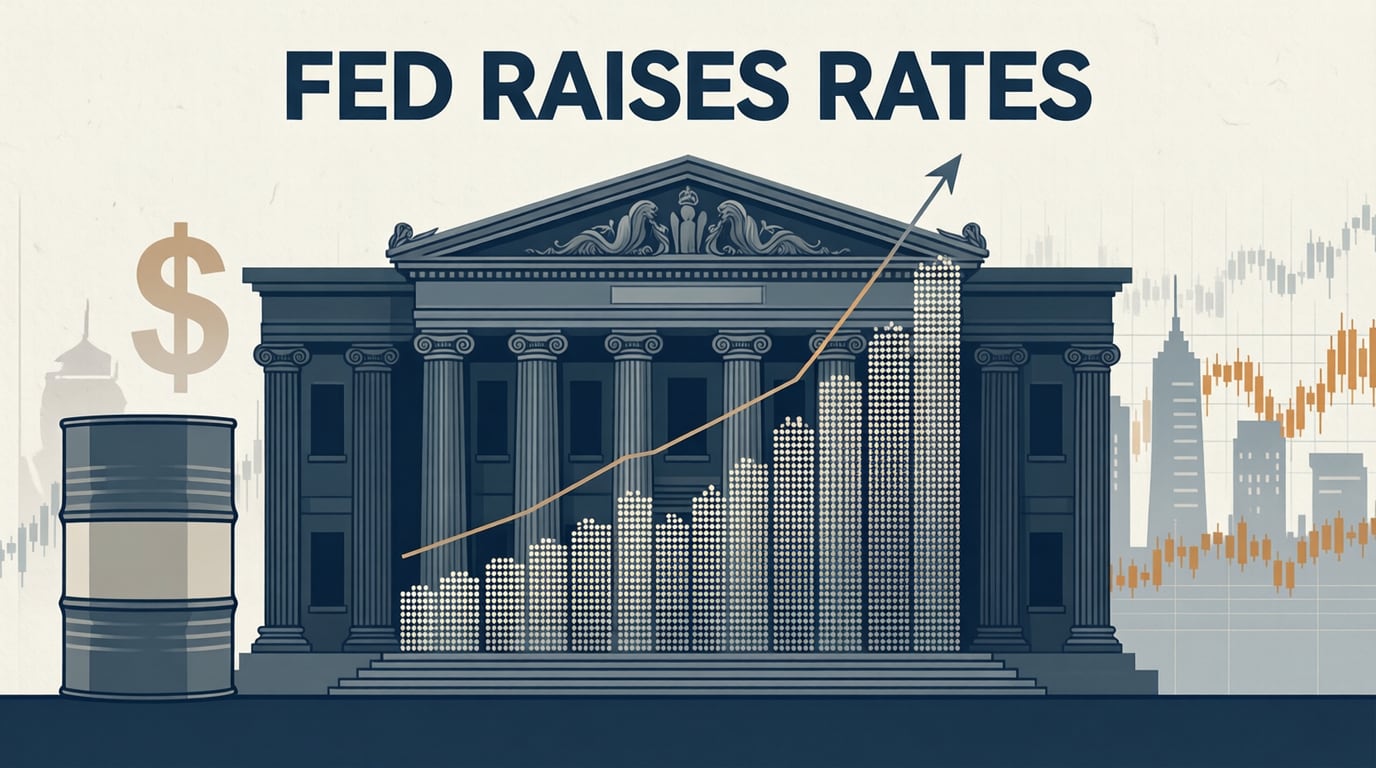
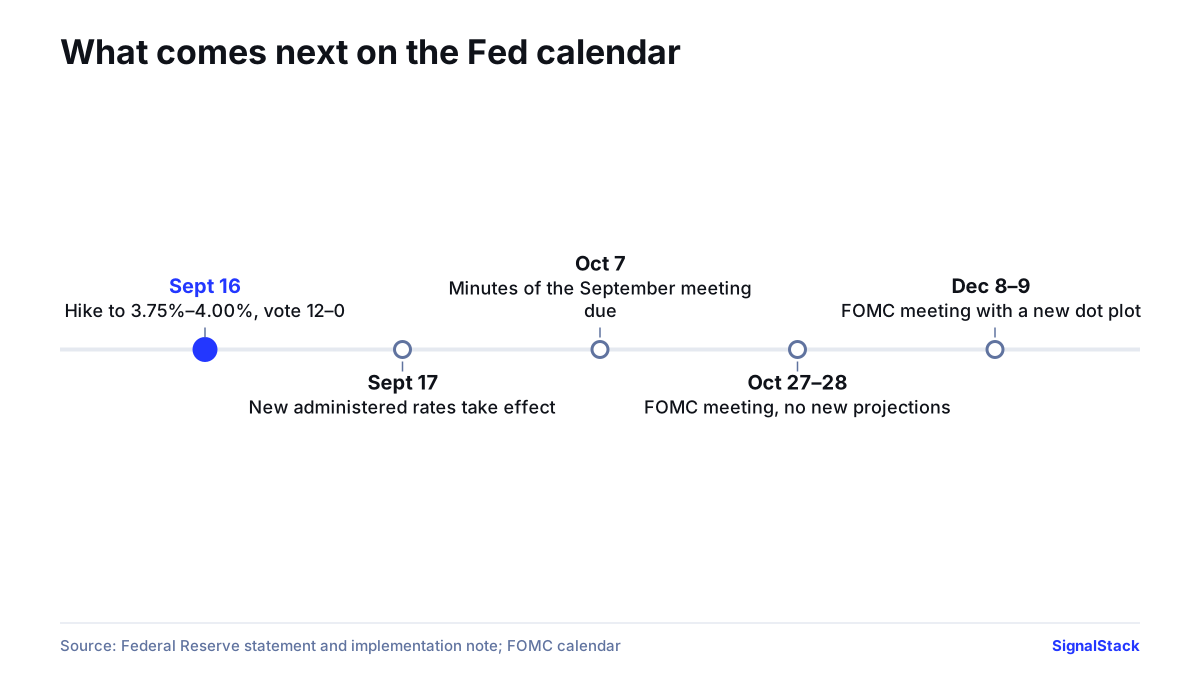
On September 16, 2026, the Federal Open Market Committee raised the federal funds target range by 0.25 percentage point, from 3.50%–3.75% to 3.75%–4.00%. The vote was 12–0. CNBC and Fox Business report that it was the Fed’s first rate increase since July 2023. The Fed also raised its administered rates by 25 basis points each, effective September 17. The rate on reserve balances (IORB) is now 3.90%, the primary credit (discount window) rate 4.00%, and the overnight reverse repo (ON RRP) offering rate 3.75%.
TL;DR
- The FOMC statement tied the hike to inflation, which it said “remains elevated”. It said the move will support “a timelier return” to 2%. In July, three officials had dissented in favor of a hike. This time the vote was unanimous.
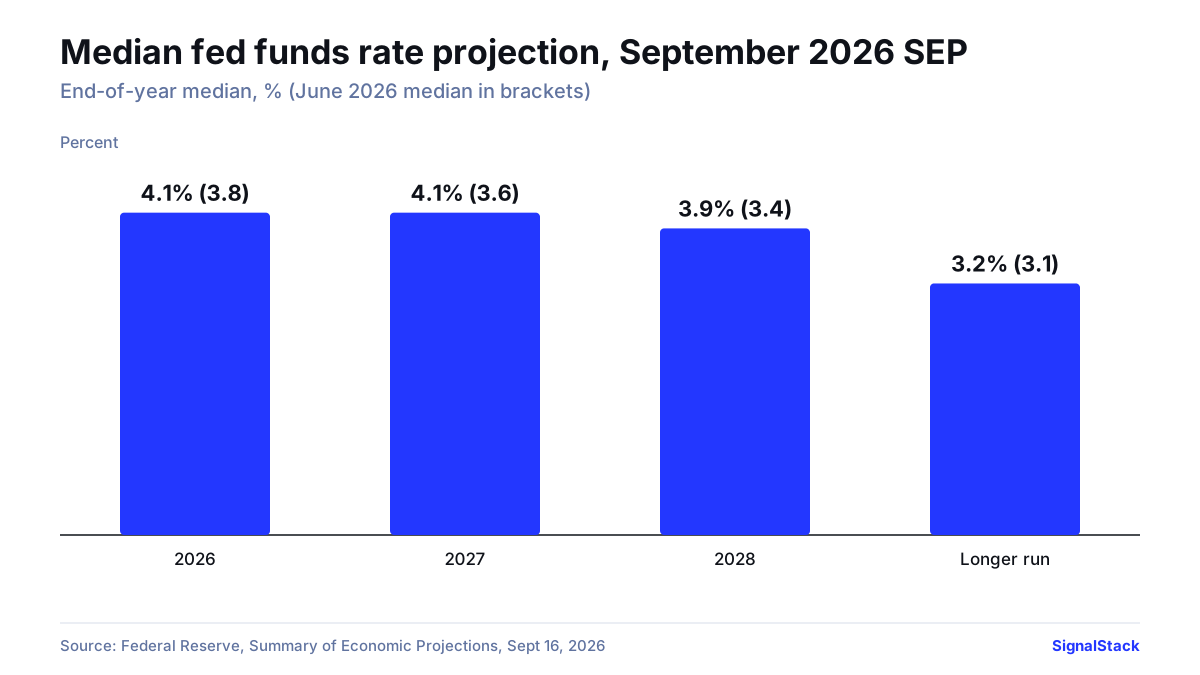
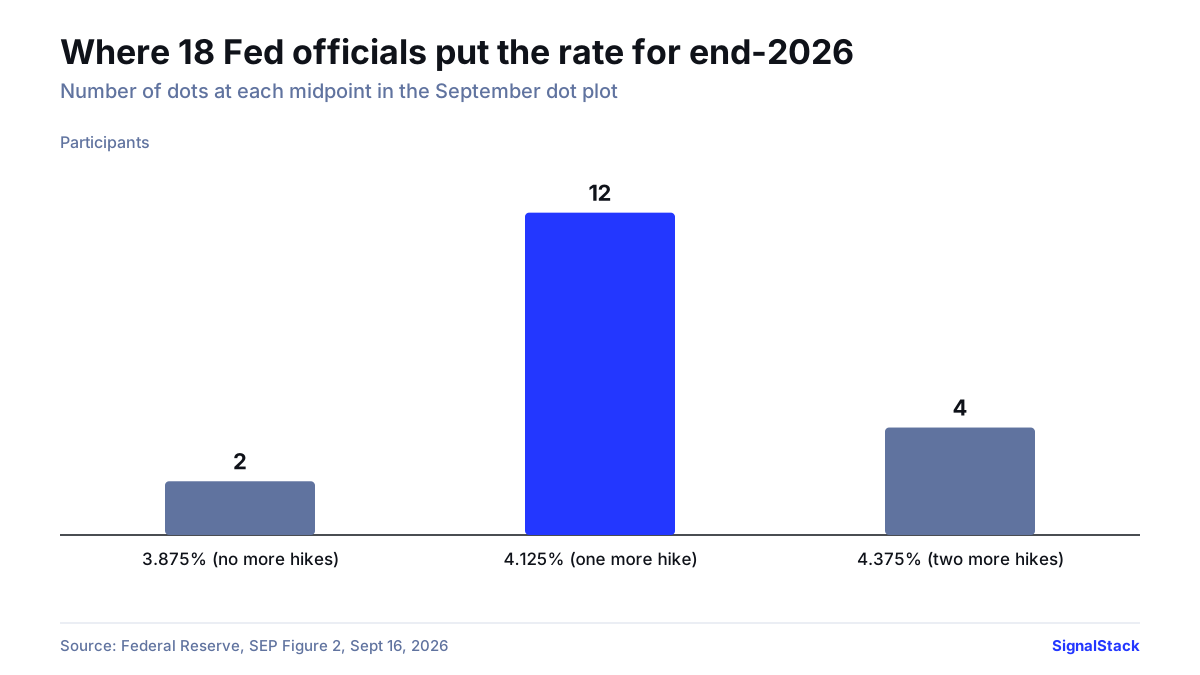
- The median projection puts the funds rate at 4.1% at the end of 2026, which implies one more quarter-point move this year. Twelve of the 18 participants placed their dot there. Four placed it higher and two at the current level.
- All the administered rates rose 25 bp and kept their positions relative to the range. The next meeting is October 27–28.
What the Fed decided: the rate table
“Before” figures are from the July 29, 2026 implementation note.
| Rate | Before | After | Effective | Source |
|---|---|---|---|---|
| Federal funds target range | 3.50%–3.75% | 3.75%–4.00% | Sep 17, 2026 | Statement; implementation note |
| Interest on reserve balances (IORB) | 3.65% | 3.90% | Sep 17, 2026 | Implementation note |
| Primary credit rate | 3.75% | 4.00% | Sep 17, 2026 | Implementation note |
| Overnight reverse repo (ON RRP) offering rate | 3.50% | 3.75% | Sep 17, 2026 | Implementation note |
| Standing overnight repo operations rate | 3.75% | 4.00% | Sep 17, 2026 | Implementation note |
The spacing did not change. IORB sits 10 basis points below the top of the range. ON RRP marks the floor. The standing repo and primary credit rates sit at the ceiling. The ON RRP per-counterparty limit stays at $160 billion a day, and the balance-sheet instructions are the same as in July.
What the statement says, and what it left out
The September statement is short. It describes solid growth, resilient spending, strong productivity and robust capital investment, with unemployment little changed. On prices it gives one line: inflation is still elevated.
Comparing it with July’s statement shows two notable changes. In July, the Committee held rates by a 9–3 vote. Beth M. Hammack, Neel Kashkari and Lorie K. Logan wanted a quarter-point hike. July’s text also tied elevated inflation partly to “supply shocks” in sectors “including energy,” and attributed elevated uncertainty partly to “the conflict in the Middle East.” The September text drops both references and speaks only of “geopolitical developments”. It has no dissent section.
Why the Fed says it moved: the press conference
At the press conference, Chairman Kevin Warsh pointed to three things that changed in the seven weeks after July:
- Growth: a wide set of data, including the labor market, showed the economy had strengthened. He put unemployment at around 4.1%.
- Inflation trends: he estimated that headline PCE inflation was around 3.6% over the 12 months to August. He said summer readings had not shown real improvement in the underlying trend.
- Geopolitics: the Committee’s view of how likely different geopolitical outcomes are had shifted.
He said he would be “hard pressed” to describe broad financial conditions as restrictive, a view he said was widely shared by the Committee. He described the hike as removing “a dose of accommodation.”
On oil, a reporter noted that a rate hike cannot reopen the Strait of Hormuz. Warsh said the Fed cannot move any single price, oil included. What it can do, he said, is try to stop changes in relative prices from spreading through the economy. NPR reports that August CPI inflation was 3.4% and, citing AAA, that diesel hit a record $6.31 a gallon on September 16.
Warsh did not signal what comes next. He said he is “not in the forward guidance business,” and he did not submit a projection of his own.
What the projections and dot plot show
Eighteen participants submitted projections, and Warsh was not among them. Medians compared with June:
| Median | 2026 | 2027 | 2028 | Longer run |
|---|---|---|---|---|
| Fed funds rate | 4.1 (June 3.8) | 4.1 (3.6) | 3.9 (3.4) | 3.2 (3.1) |
| PCE inflation | 3.7 (3.6) | 2.3 (2.3) | 2.1 (2.0) | 2.0 |
| Core PCE inflation | 3.4 (3.3) | 2.5 (2.5) | 2.2 (2.1) | n/a |
| Unemployment rate | 4.1 (4.3) | 4.1 (4.3) | 4.1 (4.2) | 4.2 |
| Real GDP growth | 2.3 (2.2) | 2.4 (2.3) | 2.2 (2.2) | 2.0 |
The dot plot counts, from Figure 2 of the SEP:
- End-2026: 12 dots at 4.125%, which is a 4.00%–4.25% range, or one more hike. Four dots are at 4.375%, or two more hikes. Two are at 3.875%, the current midpoint.
- End-2027: 8 dots at 4.375%, 6 at 4.125%, 3 at 3.625% and 1 at 3.125%. The median participant holds the rate flat through 2027.
- Inflation reaching 2%: the median does not show PCE inflation at 2.0% until 2029.
In the risk panels, 17 of 18 participants see headline PCE inflation risks weighted to the upside, as in June. On unemployment, 17 now see balanced risks, up from 10 in June, and none see upside risk (June: 7).
International spillovers: the dollar, Asia and Korea
Warsh said Fed decisions affect the rest of the world, with “spillovers and spillbacks” both ways, and that most advanced economies face price pressures too. Press reports from September 17:
- Dollar: Seoul Economic Daily reports that the dollar index rose above 100 in New York trading, its first time there since August 13.
- Korean won: The Korea Times reports that on September 17 the won weakened by 13.6 won to 1,382.2 per dollar. The paper attributed the move to a wider Korea–US rate gap, now back above 1 percentage point, and expectations of more Fed tightening.
- Korean stocks: The KOSPI ended at 6,715.41, down 0.04%. Foreign investors were net sellers of 2.28 trillion won, about $1.65 billion at the 1,382.2 close. See our report on why foreign investors are selling Korean stocks.
What to watch before October 27–28
The October 27–28 meeting has no new projections. December 8–9 does. Both are on our 2026 FOMC calendar. The September minutes are due October 7, since the Fed releases minutes three weeks after each decision.
Warsh listed what the Fed is watching:
- whether relative price changes in some sectors broaden
- whether inflation compensation in market prices stays low and expectations stay anchored
- whether credit and financial conditions fit the mandate
- commodity and input prices, which he said rose between meetings
He said trends matter more than single data releases. Fox Business, citing the CME FedWatch tool on September 16, put the odds of an October hike at 51%.
What could go right / What could go wrong
What could go right: Underlying inflation could move toward 2% “clearly and at sufficient speed”, Warsh’s stated test, with energy costs staying contained. Unemployment could hold near the projected 4.1%. Warsh said he does not think the Fed needs to harm the labor market.
What could go wrong: The upside inflation risk most participants flagged could materialize, with relative price increases spreading or expectations drifting. Long-term yields could keep rising. Warsh tied their rise this year to growth, hyperscaler capital spending and geopolitics. For Korea, local press already links won weakness to the wider rate gap.
Related coverage lives in our Markets & Policy section.
FAQ
Q Did the Fed raise interest rates in September 2026?
A Yes. On September 16, 2026, the FOMC voted 12–0 to raise the federal funds target range by 0.25 percentage point to 3.75%–4.00%, effective September 17.
Q What is the IORB rate after the September 2026 Fed hike?
A The Board raised the interest rate on reserve balances from 3.65% to 3.90%, effective September 17, 2026. The primary credit rate rose to 4.00% and the ON RRP rate to 3.75%.
Q How many more rate hikes does the September 2026 dot plot show?
A The median shows one more quarter-point hike by the end of 2026, to a 4.1% midpoint. Of 18 participants, 12 projected one more hike, 4 projected two, and 2 projected none.
Q Why did the Fed raise rates if oil prices drive inflation?
A Chairman Warsh said the Fed cannot change individual prices such as oil. He said the aim is to keep relative price increases from broadening, with inflation too high for too long and the economy strengthening.
Q When is the next FOMC meeting after September 2026?
A October 27–28, 2026, followed by December 8–9, which includes new projections. The September minutes are due October 7.
Sources
- Federal Reserve issues FOMC statement (Sep 16, 2026)
- Implementation Note issued September 16, 2026
- Summary of Economic Projections, September 16, 2026
- Transcript of Chairman Warsh's Press Conference (Sep 16, 2026)
- Implementation Note issued July 29, 2026
- Federal Reserve issues FOMC statement (Jul 29, 2026)
- Meeting calendars and information
- Fed approves interest rate hike, signals one more to come this year
- Federal Reserve hikes interest rates for first time since 2023 amid stubborn inflation
- The Fed raises interest rates for the first time in over three years
- Seoul stocks shrug off Fed hike, but won weakens sharply
- Won Falls Past 1,380 per Dollar After Hawkish Fed Hike