

AI-generated illustration
TL;DR
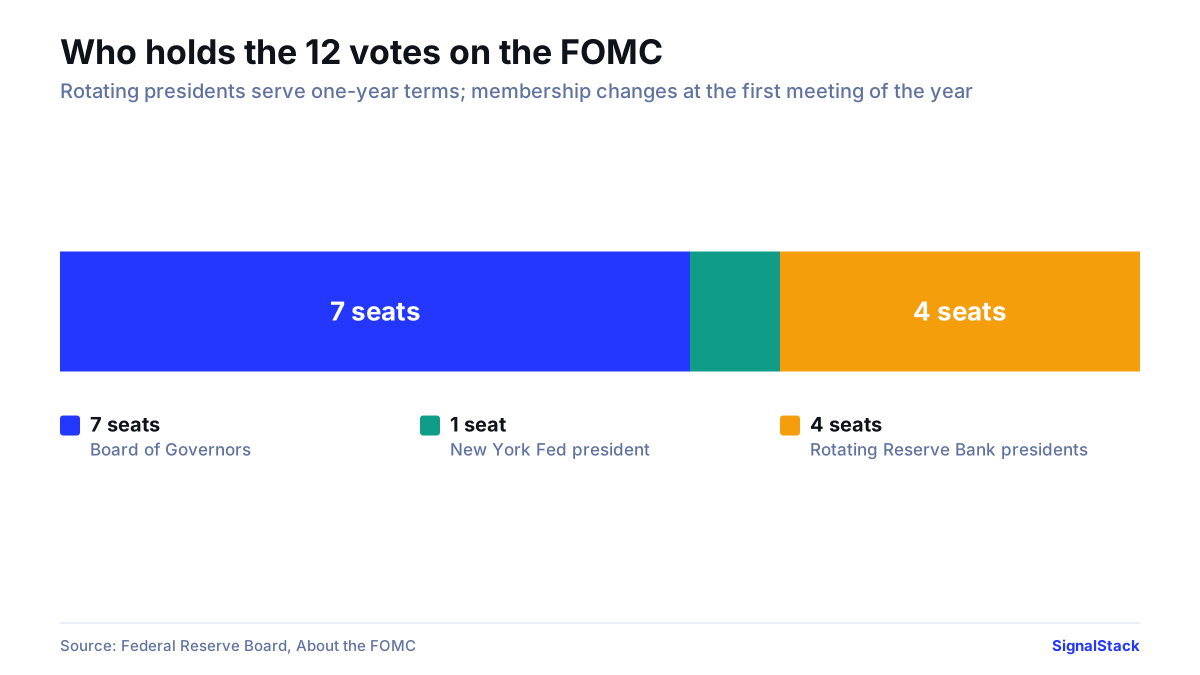
- The Fed sets its main interest rate at Federal Open Market Committee (FOMC) meetings. Twelve members vote: seven Fed governors, the New York Fed’s president, and four regional Fed presidents who take turns each year.
- The FOMC holds eight scheduled meetings a year, plus other meetings as needed. The decision comes in a short statement at 2:00 p.m. Eastern on the second day, followed by the chair’s press conference. Minutes come out three weeks later.
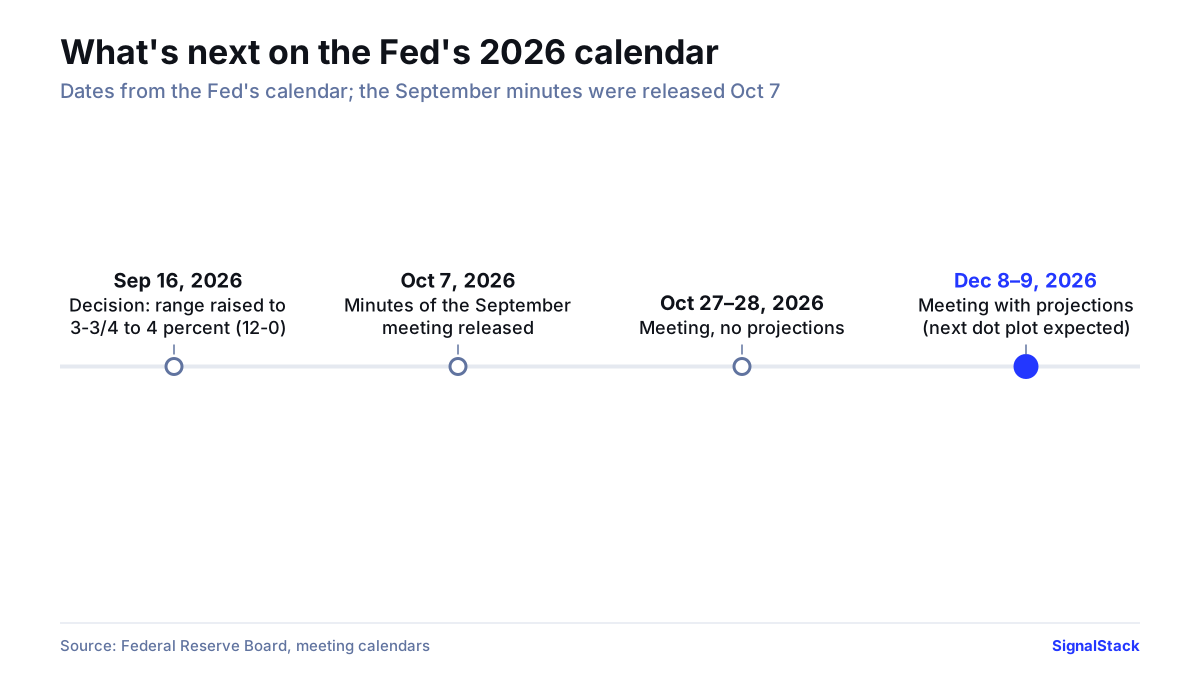
- Four of the eight meetings also publish the Summary of Economic Projections, which includes the “dot plot”: one dot per participant for where each thinks the rate should be. The next meeting is Oct. 27–28, 2026, without projections; the next dot plot is expected with the Dec. 9 decision (meeting dates are tentative until confirmed at the meeting before).
Who decides
Rates are set by the Federal Open Market Committee, the FOMC. Its twelve votes break down like this:
- 7 seats for the Fed’s Board of Governors in Washington;
- 1 permanent seat for the head of the New York Fed;
- 4 seats that rotate each year among the other eleven regional Fed banks, one from each of four groups.
The four rotation groups, per the Fed:
- Group 1: Boston, Philadelphia, Richmond
- Group 2: Cleveland, Chicago
- Group 3: Atlanta, St. Louis, Dallas
- Group 4: Minneapolis, Kansas City, San Francisco
Each rotating term is one year, and the line-up changes at the year’s first scheduled meeting. Presidents without a vote that year still sit in, join the discussion and feed into the Committee’s view of the economy, the Fed says.
The Fed’s 2026 list names Kevin Warsh as chairman and the New York Fed’s John C. Williams as vice chair. This year’s rotating voters lead the Cleveland, Minneapolis, Dallas and Philadelphia banks. According to the Fed’s rotation table, those four seats pass to Chicago, Richmond, Atlanta and San Francisco in 2027.
When it decides
The FOMC holds eight regularly scheduled meetings a year, and other meetings as needed. Each scheduled meeting runs two days, and the Fed notes that each date is tentative until confirmed at the meeting before it. The 2026 schedule, from the Fed’s calendar, is Jan. 27–28, March 17–18, April 28–29, June 16–17, July 28–29, Sept. 15–16, Oct. 27–28 and Dec. 8–9. The March, June, September and December meetings include the Summary of Economic Projections. Our FOMC meeting calendar for 2026 and 2027 lists every date and can be added to your own calendar.
On the second day, the statement is released at 2:00 p.m. Eastern time, followed by the chair’s press conference. The Fed’s calendar page says minutes of regularly scheduled meetings “are released three weeks after the date of the policy decision.” The Fed’s calendar lists the minutes of the Sept. 15–16 meeting as released on Oct. 7, 2026.
How to read the statement
The statement is short. The Sept. 16, 2026 statement, approved by a 12–0 vote, is a good example. Three parts matter most:
- The decision. “The Committee decided to raise the target range for the federal funds rate by 1/4 percentage point to 3-3/4 to 4 percent”. The Fed sets a target range, not a single rate.
- The reason. The next two paragraphs describe the economy in the Committee’s words: economic activity “expanding at a solid pace,” the unemployment rate having “changed little,” inflation that “remains elevated.” This wording can be compared from one meeting to the next.
- The vote. The opening line gives the tally, 12–0 in September.
A second document, the Implementation Note, turns the decision into instructions. For September, the FOMC directed the New York Fed’s trading desk, as set out in the Implementation Note, to keep the federal funds rate in the 3-3/4 to 4 percent range, to run standing overnight repurchase operations at 4.0 percent and reverse repurchase operations at 3.75 percent. Separately, the Board of Governors raised the interest rate paid on reserve balances to 3.90 percent and approved an increase in the primary credit rate to 4.0 percent, both effective Sept. 17.
How to read the dot plot
At four meetings a year, the participants, meaning the Board members and the Reserve Bank presidents, submit projections for growth, unemployment and inflation, along with their own view of “appropriate monetary policy.” The Fed publishes these as the Summary of Economic Projections.
The dot plot is the chart in that release. The Fed’s note says each dot shows “an individual participant’s judgment of the midpoint of the appropriate target range” for the federal funds rate at the end of each year and over the longer run, rounded to the nearest 1/8 percentage point. The dots are not labeled with names; the Fed releases the individual projections, with numbers in place of names, after five years, and for projections from March 2016 on, the key linking those numbers to names is released with the same five-year lag.
The table version gives the median. In September 2026, the median projection for the federal funds rate was 4.1% for the end of 2026 and 2027, 3.9% for 2028, 3.6% for 2029 and 3.2% for the longer run. The table also shows a range, from the lowest to the highest projection: for the end of 2026, 3.9% to 4.4%. In June, the median for the end of 2026 had been 3.8%.
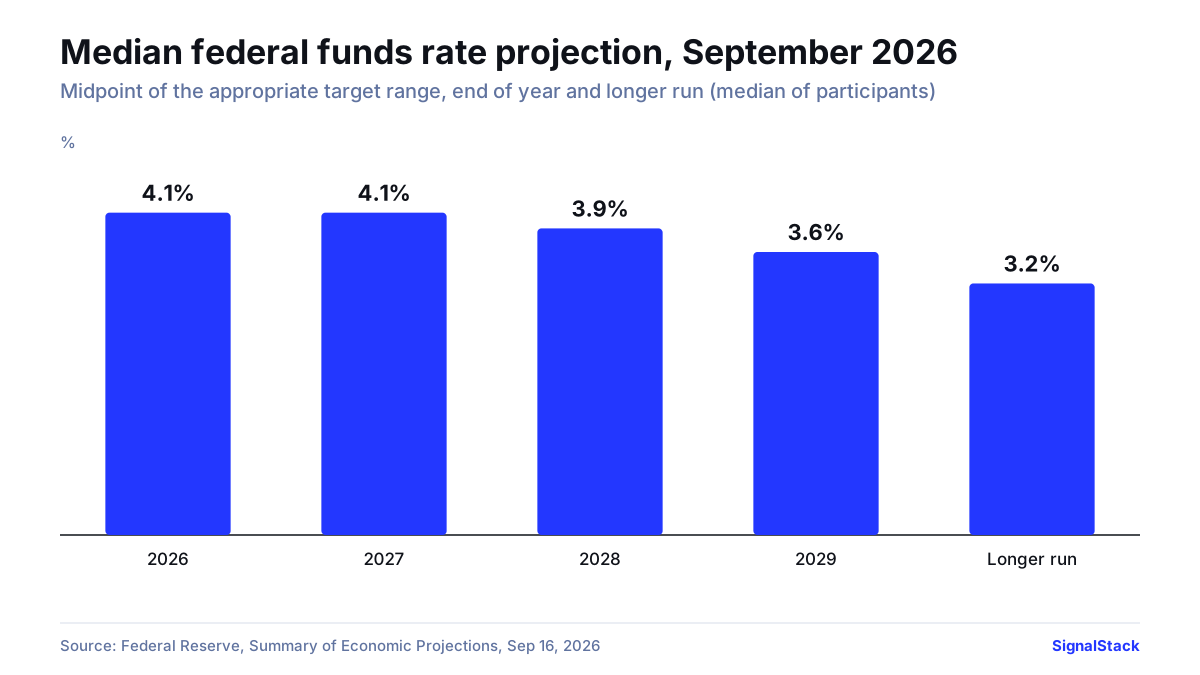
Two things to keep in mind. The dots are individual projections made “under their individual assumptions of projected appropriate monetary policy,” in the Fed’s words, not a Committee decision. And they change: the next set is expected with the Dec. 9 decision.
How to follow a meeting
On decision day, read the documents in this order:
- The statement (2:00 p.m. ET): the range, the vote, and any change in the wording about the economy.
- The Implementation Note: the exact rates the Fed will use in its operations.
- The projections, in March, June, September and December: the median and the range of the dots.
- The press conference: the chair’s answers, published later as a transcript.
- The minutes, three weeks later: the discussion behind the decision.
For what happened at the September 2026 meeting itself, see our report Fed Rate Hike September 2026: Statement, Dot Plot, Key Rates. The glossary entry for the FOMC has a short definition.
What could go right / What could go wrong
What could go right
- Reading the Fed’s own documents in order gives the decision, the reasoning and the range of views without relying on summaries.
- The Fed publishes its scheduled meeting dates well ahead (2026, and tentatively 2027), so readers know when decisions are likely to come, though the Committee can also meet as needed.
What could go wrong
- The median dot is easy to over-read. It is the middle projection when they are ranked from lowest to highest, or the average of the two middle ones when the count is even (18 participants submitted information in September 2026; 17 gave projections for 2028 and 2029), each made under that participant’s own assumptions, and the Fed’s table shows the full range around it: 3.9% to 4.4% for end-2026 and 3.1% to 4.4% for end-2027.
- The statement’s wording changes in small steps. Reading one statement alone, without comparing it to the last, can miss what changed.
- Rotating voters change at the year’s first scheduled meeting, so a regional president other than New York’s is a voting member only in years when that bank holds one of the four rotating seats. Each year the Fed also names alternate members; under the FOMC’s rules, an alternate attending in place of an absent member “shall have the same status as the member.”
FAQ
Q Who votes on Fed interest rate decisions?
A The twelve voting members of the FOMC: seven Fed governors, the New York Fed's president, and four regional Fed presidents who take turns, one year at a time.
Q How often does the Fed meet?
A Eight scheduled meetings a year, each lasting two days. In 2026 the remaining meeting dates are Oct. 27–28 and Dec. 8–9.
Q What time is the Fed announcement?
A The statement is released at 2:00 p.m. Eastern time on the second day of the meeting, followed by the chair's press conference.
Q What is the Fed dot plot?
A A chart in the Summary of Economic Projections, published four times a year. Each dot is one participant's view of the midpoint of the appropriate federal funds rate range at the end of a given year or over the longer run.
Q When are Fed minutes released?
A Three weeks after the policy decision, according to the Fed. The minutes of the Sept. 15–16, 2026 meeting were released on Oct. 7, 2026, per the Fed's calendar.
Sources
- About the FOMC (structure, 2026 members, rotation)
- Meeting calendars, statements and minutes
- FOMC statement (Sep 16, 2026)
- Implementation Note (Sep 16, 2026)
- Summary of Economic Projections (Sep 16, 2026)
- Transcripts and other historical materials
- Press conference transcript (Sep 16, 2026)
- FOMC Rules of Organization