
AI-generated illustration
A Form 4 is the filing that tells the public when a company insider, such as a director, a senior officer or a holder of more than 10% of a share class, buys, sells or otherwise changes their stake. Our glossary entry gives the short definition. This guide works from the SEC’s own Form 4 instructions, the statute and the rules behind it, and it reads real filings from the data behind our insider trading tracker: an Uber purchase, a series of Nvidia sales under a trading plan, and a “purchase” that turns out to be reinvested dividends.
TL;DR
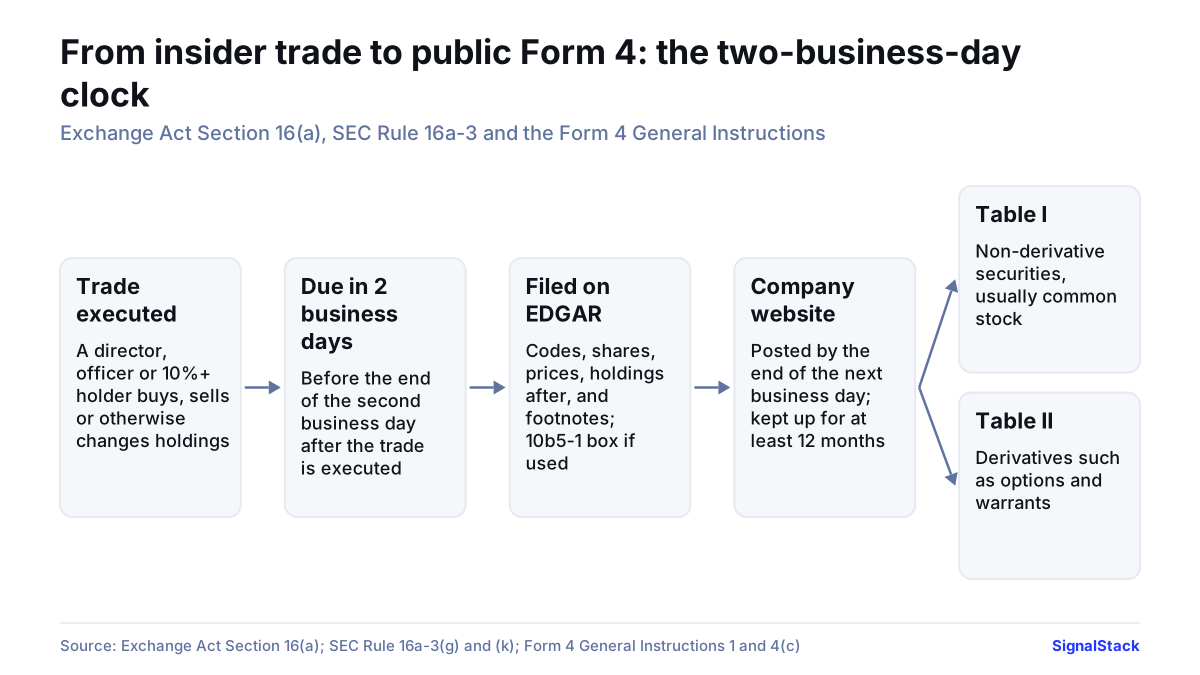
- What it is: Section 16(a) of the Securities Exchange Act requires directors, officers and holders of more than 10% of a registered class of equity to report changes in their ownership. Form 4 is due before the end of the second business day after the trade.
- How to read it: the one-letter transaction code in each row tells you what kind of transaction it was. P and S are open-market or private purchases and sales; A, M and F are mostly grants, exercises and shares withheld for tax; G is a gift.
- The 10b5-1 checkbox: since April 1, 2023, a Form 4 must say by checkbox whether a trade was made under a Rule 10b5-1 plan, and give the date the plan was adopted. Directors and officers must wait out a cooling-off period of at least 90 days before such a plan can trade.
What a Form 4 is and who files it
The form’s heading calls it a “Statement of Changes in Beneficial Ownership.” It is filed under Section 16(a) of the Exchange Act, which names three groups: directors and officers of the company, and anyone who directly or indirectly owns more than 10% of a class of its registered equity securities. The SEC’s investor bulletin on Forms 3, 4 and 5 calls them “insiders.”
Section 16 uses three forms:
- Form 3 is the first statement of holdings, due within 10 days after a person becomes an insider.
- Form 4 reports each change. The statute, Rule 16a-3(g) and General Instruction 1(a) of the form all set the same deadline: before the end of the second business day after the day the transaction was executed.
- Form 5 is an annual catch-up, due within 45 days after the company’s fiscal year ends, for transactions that were exempt from Form 4 or were not reported when they should have been.
Two days was not always the rule. Before the Sarbanes-Oxley Act of 2002 (Pub. L. 107-204), the statute allowed insiders to report changes within ten days after the end of the calendar month in which they happened. Rule 16a-3(k) adds a second channel: a company with a website must post each Form 3, 4 or 5 about its shares by the end of the next business day after filing and keep it up for at least 12 months.
New in 2026 for foreign companies. A December 18, 2025 amendment to Section 16(a) extended reporting to directors and officers of foreign private issuers, effective 90 days after enactment. The law firm Skadden notes that this date was March 18, 2026, and that 10% holders of foreign private issuers remain exempt from Section 16.
How to read one, box by box
Open any Form 4 on EDGAR and the layout is the same.
- The two checkboxes at the top. One says the person is no longer subject to Section 16. The other says a transaction was made under a plan “intended to satisfy the affirmative defense conditions of Rule 10b5-1(c).”
- Boxes 1, 2 and 5: who and where. The reporting person, the company and ticker, and the relationship: director, officer (with title), 10% owner or other.
- Table I: non-derivative securities, usually common stock. Each row has the transaction date, the code, the number of shares, whether they were acquired (A) or disposed of (D), the price, the holdings after the transaction, and whether those holdings are direct (D) or indirect (I). Indirect holdings name the vehicle, such as “By Trust.”
- Table II: derivative securities, such as options, warrants and convertible securities. General Instruction 4(c) says an exercise is reported here as a disposal of the option, with the holdings of the underlying shares shown in Table I.
- Explanation of Responses. The footnotes. They often carry the most useful detail: weighted-average price ranges, plan adoption dates, and what a code “J” or an indirect holding actually is.
General Instruction 5 says prices are per share and exclude brokerage commissions. When a trade was filled at many prices, filers commonly report a weighted average and give the range in a footnote, as both examples below do.
The transaction codes
General Instruction 8 lists the codes. The table shows the ones you will see most, with the counts from our own tracker data.
| Code | Meaning (SEC wording, shortened) | Form 4s in our data with this code |
|---|---|---|
| S | Open-market or private sale | 818 |
| A | Grant, award or other acquisition under Rule 16b-3(d) | 579 |
| M | Exercise or conversion of a derivative security exempt under Rule 16b-3 | 530 |
| F | Payment of exercise price or tax by delivering or withholding securities | 512 |
| G | Bona fide gift | 80 |
| P | Open-market or private purchase | 43 |
| C | Conversion of derivative security | 33 |
| J | Other acquisition or disposition (described in a footnote) | 33 |
| D | Disposition to the issuer under Rule 16b-3(e) | 11 |
Other codes include X (in-the-money or at-the-money exercise), W (will or inheritance), K (equity swap) and V (reported voluntarily early). Under the SEC’s 2022 amendments, bona fide gifts that could previously wait for Form 5 must now be reported on Form 4.
Our count covers the 2,549 original Form 4s (not amendments) filed by insiders of 114 of the 116 US-listed companies we track, from June 5 to October 2, 2026, Table I rows only. One filing can carry several codes. Dell’s list hit our 120-filing cap, so its count is incomplete.
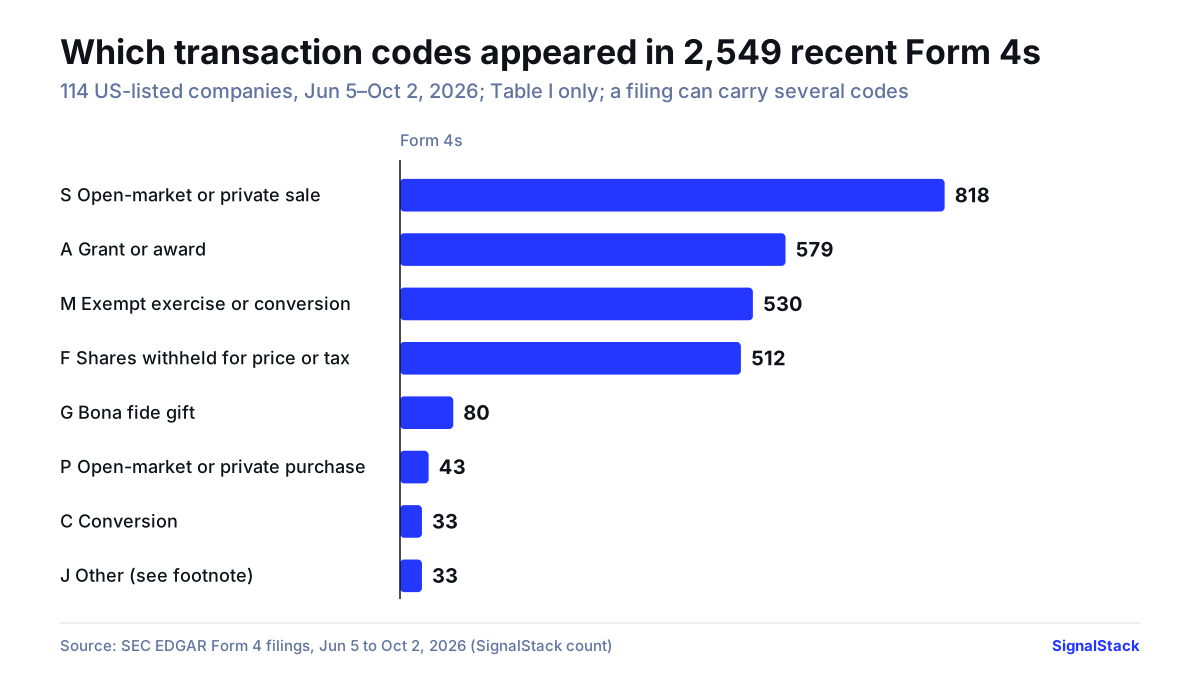
Two numbers from the same data stand out. Of the 818 filings with at least one S row, 482 (about 59%, our arithmetic) had the 10b5-1 box checked. And 22 of the 43 filings with a P row came from Simon Property Group directors on two dates; every one of them carries a footnote saying the shares came from reinvested dividends on restricted stock.
Rule 10b5-1 plans and the 2022 changes
The SEC adopted Rule 10b5-1 in August 2000. Its fact sheet describes it as an affirmative defense to insider trading liability when a trade was made under a binding contract, an instruction, or a written plan adopted when the person was not aware of material nonpublic information.
On December 14, 2022, the SEC tightened the conditions. For directors and officers, the main changes are:
- Cooling-off period: no trades until the later of 90 days after the plan is adopted or modified, or two business days after the company discloses results in its 10-Q or 10-K for the quarter in which the plan was adopted, capped at 120 days. For other people (not the company itself) it is 30 days.
- Certification: the plan must state that they are not aware of material nonpublic information and are adopting it in good faith.
- Limits: restrictions on overlapping plans (with narrow exceptions, such as plans that only sell to cover taxes on vesting awards), and only one single-trade plan in any 12-month period, for everyone except the company.
- Disclosure: the Form 4 checkbox and plan adoption date, and, under Item 408 of Regulation S-K, quarterly disclosure in the company’s 10-Q or 10-K of plans adopted or terminated by directors and officers, with name, title, date, duration and the total number of shares covered.
That last point means a Form 4 checkbox can be traced back to a named plan in the company’s Form 10-Q.
Real examples
Uber: an open-market purchase (code P)
On Thursday, September 10, 2026, Uber CEO Dara Khosrowshahi reported buying 141,000 Uber shares that day, code P, at a weighted-average price of $70.9642 (fills ranged from $70.73 to $71.18). That is about $10.0 million by our arithmetic. The filing says he held 1,367,100 shares directly afterward, a figure that includes 298 shares bought through Uber’s employee stock purchase plan on May 20, 2026. The 10b5-1 box is not checked. The Form 4 was filed the same day as the trade, ahead of the two-day deadline. See all reported trades on our Uber insider page.
Nvidia: sales under a 10b5-1 plan (code S), traced to the 10-Q
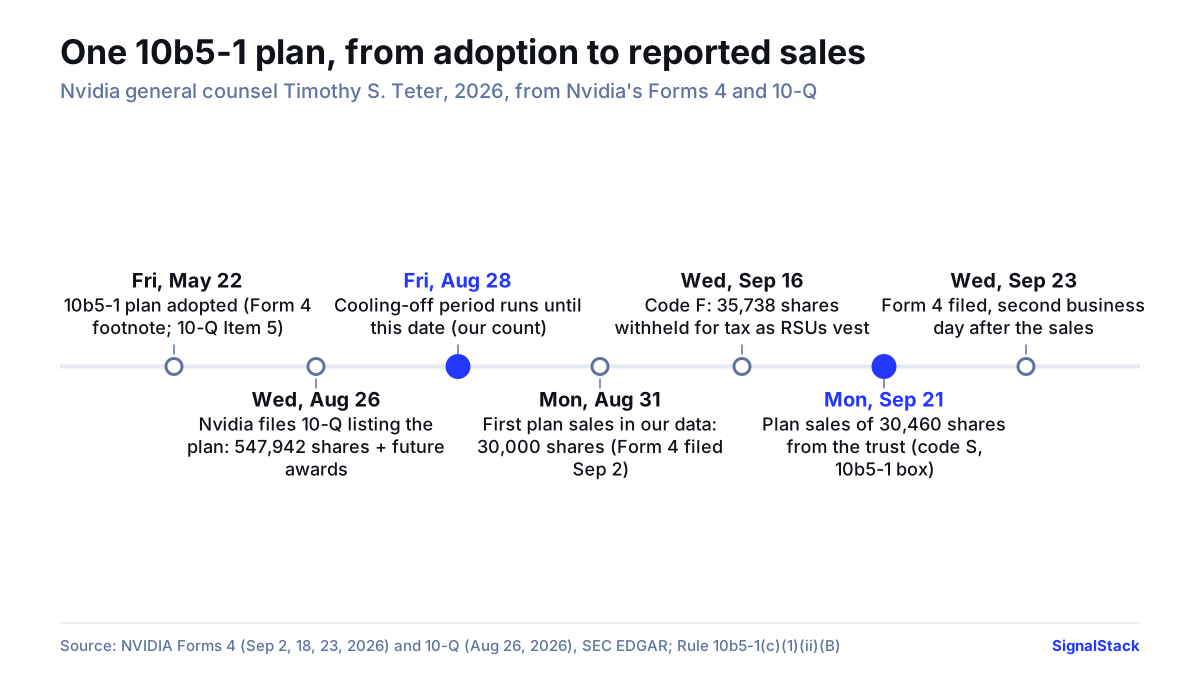
Timothy S. Teter, Nvidia’s general counsel, filed a Form 4 on Wednesday, September 23, 2026. It reports three sales on Monday, September 21, totaling 30,460 shares (our sum) at weighted averages of $222.19 to $223.75. The 10b5-1 box is checked, and footnote 1 says the plan was adopted on May 22, 2026. The shares were held indirectly, “By Trust.”
Nvidia’s 10-Q for the quarter ended July 26, 2026, filed August 26, lists that plan under Item 5: adopted May 22, 2026, covering “547,942 and any future equity awards,” expiring December 13, 2027. It lists two other plans in the same quarter, for director Aarti Shah and CFO Colette Kress.
The dates show the cooling-off rule at work. Ninety days after May 22 was August 20; two business days after the August 26 10-Q was Friday, August 28. By our count, the cooling-off period ran until the later of the two, August 28. The first plan sales in our data came on Monday, August 31: 30,000 shares, reported on September 2.
The filings also show how codes connect. A Form 4 filed September 18 reports code F: 35,738 shares withheld by Nvidia on September 16 to cover taxes when restricted stock units vested, and its holdings figure includes 30,460 shares issued upon the vesting of restricted stock units. The September 23 filing says 30,460 shares were transferred, without consideration, to a family trust of which he is trustee, and the September 21 sales from that trust total the same 30,460. More on our Nvidia insider page.
Simon Property: a “P” that is not a market decision
On October 1, 2026, eleven Simon Property Group directors each filed a Form 4 with code P for September 30. Director Stefan M. Selig’s shows 208 shares at $202.78. Footnote 1 says they were “acquired through the reinvestment of dividends received on restricted stock” awarded as non-cash compensation. The code is P; the footnote explains what happened.
What a Form 4 doesn’t tell you
- Why. The form records what was traded, when, at what price and what is left. The SEC’s investor bulletin notes that insiders “may sell company securities for any number of reasons, including for liquidity and diversification purposes.”
- The plan’s terms. The checkbox and adoption date are on the Form 4; price terms are not. Item 408 explicitly leaves out the price at which a plan may trade.
- Every share sold. F rows are shares withheld by the company for taxes, not sales in the market, and G rows are gifts.
- Whole-company totals. Each Form 4 covers one company and usually one person (several owners of the same shares may file jointly), so a single Form 4 is not company-wide activity. Our insider tracker collects them by company and person. Large holders that are not insiders may file Schedule 13D or 13G instead, and fund managers report holdings on Form 13F.
For the other filing you will see most often, read our guide to how to read a Form 8-K. All filings are free on SEC EDGAR. More explainers: Guides.
FAQ
Q What is a Form 4 filing?
A It is the SEC form that directors, officers and holders of more than 10% of a company's registered equity use to report changes in their holdings under Section 16(a) of the Exchange Act. Each row shows the date, a transaction code, the number of shares, the price and the holdings afterward.
Q How long does an insider have to file a Form 4?
A Before the end of the second business day after the day the transaction was executed, under Section 16(a)(2)(C) and Rule 16a-3(g). The company must also post it on its website by the end of the next business day after filing, if it has one.
Q What do the codes P, S, A, M and F mean on a Form 4?
A P is an open-market or private purchase and S an open-market or private sale. A is a grant or award, M an exempt exercise or conversion of a derivative such as an option, and F is shares delivered or withheld to pay an exercise price or taxes.
Q What is a 10b5-1 plan on a Form 4?
A A pre-arranged trading plan intended to meet the conditions of the Rule 10b5-1(c) affirmative defense to insider trading liability. Since April 1, 2023, filers must check a box on Form 4 for trades under such a plan and give the plan's adoption date; directors and officers face a cooling-off period of 90 to 120 days before the plan can trade.
Q Where can I see insider trades for free?
A Every Form 4 is public on SEC EDGAR, under both the company and the insider's name. SignalStack's insider tracker lists the Form 4 trades for the companies with live insider pages, each linked to its filing.
Companies in this report: NVIDIA , Uber
Sources
- Form 4 and General Instructions (SEC 1474)
- Securities Exchange Act of 1934, Section 16 (15 U.S.C. 78p)
- 17 CFR 240.16a-3: Reporting transactions and holdings
- 17 CFR 240.10b5-1: Trading on the basis of material nonpublic information
- 17 CFR 229.408 (Item 408 of Regulation S-K): Insider trading arrangements and policies
- SEC Adopts Amendments to Modernize Rule 10b5-1 Insider Trading Plans and Related Disclosures (Press Release 2022-222, Dec 14, 2022)
- Fact Sheet: Rule 10b5-1 Insider Trading Arrangements and Related Disclosure (Release 33-11138)
- Final Rule: Insider Trading Arrangements and Related Disclosures (Release 33-11138)
- Investor Bulletin: Insider Transactions and Forms 3, 4, and 5 (SEC Pub. No. 137)
- Uber Form 4: Dara Khosrowshahi, code P (filed Sep 10, 2026)
- NVIDIA Form 4: Timothy S. Teter, code S under a 10b5-1 plan (filed Sep 23, 2026)
- NVIDIA Form 4: Timothy S. Teter, code S under a 10b5-1 plan (filed Sep 2, 2026)
- NVIDIA Form 4: Timothy S. Teter, code F (filed Sep 18, 2026)
- NVIDIA Form 10-Q for the quarter ended Jul 26, 2026 (Item 5: Rule 10b5-1 trading arrangements)
- Simon Property Group Form 4: Stefan M. Selig, code P (filed Oct 1, 2026)
- SEC Insider Reporting Requirements for Directors and Officers of Foreign Private Issuers Apply Starting March 18, 2026