AI-generated illustration
Memory chips got much more expensive in 2026, and laptop and tablet buyers have started to feel it. News coverage tends to show one side at a time: a chipmaker’s record quarter, or a gadget price increase. This report puts the two sides of the trade next to each other, using their own filings. On the buying side is Nvidia, which names all three main memory makers as its suppliers. On the selling side are the three main makers: Micron, SK hynix and Samsung. Every figure below comes from a filing, an official release or a named third party.
TL;DR
- Buyer side: Nvidia’s supply and capacity commitments rose from $119 billion to $279 billion in one quarter, to July 26, 2026. Its CFO commentary says the increase was “primarily related to the procurement of memory.” Nvidia’s spec pages list 80 GB of memory on the H100 SXM GPU and 288 GB on Rubin.
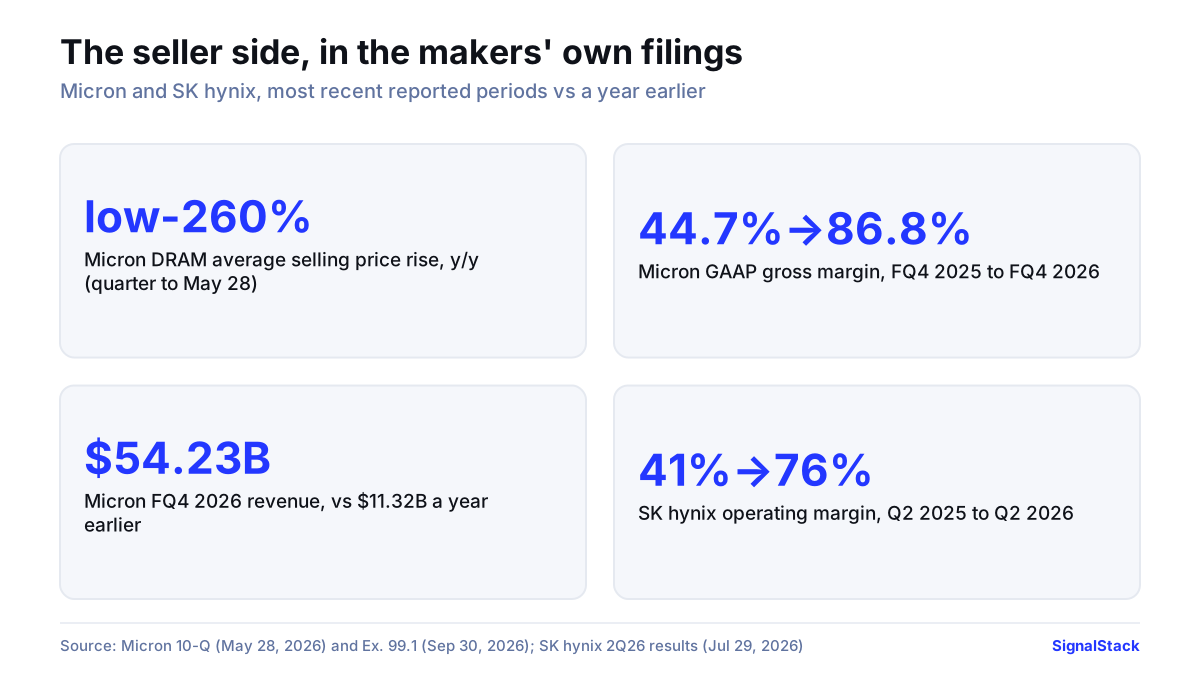
- Seller side: Micron says DRAM average selling prices rose in the “low-260% range” year over year in its quarter ended May 28. In fiscal Q4 (quarter ended Sep 3, 2026), its GAAP gross margin was 86.8%, against 44.7% a year earlier. SK hynix’s operating margin was 76% in Q2 2026, against 41% in Q2 2025.
- When prices fall: none of the companies gives a date. Micron says it does “not have line of sight to when supply and demand will return to balance.” TrendForce forecasts smaller, but still positive, contract price increases in the fourth quarter of 2026.
What happened
Micron’s fiscal Q4 2026 results, released September 30, showed revenue of $54.23 billion. A year earlier it was $11.32 billion. In the 8-K exhibit, GAAP gross margin was 86.8%, against 44.7% a year earlier (non-GAAP: 87.0% against 45.7%). The day before, TrendForce raised its forecast for 2027 HBM prices.
The price rises have reached consumer devices. On June 26, CNBC reported that Apple announced it was raising prices on MacBooks and iPads; Apple said in a statement that the memory shortage was an “unprecedented challenge.” CNBC also cited Gartner, which projected that 2026 PC prices would rise 17% and smartphone prices 13% from 2025 levels. Those are Gartner’s projections. Nvidia’s own 10-Q points the same way: Edge Computing revenue growth was partly offset by “slower consumer PC sales that were tempered by elevated memory and systems prices.”
The buyer: what Nvidia’s filings say
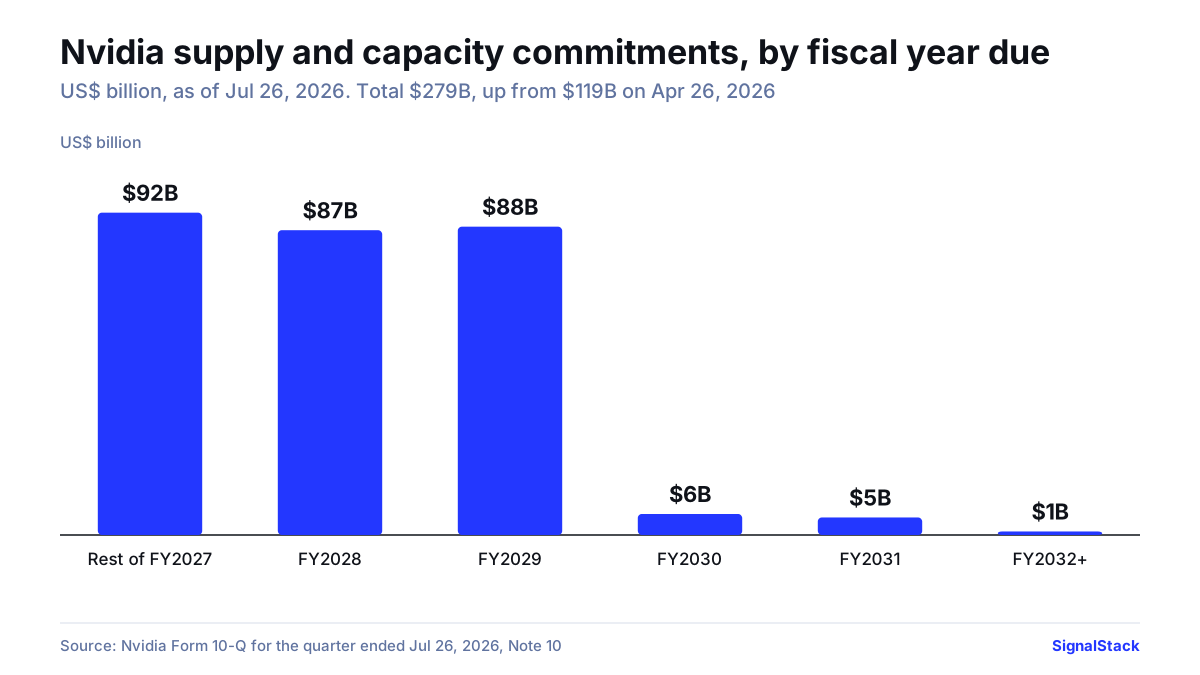
Commitments. Note 10 of Nvidia’s 10-Q for the quarter ended July 26, 2026 (filed August 26) reads: “increasing supply commitments from $119 billion last quarter to $279 billion as of July 26, 2026. These supply commitments are for our data center infrastructure systems, primarily memory and manufacturing facilities…” The CFO commentary filed with the results is more direct. It says the increase was “primarily related to the procurement of memory.” Nvidia does not say how much of the $279 billion is memory.
The schedule shows when the money falls due, by Nvidia fiscal year (ending in late January):
| Supply and capacity, as of Jul 26, 2026 | US$ billion |
|---|---|
| Remainder of fiscal 2027 | 92 |
| Fiscal 2028 | 87 |
| Fiscal 2029 | 88 |
| Fiscal 2030 | 6 |
| Fiscal 2031 | 5 |
| Fiscal 2032 and after | 1 |
| Total | 279 |
Source: Nvidia 10-Q, Note 10. The total rose about 134% in one quarter, and about 96% of it falls due in fiscal 2027 to 2029 (our arithmetic). The same note says some agreements “may be cancelable, rescheduled, or adjustable” before firm orders are placed.
Inventory. Raw materials on Nvidia’s balance sheet were $3,807 million on January 25, 2026, $6,647 million on April 26 and $11,341 million on July 26. That is nearly triple in six months (our arithmetic). The filing does not break raw materials down by component. Its 10-K says Nvidia may buy some raw materials directly, naming memory and substrates as examples.
Who it buys from. The 10-K names the suppliers: “We purchase memory from SK Hynix Inc., Micron Technology, Inc., and Samsung.”
Cost language. The 10-K says premiums, deposits and long-term supply agreements “have increased our product costs and this may continue.” The 10-Q for the quarter ended April 26 adds: “Supply availability affecting memory, and other components, as well as rising prices, may drive the prices for data center buildouts higher.” For the quarter to October, Nvidia’s outlook puts both its GAAP and its non-GAAP gross margin at 74.0%, give or take half a point, against 75.0% on both measures in the July quarter. The release does not give a reason. TrendForce News, citing Reuters, linked the expected dip to memory and component costs.
More memory per GPU
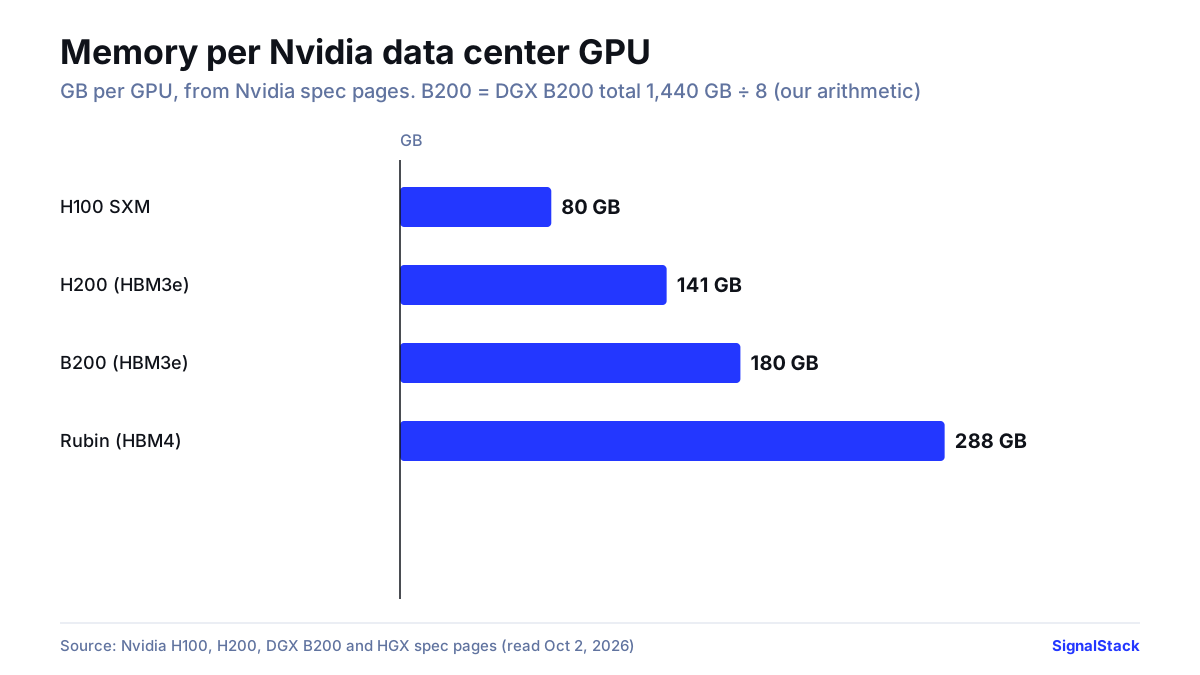
Each new Nvidia GPU also carries more memory. Nvidia’s spec pages list:
| Nvidia GPU | Memory per GPU | Bandwidth | Type |
|---|---|---|---|
| H100 SXM | 80 GB | 3.35 TB/s | Not stated |
| H200 | 141 GB | 4.8 TB/s | HBM3e |
| B200 | 180 GB | 8 TB/s | HBM3e |
| Rubin | 288 GB | 22 TB/s | HBM4 |
The B200 row is our arithmetic. Nvidia lists the eight-GPU DGX B200 with “1,440 GB total, 64 TB/s HBM3e bandwidth.” From H100 to Rubin, memory per GPU rises 3.6 times (our arithmetic). Our HBM guide explains how these stacks are built.
The sellers: what the memory makers report
Micron. Micron’s 10-Q for the quarter ended May 28, 2026 gives a direct price figure. DRAM sales rose 343% from a year earlier, “primarily due to a low-260% range increase in average selling prices and a low-20% range increase in bit shipments.” Against the prior quarter, DRAM prices rose in the “low-60% range.” In fiscal Q4, Micron’s prepared remarks say DRAM prices rose again by a “high-teens percentage range” from the previous quarter.
Micron’s 10-Q explains why AI memory takes capacity away from ordinary chips: “HBM requires a higher number of wafers and more cleanroom space to produce the same number of bits as conventional DRAM in the same technology node.” In its September 30 prepared remarks, Micron says it has “completed agreements for the vast majority of our calendar 2027 HBM bit supply with significant price increases year over year.” It also says that when pricing comes up in new talks on its strategic customer agreements (SCAs), those prices are set higher, reflecting current market conditions and its outlook.
SK hynix (KRX: 000660; Nasdaq: SKHY). The company’s Form 6-K shows preliminary, unaudited second-quarter 2026 revenue (K-IFRS, consolidated) of ₩79.32 trillion, up 256.8% from a year earlier. Operating profit was ₩60.54 trillion. Its results release puts the operating margin at 76%, against 41% a year earlier. It says “both DRAM and NAND flash memory prices experienced significant quarter-over-quarter increases.” It describes customer demand as exceeding supply capabilities. That revenue is about $58.5 billion (our conversion, at the Federal Reserve H.10 rate of ₩1,356.51 per dollar on September 25, 2026; one recent rate, not the quarter’s average).
Samsung Electronics (KRX: 005930). Samsung’s Device Solutions division, which includes memory, reported ₩127.5 trillion in second-quarter revenue (K-IFRS, consolidated) and ₩89.2 trillion in operating profit. Samsung said “the continued industry-wide upward trend of prices also contributed to the record earnings” in memory. Samsung does not give memory-only figures in that release. Seoul Economic Daily reports that its preliminary third-quarter results are due on October 8.
Put side by side, the documents line up as follows. Nvidia’s $279 billion of commitments, which it describes as primarily for memory and manufacturing facilities, mostly fall due by fiscal 2029, which ends in January 2029. The makers report record prices and margins. And Micron says each HBM bit needs more wafers and cleanroom space than an ordinary DRAM bit.
When will memory prices fall? What the companies say
None of these companies gives a date. Here is what each has said, and when:
- Micron (Sep 30): “we do not have line of sight to when supply and demand will return to balance.” It expects conditions “to be much tighter in calendar 2027 and 2028 than they were in 2026.” It expects industry DRAM bit shipments to grow by about the low 20s percent in both years, with the industry still supply constrained. The CFO said: “We expect higher gross margins beyond fiscal Q1 for the remainder of fiscal 2027, with a more moderate rate of price increases.”
- Micron’s new supply (Sep 30): its first Idaho fab is on track to start wafer output in mid-calendar 2027 and the second in late 2028. The first New York fab expects initial output in 2030.
- Samsung (Jul 30): for the second half of 2026, demand “is projected to keep the market undersupplied,” and Samsung expects supply constraints to continue despite efforts to increase production.
- SK hynix (Jul 29): “the momentum in memory demand is expected to persist.” It says it is investing to expand production capacity quickly once its Yongin Phase 1 cleanroom opens in early 2027.
- TrendForce (Sep 30), a forecast: conventional DRAM contract prices are projected to rise 10–15% quarter on quarter in the fourth quarter of 2026, and NAND flash 15–20%. TrendForce says it expects the pace of increases to moderate. On September 29, it projected the blended average selling price of HBM to rise 121% year on year in 2027.
What could go right / What could go wrong
What could go right (for buyers of memory)
- SK hynix says its Yongin Phase 1 cleanroom opens in early 2027. Micron says cleanroom additions are required to “help narrow the gap” between supply and demand growth.
- Micron’s CFO expects “a more moderate rate of price increases” beyond fiscal Q1 2027, and TrendForce expects slower DRAM contract price growth in the fourth quarter.
- Three-quarters of the revenue Micron expects from its 26 strategic customer agreements has a defined pricing framework, mostly with floor and ceiling prices. Micron says the agreements give customers “supply assurance.”
What could go wrong (for the makers and for Nvidia)
- Micron’s 10-Q warns that if HBM demand weakens and suppliers move capacity to conventional DRAM, “an oversupplied DRAM market may lead to downward pressure on pricing.” It also says the long-term trajectory of AI-driven demand “is unknown.”
- Nvidia’s 10-K says that if it overestimates demand, its non-cancellable orders and growing prepaids may hurt its gross margins. Its 10-Q says it “may be unable to reduce these commitments” if future demand differs from its expectations.
- On the consumer side, Nvidia’s 10-Q links slower consumer PC sales to elevated memory and systems prices, and Gartner (via CNBC) projects higher PC and smartphone prices in 2026.
More from AI & Semiconductors: Micron’s fiscal Q4 2026 8-K, What is HBM?, and the Nvidia, Micron, SK hynix and Samsung Electronics company hubs. All reports: AI & Semiconductors.
FAQ
Q Why are memory prices so high in 2026?
A The makers report demand above supply, led by AI servers. Micron says HBM needs more wafers and cleanroom space per bit than ordinary DRAM. Nvidia's supply and capacity commitments rose to $279 billion as of July 26, 2026, and its CFO commentary says the increase was mainly for memory.
Q How much have DRAM prices risen?
A Micron's 10-Q says its DRAM average selling prices rose in the "low-260% range" year over year in the quarter ended May 28, 2026. They rose by a further "high-teens percentage range" in the following quarter.
Q How much memory is Nvidia buying?
A Nvidia does not give a memory-only figure. Its supply and capacity commitments were $279 billion as of July 26, 2026, up from $119 billion a quarter earlier. Its CFO commentary says the increase was mainly for memory procurement.
Q When will memory prices go down?
A No maker has given a date. Micron says it has no "line of sight" to when supply and demand will balance and expects tighter conditions in 2027 and 2028. TrendForce forecasts conventional DRAM contract prices to rise 10–15% in the fourth quarter of 2026, a slower pace.
Q Who supplies Nvidia's memory?
A Nvidia's 10-K says it buys memory from SK hynix, Micron and Samsung.
Companies in this report: NVIDIA , Micron , SK hynix , Samsung Electronics
Sources
- NVIDIA Form 10-Q for the quarter ended Jul 26, 2026 (filed Aug 26, 2026)
- NVIDIA CFO Commentary, Q2 fiscal 2027 (Form 8-K exhibit, Aug 26, 2026)
- NVIDIA Q2 fiscal 2027 results press release (Form 8-K exhibit, Aug 26, 2026)
- NVIDIA Form 10-Q for the quarter ended Apr 26, 2026 (filed May 20, 2026)
- NVIDIA Form 10-K for the fiscal year ended Jan 25, 2026 (filed Feb 25, 2026)
- NVIDIA H100 Tensor Core GPU specifications
- NVIDIA H200 GPU specifications
- NVIDIA DGX B200 specifications
- NVIDIA HGX platform specifications (Rubin GPU)
- Exhibit 99.1: Micron fiscal Q4 and full-year 2026 results (Sep 30, 2026)
- Micron Fiscal Q4 2026 Earnings Call Prepared Remarks (Sep 30, 2026)
- Micron Form 10-Q for the quarter ended May 28, 2026 (filed Jun 25, 2026)
- SK hynix Form 6-K, preliminary results for Q2 2026 (Jul 29, 2026)
- SK hynix Announces 2Q26 Financial Results (Jul 29, 2026)
- Samsung Electronics Announces Second Quarter 2026 Results (Jul 30, 2026)
- Foreign Exchange Rates, H.10 weekly release (Sep 28, 2026)
- AI Server Demand Sustains Memory Contract Price Increases in 4Q26 (Sep 30, 2026)
- HBM Supply Constraints Persist, 2027 Price Outlook Revised Upward (Sep 29, 2026)
- NVIDIA's Supply Commitments Soar to $279B as Memory Costs Surge (Aug 27, 2026)
- Rise in memory chip costs puts pressure on retailers of laptops and smartphones (Jun 26, 2026)
- Samsung Electronics Reports Q3 Earnings as Fed Releases September Minutes (Oct 4, 2026)