

AI-generated illustration
TL;DR
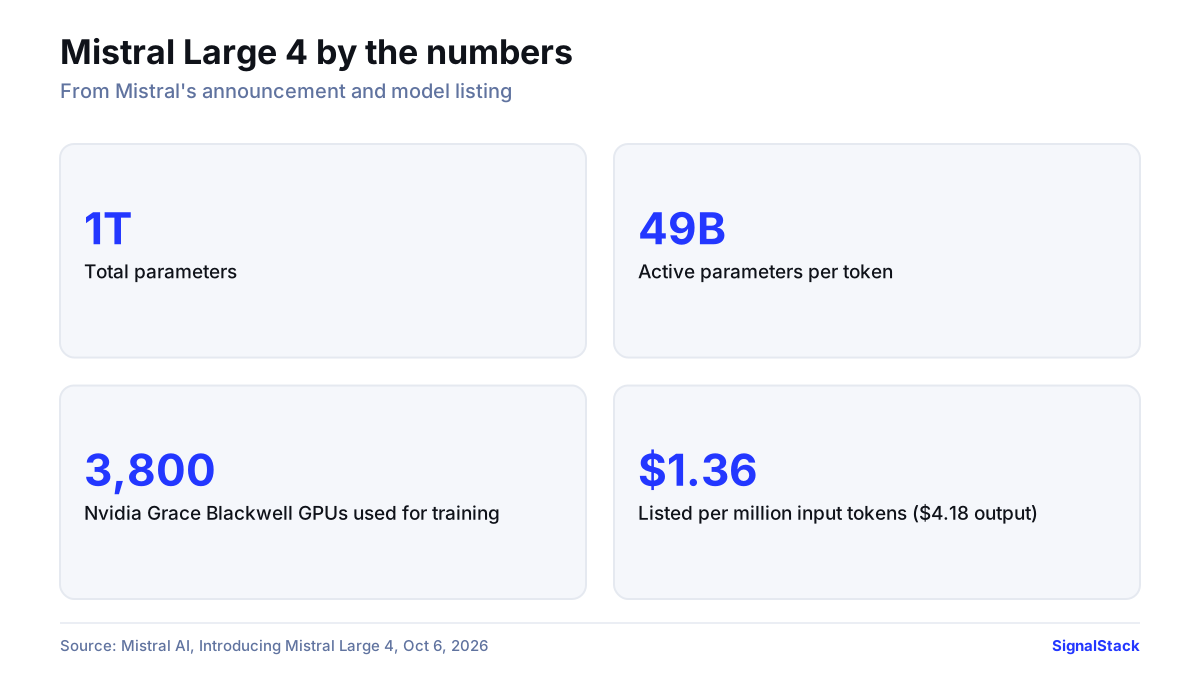
- Mistral AI launched a public preview of Mistral Large 4 on Oct. 6, 2026: a natively multimodal model with 1 trillion parameters, 49 billion of them active per token. It is available through Mistral’s API now; Mistral says the weights will be released “by the end of the month.”
- On one security test, Mistral says Large 4 scores 82%, “the highest of any model,” while Claude Opus 5.5 and GPT-6 Astra “score near zero” because they refuse the task. In the same post, it says Large 4’s average refusal rate on cyber prompts from JailbreakBench, StrongREJECT and AgentHarm is higher than that of the five other open models it compared: 95.3, against 93.7 for Kimi K3 and 77.7 for DeepSeek-V4-Pro-0813.
- Mistral’s announcement page lists Mistral Large 4 at $1.36 per million input tokens and $4.18 per million output tokens; AlphaSignal reported that Mistral had not announced API pricing. AlphaSignal also reported that the license terms for the downloadable weights had not been disclosed.
What happened
Paris-based Mistral AI published “Introducing Mistral Large 4” on Oct. 6. It calls the model its “largest and most capable model to date” and nicknames it “le Chonk.” Large 4 takes text and images as input, combines instruction-following and reasoning in one model, and supports more than 160 languages, the post says.
Mistral says it trained the model “from scratch on 3,800 NVIDIA Grace Blackwell GPUs” in its own European data centers (The Next Web says about 4,000; AlphaSignal says 4,000), and that the preview runs on the same infrastructure. The model was trained with enterprise customers in finance, manufacturing, shipping, the public sector and other industries, using the same environment Mistral offers through its Mistral Forge product.
Mistral also says Large 4 is the first milestone on the roadmap funded by its €3 billion Series D, which it calls “the largest equity round ever raised by a European technology company.”
What Mistral’s post says
Coding and agents. Its reported scores: DeepSWE v1.1, 61.7%; SWE-Atlas-QnA, 59.4%; Terminal-Bench 4, 28.3%. It says a combined “Coding Agent Index” score of 49.8% puts Large 4 ahead of DeepSeek V4 Pro 0813 and Qwen3.8 Max. On AutomationBench, 657 business workflows across apps such as Gmail and Salesforce, it reports 59.9%.
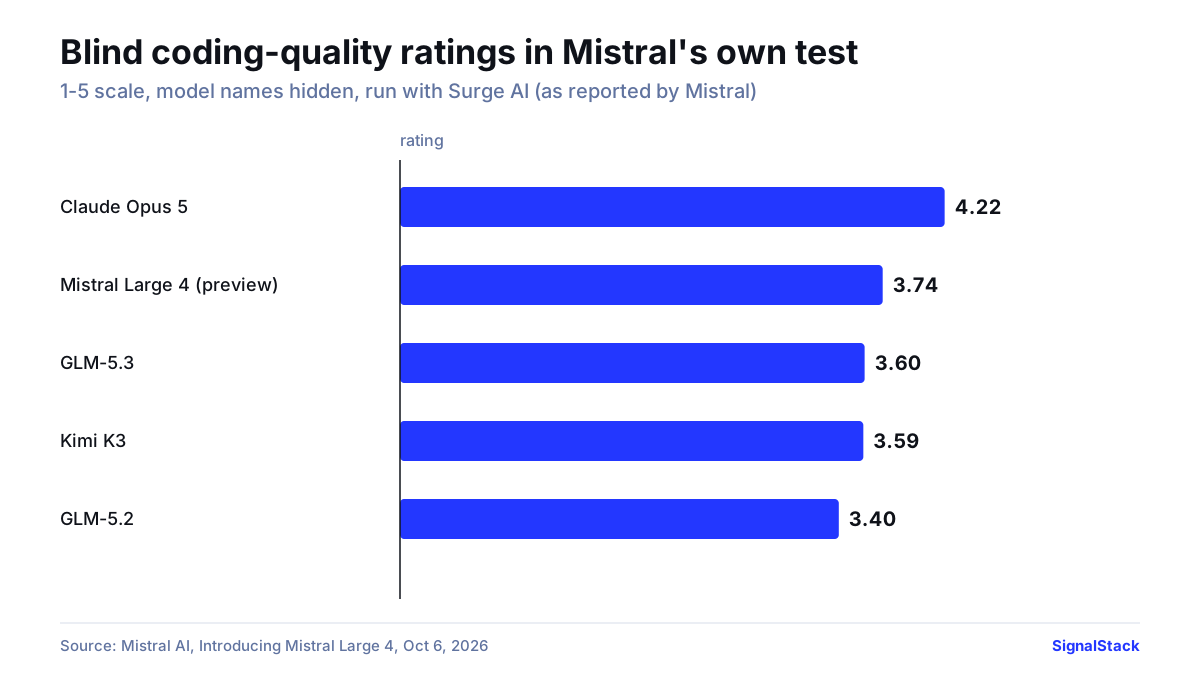
A blind human test. Mistral says professional annotators rated coding outputs on a 1-to-5 scale with model names hidden, in an evaluation run with Surge AI. Large 4’s preview ranked second of five models at 3.74. Claude Opus 5 ranked first at 4.22; GLM-5.3 scored 3.60, Kimi K3 3.59 and GLM-5.2 3.40.
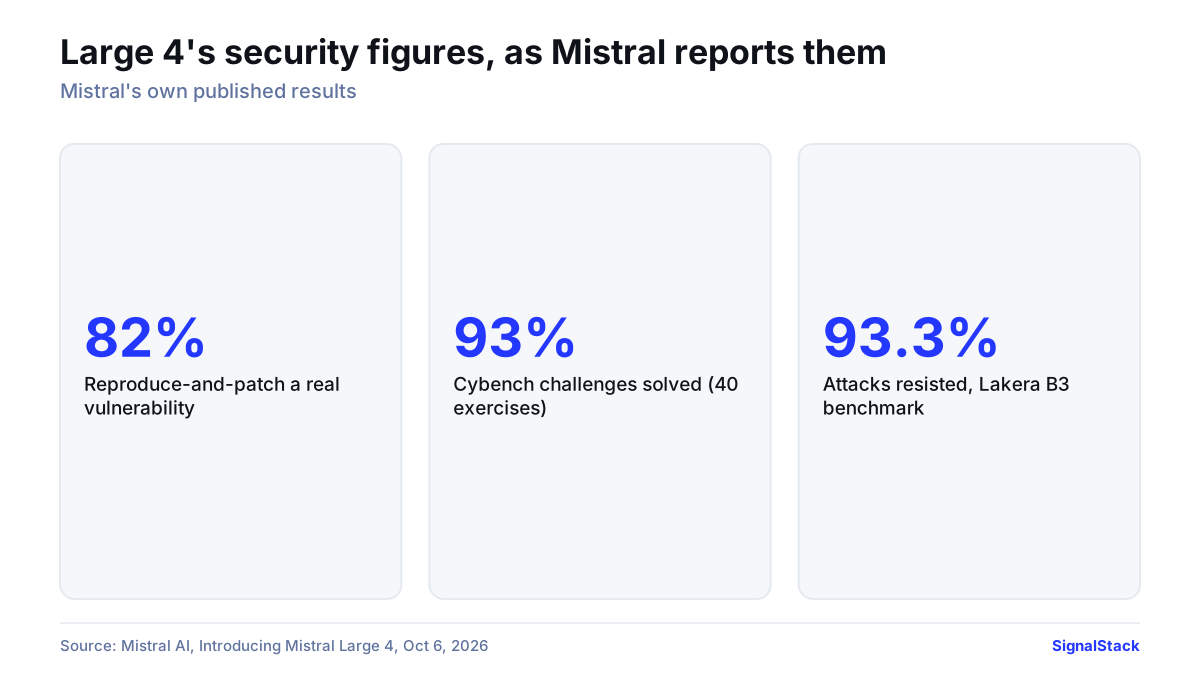
Cybersecurity, the post’s main claim. Mistral describes Large 4 as “one of the world’s strongest AI models for cybersecurity.” It says the model ranks in the top five on the Artificial Analysis Cyber Index and solves 93% of Cybench, a set of 40 exercises from security competitions. On one test in that index, where a model has to reproduce a real vulnerability in open-source code and then fix it, Mistral says Large 4 scores 82%. It says closed models including Claude Opus 5.5 and GPT-6 Astra “score near zero” on that test “because they refuse to perform the task.”
Two further lines in the same post sit beside that claim:
- Until the weights are released, Mistral says security firms, vetted partners and “state authorities” are testing the model, and that they will get it with “reduced moderation and expanded cyber capabilities.” AlphaSignal reported that the public API preview automatically blocks malicious cyber queries, while a separate private API gives vetted partners and state organizations broader access.
- In its safety section, Mistral says Large 4’s average refusal rate on cyber prompts drawn from JailbreakBench, StrongREJECT and AgentHarm “is higher than all OSS models,” and that it resists 93.3% of attacks on Lakera’s B3 security benchmark.
In other words, Mistral is claiming both that its model does legitimate security work that some closed models refuse, and that it refuses malicious requests more often than other open models. Both claims rest on Mistral’s own selection of tests.
Background: a second big open-weight announcement in two days
Large 4 arrived one day after Reflection AI announced Beam, a 501-billion-parameter open-weight model, which we covered in Reflection AI’s Beam: What the 501B Open-Weight Model Shows. Both companies published benchmark results first and promised weights later in October. Mistral made the comparison itself: its DeepSWE 1.1 and SWE-Atlas-QnA charts include Beam, using Reflection’s self-reported scores (44 and 35), next to Large 4’s 61.7% and 59.4%. Reflection’s own table gives Beam 44.4 on DeepSWE v1.1 and 34.6 on what it calls SWE Atlas Codebase QnA. Their Terminal-Bench versions differ (v2.1 for Reflection, 4 for Mistral). On DeepSWE, AlphaSignal lists GPT-6 Astra, DeepSeek-V4.1-Flash and Kimi K3 ahead of Large 4. The Next Web reported that Mistral calls the benchmark results preliminary and expects them to change before the weights are released.
The Next Web described Large 4, in Mistral’s framing, as the most powerful open-weight model outside China. In its charts, Mistral compares Large 4 mostly with open models from DeepSeek, Qwen, Kimi and GLM, and on its coding charts it also includes Reflection AI’s Beam, marked “self-reported.” The post itself says Large 4 is “significantly outperforming any open-weight model developed in the US or Europe.”
“Open-weight” means the trained parameters can be downloaded and run on your own servers. It does not by itself say what the license allows. AlphaSignal noted that once downloaded, the checkpoint can run on infrastructure the operator controls, “subject to the final license.” For the hardware side of running models this size, see what HBM is and why AI chips need so much of it. More in AI & Semiconductors.
What could go right / What could go wrong
What could go right
- If the weights ship this month as Mistral says, companies could run a European-built model of this size on their own servers. Separately, Mistral says the model will be available in several regions, including a European deployment it operates end to end under European law.
- Security teams that hit refusals from closed models on legitimate vulnerability work may get a tool built for that work, as Mistral describes it.
What could go wrong
- Every benchmark in the post was chosen by Mistral. Mistral names outside evaluators for some (Artificial Analysis, vals.ai, Surge AI) and calls others internal; for the rest it does not say who ran them. AlphaSignal noted that independent reproductions are still pending.
- AlphaSignal, paraphrasing co-founder Guillaume Lample, describes these as “dual-use” security requests, and says the private API is for “offensive and defensive testing.” Mistral’s post points to its refusal-rate and attack-resistance results, which are also its own figures.
- The license terms for the weights were not in the announcement, according to AlphaSignal, so what companies can do with the model is not yet known.
FAQ
Q What is Mistral Large 4?
A Mistral AI's largest model, previewed on Oct. 6, 2026. It has 1 trillion parameters with 49 billion active per token, accepts text and images, and supports more than 160 languages, according to Mistral.
Q When will Mistral Large 4's weights be released?
A Mistral says it will release the weights "by the end of the month," meaning October 2026, together with more details on the architecture, additional benchmarks and its post-training methodology. The Next Web and AlphaSignal report Oct. 27 as the date. The preview is available through Mistral's API now.
Q How much does Mistral Large 4 cost?
A Mistral's announcement page lists $1.36 per million input tokens and $4.18 per million output tokens. AlphaSignal reported that Mistral had not announced API pricing, so check Mistral's pricing page before relying on these figures.
Q Did Claude and GPT score zero on Mistral's cyber test?
A Mistral says Claude Opus 5.5 and GPT-6 Astra "score near zero" on a vulnerability reproduce-and-patch test "because they refuse to perform the task," while Large 4 scores 82%. That is Mistral's account of the test, not an independent result.
Q Is Mistral Large 4 open source?
A Mistral calls it open-weight, with downloadable weights due this month. AlphaSignal reported that the license terms for those weights had not been disclosed.