AI-generated illustration
Google announced Gemini 4 Argon on September 30, 2026, in a post by Koray Kavukcuoglu, SVP of Google DeepMind and Google’s Chief AI Architect. This report puts the details from Google’s own pages, covering price, limits, access and its benchmark table as reported, next to the list prices OpenAI and Anthropic publish for their models.
TL;DR
- Not generally available yet. Google says Argon is rolling out to “a set of trusted cyber defenders” through its Fairwind Program. Paid API customers and Google AI Ultra subscribers come next, with no date given. As of October 2, Argon does not appear on the Gemini API pricing page or in its changelog.
- Announced price. Google says Argon will launch at an introductory $2 input and $10 output per million tokens, then $4 and $20 once that period ends. Those match the published list prices of OpenAI’s GPT-6.1 Sol and Anthropic’s Claude Sonnet 5.5 ($2/$10) and Anthropic’s Claude Opus 5.5 ($4/$20).
- Output limit, not input. Google says Argon’s output token limit rises to 1 million tokens from 64K. The launch post gives no input context figure; Google’s September roundup describes a 1-million-token context window.
What Google announced
Google calls Argon its “new frontier model,” built for long, multi-step work in software engineering, legal and finance tasks, and cybersecurity defense. Kavukcuoglu wrote that releasing it “requires a phased approach” and that Google is taking part in the U.S. government’s voluntary process for pre-release model access. Before wider release, Google says it is strengthening safeguards in four areas: misuse, prompt injection, misalignment monitoring and sandbox hardening.
For trusted defenders and Google’s own internal teams, Google says Argon will be released “without cyber guardrails.” Google DeepMind’s Fairwind page says partners may give Argon access only to internal cybersecurity, incident response or penetration testing teams, must use phishing-resistant multi-factor authentication, and may not resell or share access. Google’s Fairwind post, dated September 2, listed more than 650 participating partners when we checked on October 3. SiliconANGLE names CrowdStrike and Palo Alto Networks among them.
Google also gives internal examples: Google says memory optimizations found and applied by Argon agents freed more than 300 TiB of data-center memory once rolled out, and it estimates total savings of 500 TiB to 1 PiB. Google also says Argon made a memory-safe Rust port of its libgav1 video decoder 2.7 times faster than an earlier Rust port, bringing it closer to the optimized C++ version.
What Google’s pages say about price, limits and access
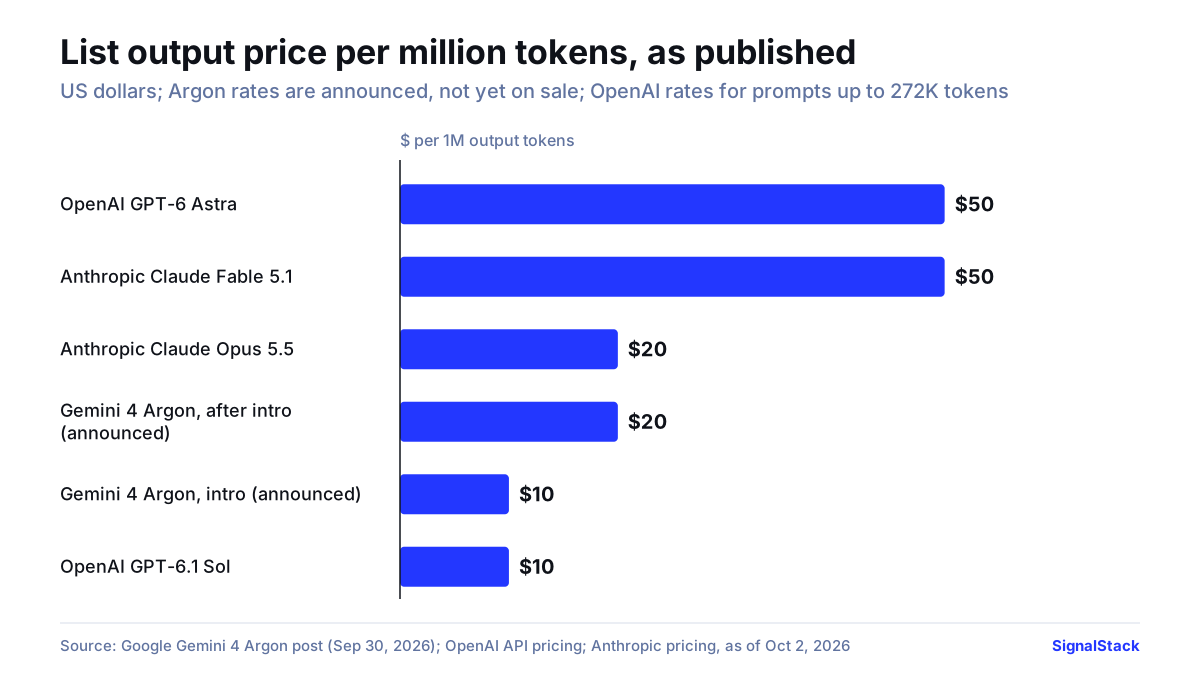
The table pairs Google’s announced Argon terms with the published list prices of the models in Google’s own benchmark table, plus GPT-6.1 Sol. All prices are list prices, per million tokens, as published on each company’s pages as of October 2.
| Model | Input | Cached input | Output | Context / max output | Status |
|---|---|---|---|---|---|
| Gemini 4 Argon, introductory (announced) | $2 | 95% off input ($0.10, our arithmetic) | $10 | 1M output (launch post) | Limited: a set of Fairwind partners, trusted testers, Google internal teams |
| Gemini 4 Argon, after introductory period (announced) | $4 | Not restated | $20 | Same | Not yet on sale |
| OpenAI GPT-6 Astra | $10 | $1 | $50 | 1,050,000 / 128,000 | Available in API |
| OpenAI GPT-6.1 Sol | $2 | $0.10 | $10 | 1,050,000 / 128,000 | Available in API |
| Anthropic Claude Fable 5.1 | $10 | $0.25 (cache hits) | $50 | 1M / 128K | Available in API |
| Anthropic Claude Opus 5.5 | $4 | $0.20 (cache hits) | $20 | 1M / 128K | Available in API |
Four details change how the numbers compare:
- No end date for the introductory price. Google’s footnote says the $4 and $20 rates apply “after the introductory period expires,” without saying when that is. It does not restate the cached-input discount for the later rate.
- Long prompts. OpenAI’s GPT-6 Astra and GPT-6.1 Sol pages say prompts above 272K input tokens are billed at 2x input and 1.5x output for the whole request. Anthropic says Claude models from 4.6 onward bill the full 1M context at standard rates. Google has not said whether Argon will have a long-prompt tier.
- Nothing to call yet. Google’s launch post names no API model ID. Its Gemini API pricing page leads with Gemini 3.8 Flash and has no Argon entry, and the API changelog’s latest entry is dated September 22. No Argon model card appears on Google DeepMind’s model card index. Google has published an evaluation methodology document.
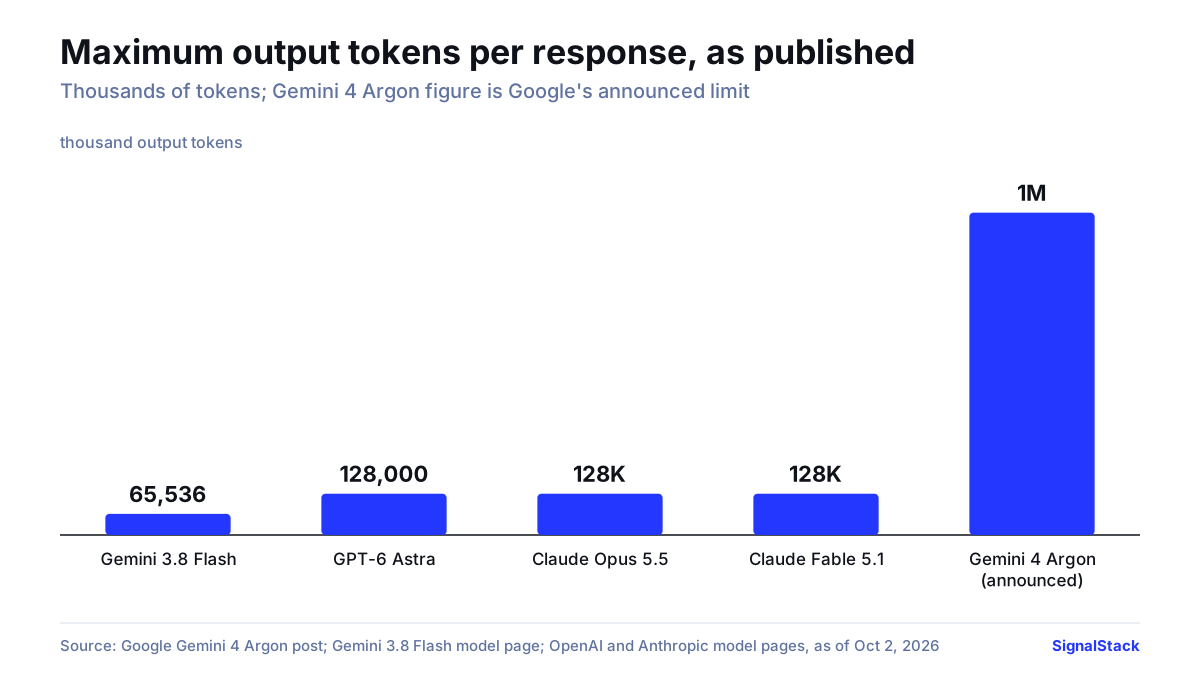
- Output limit vs. rivals. Google’s Gemini 3.8 Flash model page lists 1,048,576 input tokens and 65,536 output tokens. OpenAI and Anthropic list 128,000 and 128K maximum output for the models above. Argon’s announced 1M output limit is roughly 8 times 128,000 (about 7.8x if 1M means 1,000,000, about 8.2x if it means 1,048,576; our arithmetic).
Benchmarks, as Google reports them
Google’s chart compares Argon with GPT-6 Astra, Claude Fable 5.1 and Claude Opus 5.5 across 19 result rows. By our count of that chart, Argon has the top score in 13 rows and ties in one. GPT-6 Astra leads three and Claude Opus 5.5 leads two. A selection, all as Google reports:
| Benchmark (Google’s chart) | Gemini 4 Argon | GPT-6 Astra | Claude Fable 5.1 | Claude Opus 5.5 |
|---|---|---|---|---|
| Vals Index | 68.9% | 63.1% | 65.8% | 67.0% |
| AutomationBench | 51.3% | 41.4% | 31.4% | 42.5% |
| DeepSWE v1.1 | 77.9% | 74.1% | 67.4% | 74.2% |
| FrontierSWE v2 | 55.0% | 65.5% | 56.3% | 62.3% |
| Terminal-bench 4.0 | 57.4% | 58.2% | 57.9% | 66.4% |
| GraphWalks, 256K to 1M tokens | 84.2% | 71.8% | 65.0% | 66.8% |
| CWE-bench v1 | 68.0% | 68.0% | 58.0% | 67.0% |
Google’s methodology note says Argon was run through the Gemini API “with the highest thinking settings.” Rival numbers come from the providers’ own reports or official public leaderboards unless noted, and Google ran some benchmarks itself for all models, including GraphWalks. Several Argon scores, including DeepSWE and Terminal-bench 4.0, are Google’s own runs. One check: Google’s 68.1% for GPT-6 Astra on Terminal-Bench Science 0.1 matches the figure in OpenAI’s GPT-6.1 Sol post, as covered in our OpenAI DevDay 2026 report.
Background and reaction
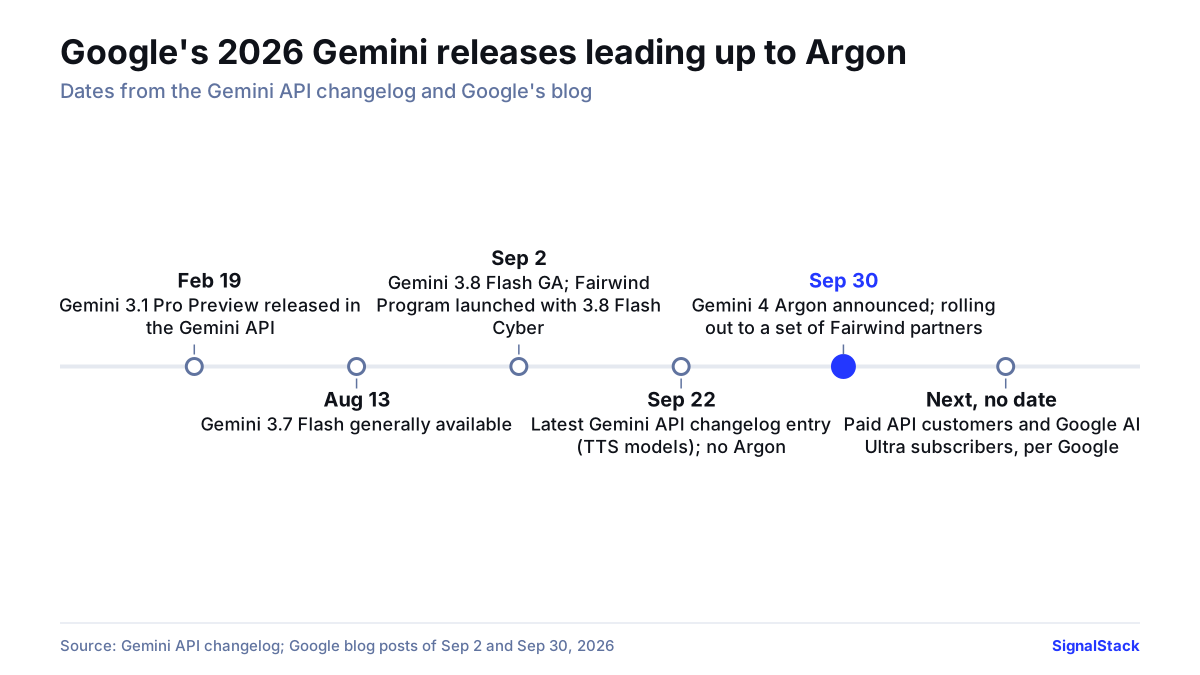
Google’s API changelog dates Gemini 3.1 Pro Preview to February 19, and the general release of Gemini 3.7 Flash and Gemini 3.8 Flash to August 13 and September 2; the Fairwind Program opened on September 2 with Gemini 3.8 Flash Cyber. The Verge noted that Argon arrived a day after OpenAI’s DevDay, where GPT-6.1 Sol launched, and in the same week OpenAI said it would not release GPT-6.1 Astra. Engadget, citing Artificial Analysis, reported that Argon matches GPT-6 Astra’s Intelligence Index score at 60 percent of the cost per task at the discounted prices. CNBC wrote on October 2 that the same index ranks Gemini 4 behind only Claude Opus 5.5 and Claude Sonnet 5.5.
9to5Google, summarizing a Bloomberg report, wrote that some Google employees said Argon’s real-world performance doesn’t always line up with its benchmark scores and that it struggles with certain coding tasks. Google told Bloomberg it “would be inaccurate to say that Gemini 4 is underperforming in areas such as coding.” Tulsee Doshi, Google’s Gemini model product lead, told CNBC the staged rollout “gives us more confidence.” On Hacker News, where the launch post drew more than 1,600 points, several top comments pointed out that the model is not yet open to the public, and one asked what the input limit is.
Gemini is made by Google, part of Alphabet; see our Alphabet company hub for filings and financials, and more model coverage in AI and semiconductors.
What could go right / What could go wrong
What could go right
- If the announced rates hold at broad release, developers get the model that tops most rows of Google’s chart (13 of 19, by our count) at GPT-6.1 Sol’s list price, then at Claude Opus 5.5’s.
- Google says the 1M output limit lets Argon work through hard problems “in one go”.
What could go wrong
- No date, model ID or API listing exists yet, and the introductory period has no stated end, so budgets built on $2 and $10 could change.
- Google says rival scores come from the providers’ own reports unless it notes otherwise, and several Argon scores are Google’s own runs; outside indexes differ: Vals AI’s Vals Index, as shown in Google’s chart, puts Argon first, while Artificial Analysis’s Intelligence Index ranks it behind Claude Opus 5.5 and Claude Sonnet 5.5, per CNBC.
- Bloomberg’s report of internal doubts about coding, which Google disputes, cannot be checked by outside users until access widens.
FAQ
Q Can I use Gemini 4 Argon now?
A Google says Argon is rolling out to a set of trusted cyber defenders through its Fairwind Program, and it says trusted testers and Google's own internal teams are also using it. Individuals cannot sign up; organizations can apply to the Fairwind Program, which Google says reviews applicants and prioritizes governments and critical-infrastructure partners. Google says paid API customers and Google AI Ultra subscribers come next but has not given a date, and as of October 2 Argon is not listed on the Gemini API pricing page.
Q How much will Gemini 4 Argon cost in the API?
A Google says the introductory rate will be $2 for input and $10 for output per million tokens, with cached input 95% cheaper than regular input. After the introductory period, Google says $4 and $20 will apply; it has not said when that period ends.
Q What is Gemini 4 Argon's context window?
A Google's launch post gives a 1 million token output limit, up from 64K. Its September roundup describes a 1-million-token context window. No model page with separate input and output limits is published yet.
Q How does Gemini 4 Argon pricing compare with GPT-6 and Claude?
A By published list prices, Argon's introductory $2/$10 equals OpenAI's GPT-6.1 Sol and Anthropic's Claude Sonnet 5.5, and its later $4/$20 equals Anthropic's Claude Opus 5.5. GPT-6 Astra and Claude Fable 5.1 list at $10 input and $50 output.
Q What is Google's Fairwind Program?
A A limited-access program Google launched in September for governments, critical infrastructure operators and core technology platforms to use its cyber defense models. Google lists more than 650 participating partners, and Google DeepMind says a set of them get exclusive access to Argon.
Companies in this report: Alphabet (Google)
Sources
- Introducing GPT-6.1 Sol
- Gemini 4 Argon: our next era of frontier intelligence (Sep 30, 2026)
- Gemini 4 Argon model evaluation: approach, methodology and results
- Fairwind Program
- Proactive cyber defense for governments and enterprises (Fairwind launch)
- The latest AI news we announced in September 2026
- Gemini Developer API pricing
- Gemini API release notes (changelog)
- Gemini 3.8 Flash model page
- API pricing
- GPT-6 Astra model page
- GPT-6.1 Sol model page
- Pricing
- Models overview
- Google releases Gemini 4 Argon, called its most powerful model yet
- Google rolls out Gemini 4 Argon, its most advanced AI model
- Can Google's new model really catch up to OpenAI and Anthropic at the frontier?
- Google announces Gemini 4 and says it's so capable that only 'trusted cyber defenders' can have it right now
- Google's first Gemini 4 model is 'Argon'
- Google's new frontier AI model Gemini 4 Argon goes to cybersecurity defenders first
- Google announces Gemini 4 Argon as its new frontier model
- Google stands by Gemini 4 performance as some claim it 'struggles' in real-world use
- Gemini 4 Argon (discussion thread)