AI-generated illustration
TL;DR
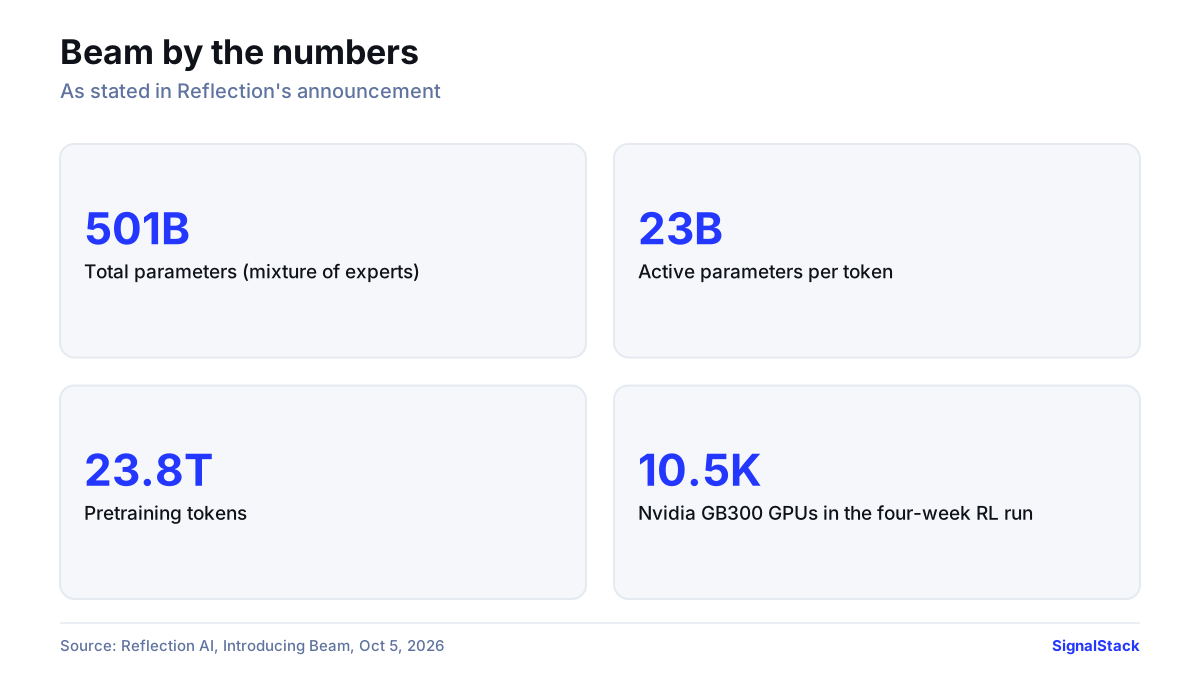
- Reflection AI announced Beam on Oct. 5, 2026: 501 billion parameters in all, of which 23 billion work on any given token (a sparse mixture-of-experts design). It targets coding, reasoning and agent work.
- The weights are not out yet. Reflection plans to put them out this month under Apache 2.0, alongside a model card and technical report. For now, access is by waitlist.
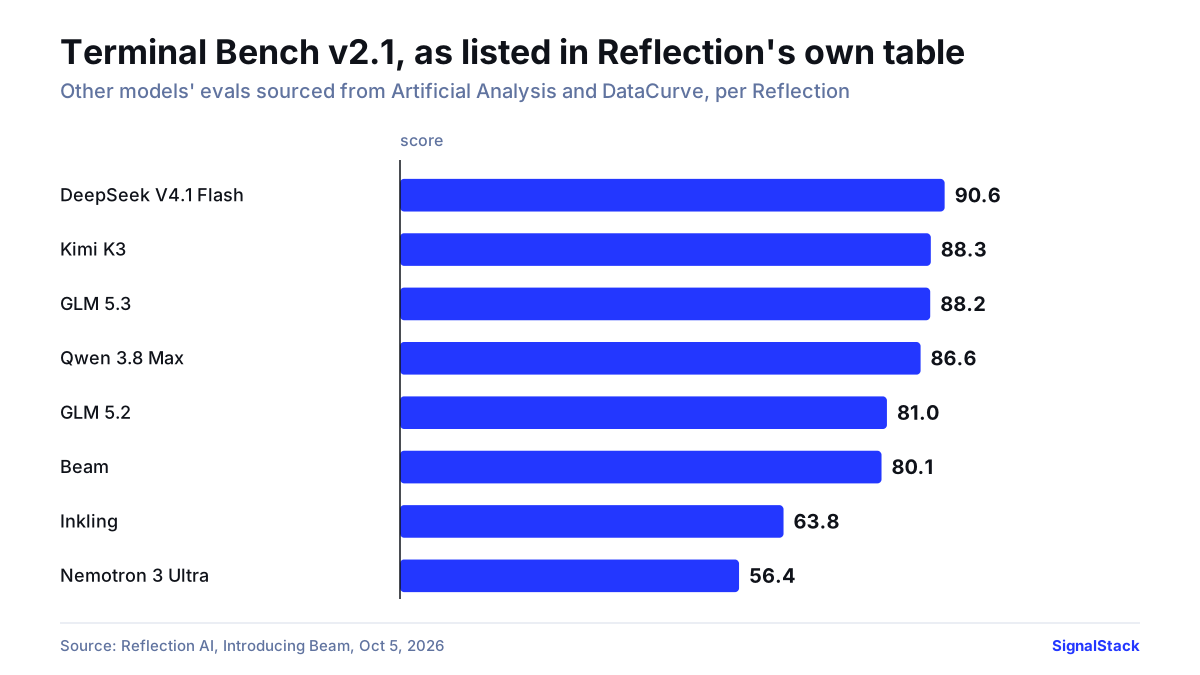
- In Reflection’s own coding table, Beam scores 80.1 on Terminal Bench v2.1. Five of the seven other models in the same table score higher, and Reflection concedes Kimi K3 leads “on raw capability.” Its pitch is efficiency, not the top score.
What happened
Reflection AI, an Nvidia-backed startup, published a blog post on Oct. 5 introducing Beam as its first open-weight model. It describes Beam as a sparse mixture-of-experts (MoE) model: of its 501 billion parameters, 23 billion are used for each token. AlphaSignal notes that this cuts the computation needed for each token, but running the model yourself still requires the full set of experts, which most deployments will spread across multiple accelerators.
The post says Beam is still in final red-teaming. Reflection plans to publish the weights later this month together with a model card, a technical report and developer tools, under Apache 2.0, a license that permits commercial use. Until then, developers can join a waitlist.
What Reflection’s own post says
How it was trained. Reflection says Beam’s pretraining used 23.8 trillion tokens drawn from web pages, public sources and licensed proprietary data. The run took under four weeks on 6,144 Nvidia GB300 NVL72 GPUs. A reinforcement learning (RL) stage followed: four weeks on “10.5K” GB300 GPUs (Reflection’s figure), producing over 100 million rollouts, with a maximum context length of 256K tokens. It says it believes this is “one of the largest scale RL runs conducted by any open lab to date.” A midtraining stage, before RL, extends Beam’s effective context length to 1 million tokens, the post says.
Safety training. Reflection says it trained a second model from the same pretrained checkpoint on safety and alignment data, then merged the two “teachers” (the RL model and the safety model) into Beam through distillation.
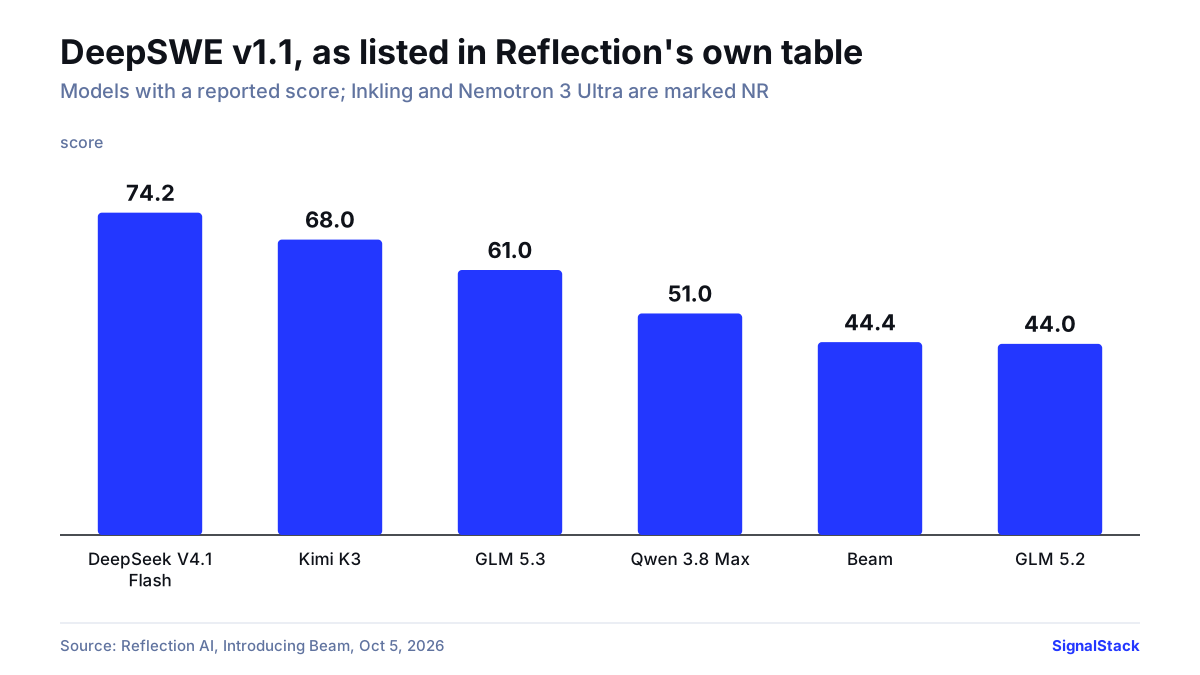
Where it lands on coding. Reflection’s coding table compares Beam with seven other models. It marks scores that were not reported as “NR.” In a figure note, Reflection says it uses Artificial Analysis and DataCurve as sources for other models’ evals. A few rows:
| Benchmark (Reflection’s table) | Beam | GLM 5.2 | Qwen 3.8 Max | Kimi K3 | DeepSeek V4.1 Flash |
|---|---|---|---|---|---|
| Terminal Bench v2.1 | 80.1 | 81.0 | 86.6 | 88.3 | 90.6 |
| DeepSWE v1.1 | 44.4 | 44.0 | 51.0 | 68.0 | 74.2 |
| SWE Bench Pro v1 | 65.5 | 62.1 | 67.7 | NR | NR |
| SWEBench Verified | 80.9 | NR | NR | NR | NR |
In the same table, Inkling (77.6) and Nemotron 3 Ultra (70.7) report SWEBench Verified scores; the four models above do not.
On Terminal Bench v2.1, Beam’s 80.1 is below GLM 5.2 (81.0), Qwen 3.8 Max (86.6), GLM 5.3 (88.2), Kimi K3 (88.3) and DeepSeek V4.1 Flash (90.6), and above Inkling (63.8) and Nemotron 3 Ultra (56.4). Reflection’s own wording matches the table: it calls Beam “competitive with” GLM 5.2 and “approaching” Qwen 3.8-Max, and says Kimi K3 stays ahead “on raw capability.”
The efficiency claim. Reflection says that on advanced reasoning benchmarks Beam scores comparably to GLM-5.2 “while using 3–4× less inference compute.” The post explains how it estimates compute in its efficiency chart: compute is approximated as 2 × active parameters × average generated tokens. It states that the estimate leaves out prompt prefill, attention costs that grow with context, and serving overhead, so it is “an approximate compute comparison rather than measured inference cost.”
All of these numbers come from Reflection’s announcement. AlphaSignal noted that the results come from Reflection’s own evaluation harness, and Startup Fortune noted that none of the figures had been independently verified yet. The weights are not public, so outside labs cannot run the same tests.
Background: why “open-weight” matters here
An open-weight model lets anyone download the trained parameters and run the model on their own hardware. Startup Fortune noted that DeepSeek and Alibaba’s Qwen have shown Chinese labs can reach near-frontier scores on public leaderboards, and that the contest now is over the cost of serving those scores. Reflection presents Beam as advancing “the Western open-weight frontier.”
Open weights are not the same as open source. AlphaSignal reported that Reflection’s proprietary training data and full training pipeline are not included in what Reflection has announced for release. The post itself says the weights will come with documentation and “the full stack for running, evaluating, and fine-tuning the model,” which is about using the model, not rebuilding it.
For another recent open-weight release, see our report on Aleph Alpha’s Kolibri. For the hardware side, see what HBM is and why AI chips need so much of it. More in AI & Semiconductors.
What could go right / What could go wrong
What could go right
- If the weights ship this month under Apache 2.0 as stated, companies get a large US-made open model they can run and fine-tune themselves, without usage fees to a model provider.
- If outside tests confirm the efficiency estimate, Beam could cost less to serve than larger open models with similar scores.
What could go wrong
- Release dates can slip. As of Reflection’s Oct. 5 post, Beam is still in final red-teaming, and “later this month” is the only date given.
- Outside tests may not match Reflection’s own harness. Until the weights are public, outside labs cannot reproduce Beam’s scores.
- The efficiency figure is an estimate that, by Reflection’s own description, leaves out prefill, context-dependent attention and serving costs, which matter in real deployments.
FAQ
Q What is Reflection AI's Beam?
A Beam is Reflection AI's first open-weight model, announced Oct. 5, 2026. It uses a mixture-of-experts design: 501 billion parameters in all, 23 billion active per token. Reflection built it for coding, reasoning and agents.
Q Can I download Beam now?
A Not yet. Reflection says it will release the weights later in October 2026 under an Apache 2.0 license; until then there is an early-access waitlist.
Q Is Beam better than DeepSeek or Kimi?
A Not on the coding scores in Reflection's own table: on every coding benchmark where DeepSeek V4.1 Flash or Kimi K3 reports a score, it is higher than Beam's. On Terminal Bench v2.1, Beam scores 80.1 against 90.6 for DeepSeek V4.1 Flash and 88.3 for Kimi K3. Reflection's claim is efficiency: similar reasoning scores to GLM-5.2 with an estimated 3–4× less inference compute.
Q What hardware was Beam trained on?
A Reflection says it pretrained Beam on 6,144 Nvidia GB300 NVL72 GPUs in under four weeks, then ran reinforcement learning on "10.5K" GB300 GPUs (Reflection's figure) for four weeks.
Q Is Beam open source?
A It is open-weight: the weights are due under Apache 2.0. AlphaSignal reported that Reflection's proprietary training data and full training pipeline are not included in what Reflection has announced for release.