Security
Qwen 3.6 27B: The Sweet Spot for Powerful Local AI Development
Qwen 3.6 27B: The Sweet Spot for Powerful Local AI Development POSITIONING PLAYBOOK (CONTEXT, NOT ADVICE) Qwen 3.6 27B offers a compelling balance of performance and accessibility, making it an excellent choice for local AI development.
TLDR
The Qwen 3.6 27B model emerges as a highly capable and practical option for local artificial intelligence development. It demonstrates impressive general intelligence and coding abilities, outperforming some larger models in specific tasks. Running Qwen 3.6 27B locally is now more accessible, offering significant advantages for privacy, cost, and iteration speed.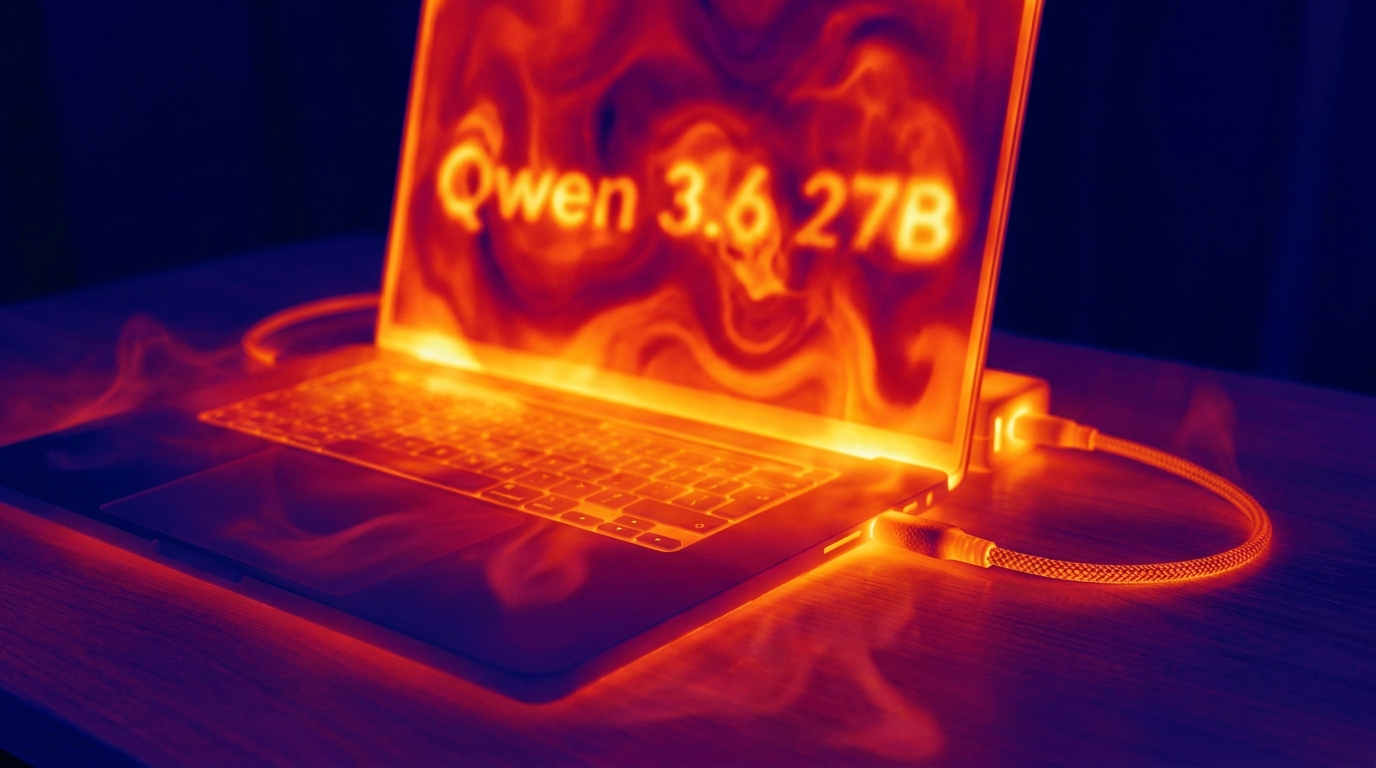
What happened
Qwen 3.6 27B, a dense large language model, has garnered significant attention for its remarkable performance in local development environments. Despite being a smaller variant compared to its mixture-of-experts counterpart, Qwen 3.6 35B A3B, the 27B model is frequently praised for 'punching above its weight' and delivering robust general intelligence. Early testing showcases its ability to handle complex creative writing tasks, such as generating an eight-line poem about Zouk dance and quantum physics, and even successfully creating functional code from a single prompt, like a hexagonal minesweeper using pnpm. While more advanced frontier models might offer higher sophistication for certain tasks, Qwen 3.6 27B proves highly effective for practical, everyday development needs, including generating website landing pages with good default settings and reactive behavior. Its local deployment is streamlined through tools like llama.cpp, which facilitates running quantized versions of the model on various hardware, including Apple Silicon devices, by efficiently utilizing GPU resources and offering multi-token prediction for enhanced speed.Why it matters
The emergence of powerful, locally runnable models like Qwen 3.6 27B signifies a pivotal shift in AI development, democratizing access to advanced language capabilities. This allows developers to operate AI without constant reliance on cloud APIs, leading to substantial cost savings, enhanced data privacy, and reduced latency for iterative development cycles. For individuals and small teams, it means greater control over their AI infrastructure and the ability to experiment and build innovative applications without prohibitive expenses or concerns about data leaving their local environment. This capability fosters a new wave of creativity and efficiency, enabling more secure and tailored AI solutions for a broader range of applications.Key details
Qwen 3.6 is available in two main variants: the dense Qwen 3.6 27B and the mixture-of-experts Qwen 3.6 35B A3B. The Qwen 3.6 27B model is recommended for its power, despite being slower than the 35B A3B variant. It demonstrates strong capabilities in constrained writing, complex creative tasks, and functional code generation from single prompts. Local deployment is facilitated by open-source tools like llama.cpp, supporting various devices and efficient GPU utilization. Quantization, such as 8-bit, significantly reduces model size with minimal quality loss, making it feasible for consumer hardware. On a Macbook Max M5, the 8-bit Qwen 3.6 27B with llama.cpp and multi-token prediction achieved 32 tokens/second using 42 GB RAM. The model can run within 48 GB of Apple Silicon's shared RAM, and on consumer Nvidia RTX cards with more aggressive quantization, it can achieve 50 tokens/second. Its native context window is 256k tokens, with configurations often setting it to 64k for practical use.
What to watch next
Future developments in local large language models will likely focus on further optimization for consumer hardware, exploring new quantization techniques, and improving inference speeds without sacrificing output quality. The community's ongoing contributions to tools like llama.cpp and the emergence of new AI agents will continue to broaden the practical applications and accessibility of these powerful models for a wider range of developers and use cases.The SignalStack angle
For builders, security specialists, and product teams, the Qwen 3.6 27B model represents a timely opportunity to integrate advanced AI capabilities directly into their local workflows. This model's proven ability to handle complex coding and creative tasks, coupled with its efficient local runnability via tools like llama.cpp, means teams can significantly reduce their reliance on external API calls, which often carry privacy risks and recurring costs. By deploying Qwen 3.6 27B on-premises, product teams can rapidly prototype features, developers can accelerate code generation and debugging in secure environments, and security teams can ensure sensitive data never leaves their controlled infrastructure. This shift towards powerful local LLMs empowers organizations to innovate faster, maintain stricter data governance, and achieve a new level of operational autonomy in their AI strategy, making it a critical consideration for current and future development cycles.FAQ
Q What is Qwen 3.6 27B?
A Qwen 3.6 27B is a powerful, dense large language model known for its strong general intelligence and coding capabilities, particularly well-suited for local deployment and development. It is part of the Qwen 3.6 series, which also includes a mixture-of-experts variant. Q How does Qwen 3.6 27B compare to the 35B A3B variant?
A While the Qwen 3.6 35B A3B is a faster mixture-of-experts model, the 27B dense model is often preferred for its perceived greater power and quality of output, even if it has a lower token generation rate. The 27B variant has demonstrated superior adherence to complex instructions in certain coding tasks. Q Can Qwen 3.6 27B be run on typical consumer hardware?
A Yes, Qwen 3.6 27B can be run on consumer hardware, including high-end laptops with Apple Silicon and consumer Nvidia RTX graphics cards. This is largely possible through techniques like quantization, which reduces the model's memory footprint while maintaining high quality, and efficient inference engines like llama.cpp. Q What are the primary benefits of running LLMs like Qwen 3.6 27B locally?
A Running LLMs locally offers several key benefits, including enhanced data privacy as sensitive information remains on your device, significant cost savings by avoiding API fees, and faster iteration cycles due to reduced network latency. It also provides developers with greater control and flexibility over the AI's operation and integration into their workflows.