

AI-generated illustration
TL;DR: JPMorgan Chase reported third-quarter 2026 net income of $15.3 billion, or $5.57 a share, on Oct. 13. Excluding $658 million of net investment securities losses, the bank put it at $15.8 billion, or $5.75 a share. Managed revenue rose 8% to $50.9 billion and expense rose 12% to $27.3 billion. Inside trading, fixed income fell 4% while equities rose 49%. The bigger read is the outlook slide. Against what JPMorgan printed in July, its 2026 figures now imply about $106.2 billion of net interest income (July: about $105.5 billion) and about $108.6 billion of adjusted expense (July: about $107.5 billion). The card loss-rate outlook stayed at about 3.2%. The bank also cut net share repurchases to $664 million, from $6.2 billion in the second quarter, and added a preliminary 2027 central case that was not on the July slide.
For how to read a release like this (8-K exhibits, non-GAAP figures, outlook slides), see earnings season explained. We previewed this release the day before it came out in what JPMorgan, Goldman, Wells and Citi said before Q3. JPMorgan’s dates and quarterly history sit on its earnings page, and the rest of the season is on the Q3 2026 earnings hub.
What JPMorgan reported
The figures below are from the bank’s earnings release (Exhibit 99.1) and the presentation it filed with the SEC the same morning. Comparisons are with the third quarter of 2025 unless noted.
| 3Q26 | Change from 3Q25 | |
|---|---|---|
| Net income | $15.3 billion | up 6% |
| Diluted EPS | $5.57 | up $0.50 |
| Managed revenue | $50.9 billion | up 8% |
| Net interest income | $27.1 billion | up 13% |
| Expense | $27.3 billion | up 12% |
| Credit costs | $2.7 billion | down $0.7 billion |
| Return on tangible common equity | 20% | flat |
The one item the bank singles out is $658 million of net investment securities losses in its Corporate segment. That cut EPS by $0.18. JPMorgan presents a second set of figures without it: $15.8 billion of net income, $5.75 a share and a 21% return on tangible common equity. Those are non-GAAP measures, and the release reconciles them. Chairman and CEO Jamie Dimon’s statement calls the losses “discretionary.”
Credit costs of $2.7 billion were $2.2 billion of net charge-offs plus a $539 million net reserve build. A reserve build means the bank set more money aside for future loan losses than it wrote off.
Yahoo Finance, citing a Bloomberg survey, reported that analysts had expected $5.92 a share. This report doesn’t rely on that figure. The comparison that follows is with JPMorgan’s own July numbers.
The trading split
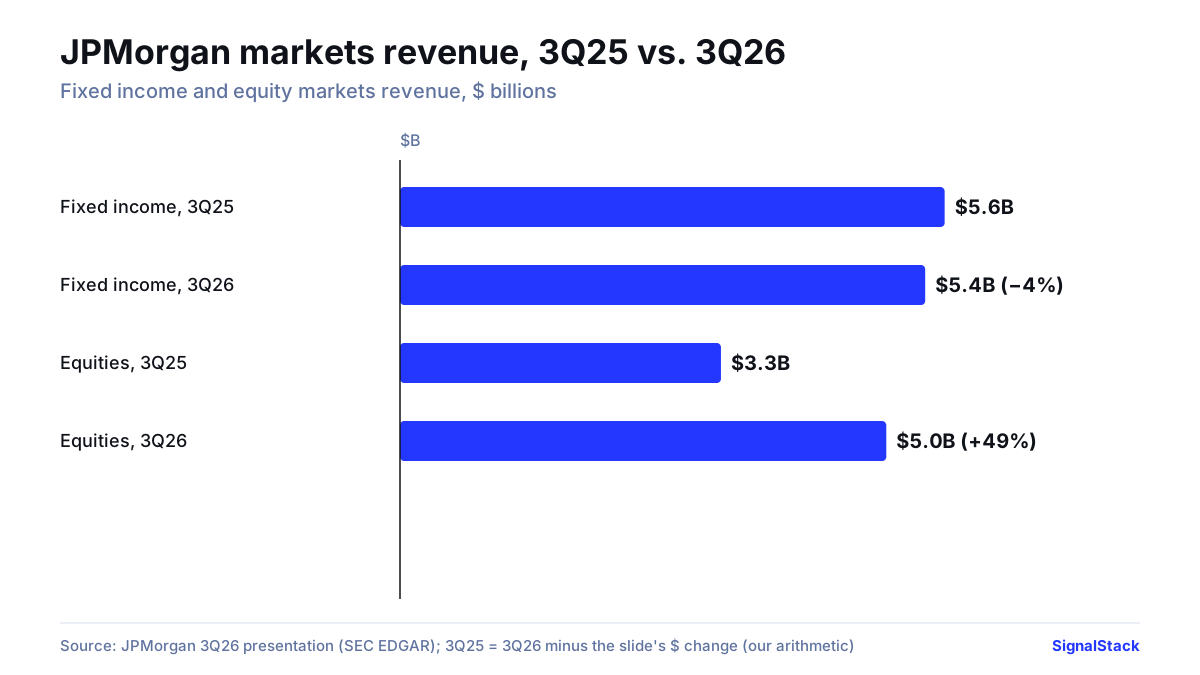
Markets revenue was $10.3 billion, up 15%. That total hides two very different results:
- Fixed income markets: $5.4 billion, down 4%. The presentation points to weaker commodities, rates, credit and public finance revenue, mostly offset by gains in currencies and emerging markets.
- Equity markets: $5.0 billion, up 49%. The bank credits “strong performance across products, particularly in Prime and Derivatives.” A year earlier the two were about $5.6 billion and $3.3 billion (our arithmetic from the presentation’s dollar changes).
Elsewhere in the Commercial & Investment Bank, investment banking fees rose 14% to $3.0 billion. JPMorgan says it ranked No. 1 in global investment banking fees with a 9.2% wallet share so far this year, according to Dealogic data cited in the release. Dimon said client activity was strong, “although activity did moderate somewhat during the quarter.”
The 2026 outlook, July vs. October
In July, JPMorgan’s second-quarter presentation gave four full-year 2026 expectations. The October slide is laid out differently. It shows what has been booked through September, adds a fourth-quarter outlook and prints the implied full year. In July, each of the three dollar figures was labeled “market dependent”; in October, that label sits on the fourth-quarter outlook column.
| 2026 figure | July outlook | October: 9 months + 4Q outlook | Implied full year |
|---|---|---|---|
| Net interest income | ~$105.5B | $78.2B + ~$28B | ~$106.2B |
| NII excluding Markets | ~$96.5B | $71.7B + ~$25.5B | ~$97.2B |
| Adjusted expense | ~$107.5B | $81.1B + ~$27.5B | ~$108.6B |
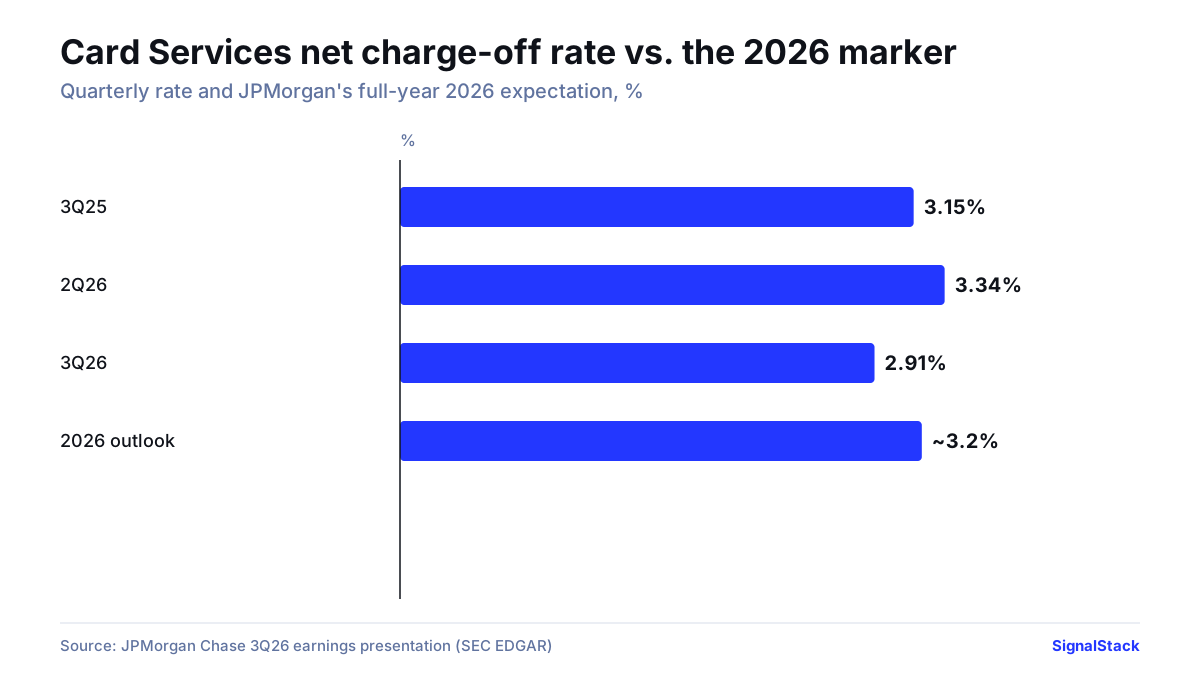
| Card Services net charge-off rate | ~3.2% | — | ~3.2% (2026 outlook, unchanged) |
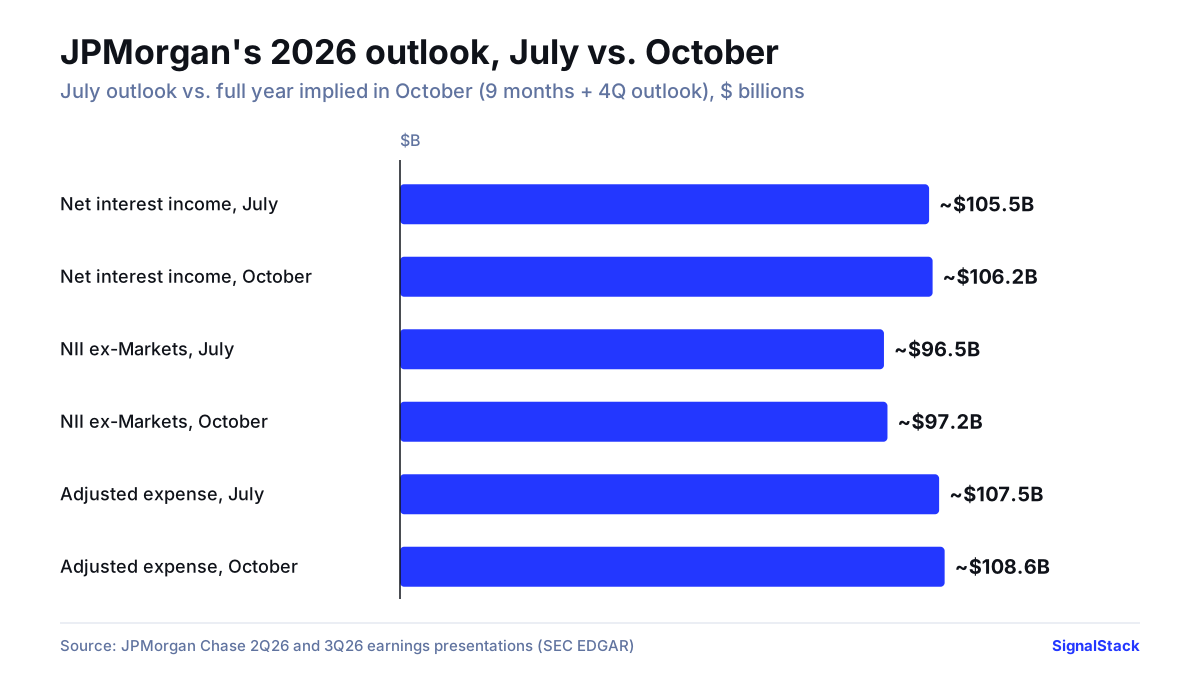
So both the income line and the cost line moved up, by roughly $0.7 billion to $1.1 billion. In July the bank tied its higher expense outlook mainly to volume- and revenue-related costs that came with stronger activity.
The October slide also has a new line, a “2027 central case (preliminary analysis)”: net interest income excluding Markets of about $107 billion. It says growth would be “driven by the impact of balance sheet growth and higher rates.” JPMorgan labels it a 2027 “central case (preliminary analysis)”; the slide gives no 2027 figure for total net interest income, expense or card losses.
The third-quarter Card Services net charge-off rate, 2.91%, came in below that ~3.2% marker, after 3.47% in the first quarter and 3.34% in the second; it was 3.15% a year earlier.
Capital: dividends up, buybacks down
JPMorgan paid a common dividend of $4.4 billion, or $1.65 a share, up from $4.0 billion, or $1.50 a share, in the second quarter. Net share repurchases were $664 million, against $6.2 billion in the second quarter. Dimon tied that to the bank’s capital hierarchy, which puts investing in the business and supporting clients first. He said the bank “reduced share repurchases this quarter” and believes it can deploy the capital over time “at very attractive returns.” (For how buyback numbers work, see buyback authorizations vs. actual repurchases.)
The standardized common equity Tier 1 (CET1) ratio was 13.9%, an estimate, down from 14.2% at the end of June (as revised in the October presentation; July’s release had estimated 14.1%), and the advanced ratio was 14.1%, with $304 billion of CET1 capital. Book value per share was $132.30, up 6% from a year earlier.
What Dimon flagged
Dimon’s outlook paragraph is a caution, not a forecast. Dimon wrote that business investment and consumer spending kept fueling the U.S. economy. He then named rising interest rates, sticky inflation, large fiscal deficits, elevated asset prices and geopolitics as forces that “continue to shift under the surface.” He added: “These forces may be manageable,” and the bank remains “prepared for a wide range of outcomes.”
What could go right / what could go wrong
Both lists come from the bank’s own numbers and words.
What could go right
- The implied 2026 net interest income (
$106.2B) is above the July figure ($105.5B), and the preliminary 2027 case points higher again for NII excluding Markets (~$107B). - Third-quarter card losses (2.91%) came in below the ~3.2% full-year marker.
- Equity trading (+49%) and investment banking fees (+14%) grew, and Dimon called asset and wealth management flows “very strong,” with $263 billion of client asset net inflows.
What could go wrong
- Expenses are rising faster than revenue (+12% vs. +8%), and the full-year adjusted expense figure moved up again.
- Fixed income trading fell, and Dimon said client activity “did moderate somewhat during the quarter.”
- The bank built reserves by $539 million, and Dimon’s statement names several forces that “continue to shift under the surface.”
FAQ
Q How much did JPMorgan earn in Q3 2026?
A Net income was $15.3 billion, or $5.57 a share, up 6% from a year earlier. Excluding $658 million of net investment securities losses, JPMorgan put it at $15.8 billion, or $5.75 a share.
Q Did JPMorgan raise its 2026 net interest income outlook?
A Its October slide implies about $106.2 billion of 2026 net interest income ($78.2 billion through September plus about $28 billion in the fourth quarter), compared with about $105.5 billion in its July outlook. The bank labels its fourth-quarter outlook market dependent.
Q Why did JPMorgan's fixed income trading revenue fall?
A Fixed income markets revenue fell 4% to $5.4 billion. JPMorgan's presentation points to weaker commodities, rates, credit and public finance revenue, mostly offset by gains in currencies and emerging markets.
Q Did JPMorgan cut its share buybacks?
A Yes. Net repurchases were $664 million in the third quarter, against $6.2 billion in the second. Dimon said the bank reduced buybacks "in line with our hierarchy," which puts investing in the business first.
Q What is JPMorgan's 2027 outlook?
A The Q3 presentation gives a preliminary 2027 central case of about $107 billion of net interest income excluding Markets, driven by balance sheet growth and higher rates. JPMorgan labels it preliminary analysis.
Companies in this report: JPMorgan Chase
Sources
- JPMorganChase third-quarter 2026 earnings release (8-K Ex. 99.1, Oct. 13, 2026)
- JPMorganChase 3Q26 earnings presentation (8-K, Oct. 13, 2026)
- JPMorganChase 2Q26 earnings presentation (July 14, 2026)
- JPMorganChase second-quarter 2026 earnings release (8-K Ex. 99.1, July 14, 2026)
- JPMorgan Chase misses third-quarter earnings estimates as fixed-income trading revenue declines