

AI-generated illustration
TL;DR: “Warren Buffett index fund advice” is back in the headlines on the back of a wave of articles. One Motley Fool headline (Oct. 9) says he recommends one Vanguard fund “for all investors.” His own words are narrower.
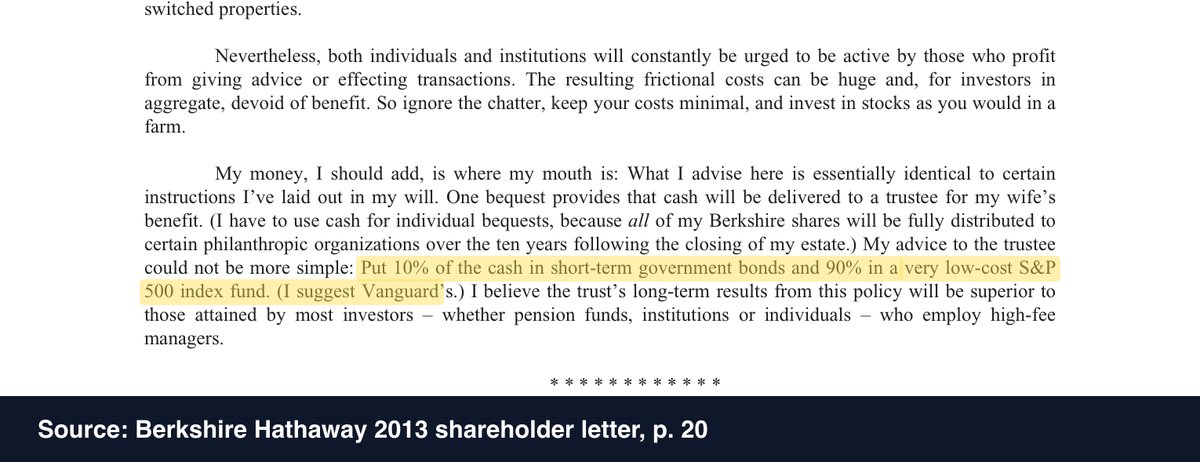
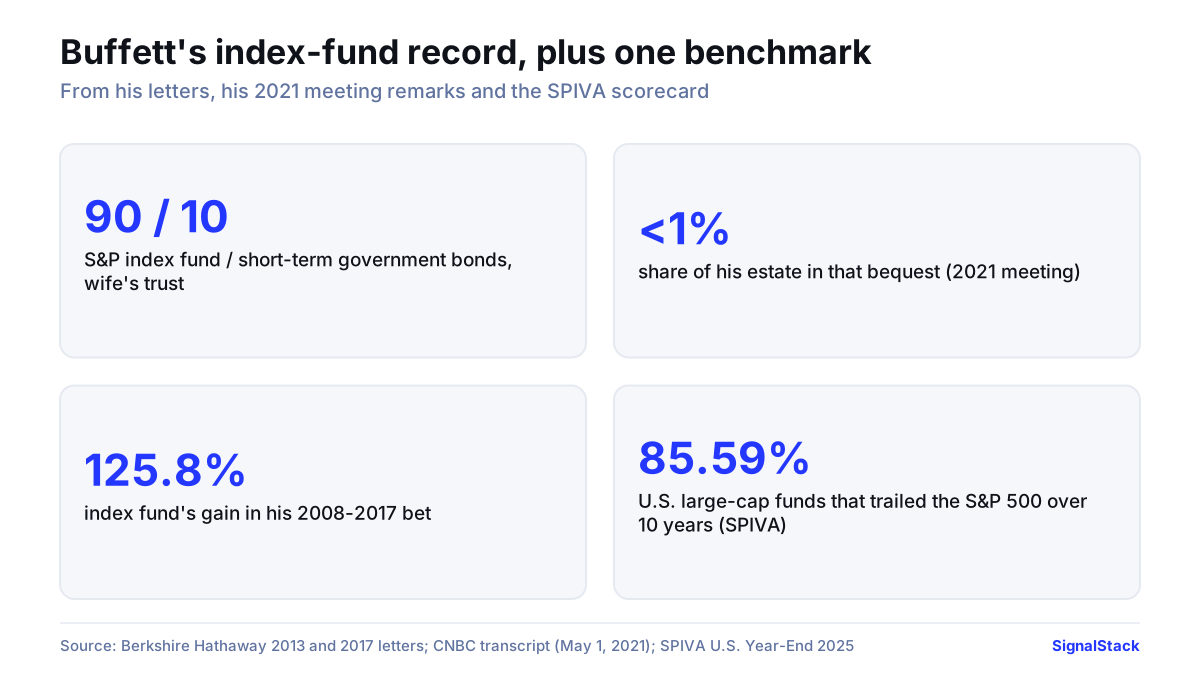
- The trust instruction: in his 2013 shareholder letter he described one bequest in his will, cash left in trust for his wife. Its instruction puts 90% into a very low-cost S&P 500 index fund and keeps the other 10% in short-term government bonds. Buffett added “I suggest Vanguard’s.”
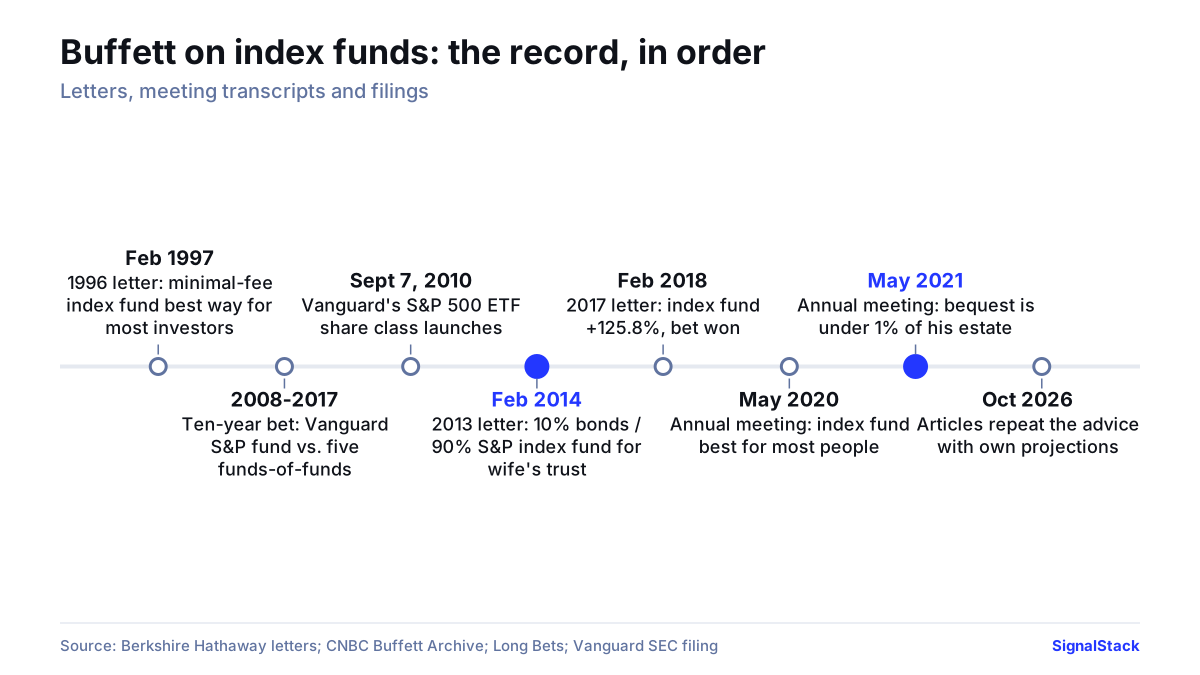
- How big it is: at the 2021 annual meeting he said that bequest was “way less than one percent of my estate.” His Berkshire shares are to go to philanthropy, per his 2013 letter.
- No ticker: no ticker appears in the letters or meeting transcripts we checked. The ten-year bet he famously won began in 2008. The Vanguard ETF that a Motley Fool article (Oct. 6), also syndicated on Yahoo Finance, says he picked for it launched in 2010.
What’s trending, and why
Articles published between Oct. 3 and Oct. 12, 2026 repeat Buffett’s case for index funds. Three of them, The Motley Fool’s Oct. 6 and Oct. 9 pieces and 24/7 Wall St.’s Oct. 12 piece, add their own projections of what monthly investing could grow to. Those projections are the writers’ own math. Buffett gave no such dollar figures. Below are the primary records: Berkshire Hathaway’s shareholder letters, CNBC’s transcripts of the annual meetings, the Long Bets record of his wager, SEC filings by Berkshire and Vanguard, and S&P’s SPIVA scorecard.
What the 2013 letter says
The passage these articles cite is on page 20 of the 2013 letter, dated Feb. 28, 2014. It is written for “non-professionals.” Buffett’s argument is that they do not need to pick winners. Their goal should be to own a cross-section of businesses, and he says a low-cost S&P 500 index fund achieves that. He also warns about timing. His remedy is to keep buying over a long period and never to sell at a moment when the news is bad and stocks trade well below their highs.
Then comes the will. Buffett wrote that one bequest delivers cash to a trustee for his wife’s benefit, and that his advice to that trustee is the 10/90 split. He added that he expects the trust’s long-term results to beat those of most investors who pay high-fee managers.
He returned to the will at the 2020 annual meeting. He said he had not changed it and that it directs 90 percent of his widow’s funds into index funds. At the 2021 meeting he put the size in context. The bequest is “way less than one percent of my estate,” and roughly 99.7% will go to philanthropy or to the federal government. A Nov. 25, 2024 release adds that his Berkshire holdings make up 99½% of his wealth and that his children will be responsible for distributing them after his death.
The bet: what it was and how it ended
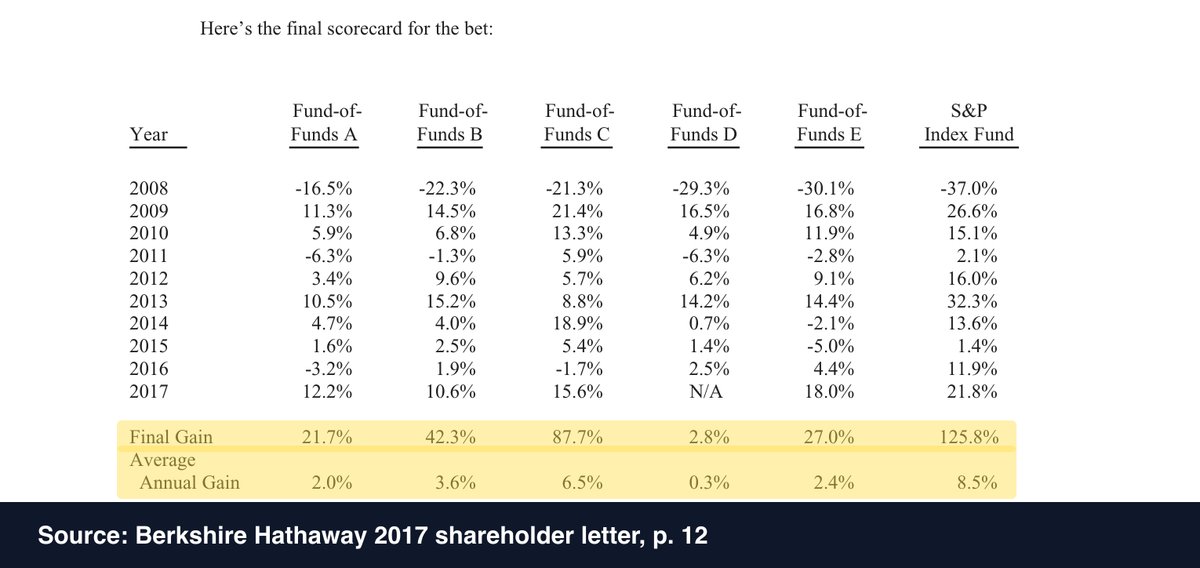
In the 2016 letter Buffett described his wager with Protégé Partners. The 2017 letter adds that each side bought $500,000 face amount of zero-coupon Treasury bonds toward a $1 million prize for charity. It pitted a low-cost Vanguard S&P fund against five funds-of-funds chosen by Protégé; per the 2017 letter, those five funds-of-funds owned interests in more than 200 hedge funds (the 2016 letter had put it at more than 100). Long Bets records the term as Jan. 1, 2008 to Dec. 31, 2017. The 2017 letter, dated Feb. 24, 2018, published the final scorecard.
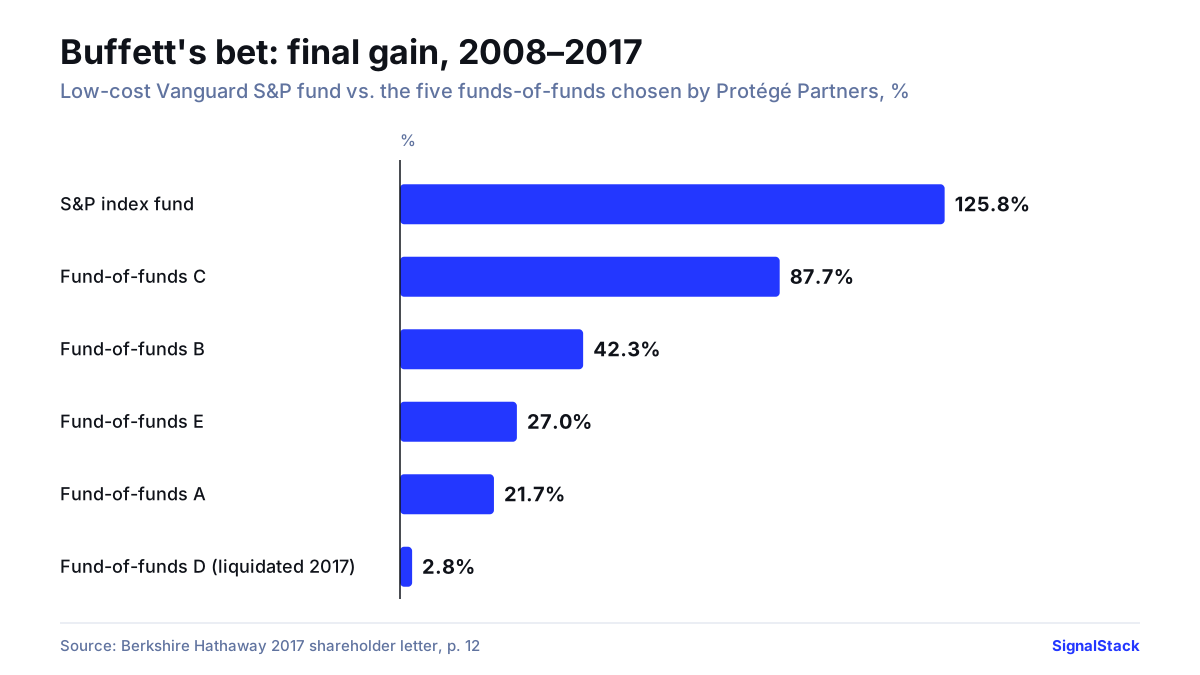
| S&P index fund | Funds-of-funds (5) | |
|---|---|---|
| Final gain, 2008–2017 | 125.8% | 2.8% to 87.7% |
| Average annual gain | 8.5% | 0.3% to 6.5% |
Fund D was liquidated in 2017, and its annual rate covers nine years. The 2017 letter gives no combined final average for the five funds; the 2016 letter put it at 2.2% a year through 2016. The prize went to Girls Inc. of Omaha, which received $2,222,279 per the 2017 letter after the bond stake was switched into Berkshire shares in 2012. One of his stated lessons is short: “Performance comes, performance goes. Fees never falter.”
What the recent articles get wrong or leave out
| What the article says | What the record says |
|---|---|
| The “for most people, the best thing to do” quote is from the 2021 meeting (Motley Fool, Oct. 6) | That line is from the May 2, 2020 meeting. In 2021 he said “I recommend the S&P 500 index fund.” |
| Buffett picked the Vanguard S&P 500 ETF (VOO) for his hedge-fund bet (Motley Fool, Oct. 6) | The bet ran from 2008. Vanguard’s 2026 prospectus filing gives the ETF share class an inception date of Sept. 7, 2010. The 2016 and 2017 letters describe the bet’s fund only in generic terms, such as “a low-cost Vanguard S&P fund” and an “unmanaged S&P 500 index fund”; none of the letters we checked names an ETF or a ticker. |
| He recommends one Vanguard fund “for all investors” (Motley Fool, Oct. 9) | The 2013 letter’s general advice is for “non-professionals” and names only a low-cost S&P 500 index fund. “I suggest Vanguard’s” appears only in the instruction for his wife’s trust, with no ticker. Elsewhere he wrote that “most investors” would find the best way to own stocks is an index fund “that charges minimal fees” (1996 letter, dated Feb. 28, 1997) and that “both large and small investors” should stick with low-cost index funds (2016 letter). |
| His will has a trustee put “most of his cash” into the fund “to benefit his wife” (Motley Fool, Oct. 9) | The instruction covers one cash bequest for his wife, 90% of it in an S&P 500 index fund. He called that bequest “way less than one percent of my estate.” |
| Buffett trusted the fund with “his own family’s money” (24/7 Wall St., Oct. 12) | True as far as it goes: the bequest is for his wife. It is way less than 1% of his estate, and his Berkshire shares, 99½% of his wealth per a Nov. 2024 release, are earmarked for philanthropy. |
The dollar projections in these articles ($820,000, $610,000 and similar) come from the writers’ assumed return rates. None of them comes from Buffett.
Does Berkshire hold index funds?
Berkshire Hathaway’s 13F filings show small positions in two S&P 500 ETFs, worth about $12.7 million each in the filing for the fourth quarter of 2019. They were worth roughly $22.7 million and $22.6 million in the Q3 2024 filing, and were gone by the filing for Q4 2024. These are company holdings, not Buffett’s personal account. Our Berkshire 13F tracker lists the latest positions, and the Form 13F glossary entry explains what those filings cover.
Background: the data Buffett’s argument rests on
S&P Dow Jones Indices’ SPIVA scorecard for year-end 2025 measures how actively managed U.S. funds did against their benchmarks. In that report, 85.59% of large-cap funds trailed the S&P 500 over 10 years and 92.89% did over 20 years, on an absolute-return basis. Buffett made a similar point in his 2014 letter, where he said that huge institutional investors as a group had long trailed the index-fund investor who simply sits tight for decades.
What could go right / What could go wrong
What could go right, by Buffett’s own reasoning:
- In the 2013 letter he argues that an investor who follows his timing rules (keep buying over a long period, and never sell at a moment when the news is bad and stocks trade well below their highs) and who diversifies and keeps costs minimal is “virtually certain to get satisfactory results.”
What could go wrong, by the same record:
- The scorecard shows the index fund fell 37.0% in 2008, the bet’s first year.
- Buffett’s warning in the 2013 letter is about timing. He calls it “the main danger” that a beginner buys in during a burst of extreme exuberance and then loses heart when paper losses appear. His antidote: never sell at a moment when the news is bad and stocks trade well below their highs.
- He also wrote in his 2016 letter that some professionals can beat the index, though he expected few to do so.
Nothing here is a recommendation from SignalStack. It is a record of what Buffett wrote and said. More reports built from filings are in our markets and policy section.
FAQ
Q What did Warren Buffett say about index funds in his will?
A In his 2013 shareholder letter, Buffett said one bequest in his will leaves cash in trust for his wife. The trustee is to put 90% into a very low-cost S&P 500 index fund and keep the other 10% in short-term government bonds. He added "I suggest Vanguard's."
Q Did Buffett tell people to buy VOO?
A No ticker appears in the letters or transcripts we checked. He wrote "I suggest Vanguard's" about a low-cost S&P 500 index fund, and his bet used "a low-cost Vanguard S&P fund." That bet began in 2008, before the ETF share class launched in September 2010.
Q Who won Buffett's bet against hedge funds?
A Buffett did. Over 2008–2017 the S&P index fund gained 125.8%, or 8.5% a year, while the five funds-of-funds gained between 2.8% and 87.7%. The winnings, $2,222,279 per his 2017 letter, went to Girls Inc. of Omaha.
Q How much of Buffett's money goes into the index fund?
A The record points to one cash bequest for his wife, 90% of which is to go into an S&P 500 index fund. He called that bequest "way less than one percent of my estate" at the 2021 annual meeting. His Berkshire shares, 99½% of his wealth per a 2024 release, are meant for philanthropy.
Q Does Buffett recommend index funds for everyone?
A Not in those words. He addressed "non-professionals" in his 2013 letter, said "most people" at the 2020 meeting, and in his 2016 letter told both large and small investors to stick with low-cost index funds. In 2021 he said he does not think the average person can pick stocks. He has also written that a few professionals can beat the index.
Sources
- Berkshire Hathaway 2013 shareholder letter
- Berkshire Hathaway 2014 shareholder letter
- Berkshire Hathaway 2016 shareholder letter
- Berkshire Hathaway 2017 shareholder letter
- Berkshire Hathaway 1996 shareholder letter
- Berkshire Hathaway annual meeting, May 2, 2020 (transcript)
- Berkshire Hathaway annual meeting Q&A, May 2, 2020 (transcript)
- 2021 Berkshire Hathaway annual meeting, Part 1 (transcript)
- Warren Buffett news release, Nov. 25, 2024
- Long Bets: Bet 362 (Buffett v. Protégé Partners)
- Berkshire Hathaway Form 13F filings
- Vanguard Index Funds Form 485BPOS (2026)
- SPIVA U.S. Scorecard, Year-End 2025
- Warren Buffett says buy this Vanguard index fund (Oct. 6, 2026)
- Warren Buffett recommends this Vanguard fund for all investors (Oct. 9, 2026)
- Warren Buffett told his wife's trustee to buy 1 Vanguard fund (Oct. 12, 2026)