
AI-generated illustration
TL;DR
- PepsiCo reported third-quarter 2026 results on Oct. 8, 2026. Net revenue rose 5.6% to $25.27 billion, and organic revenue grew 3.1%. Reported EPS rose 17% to $2.23, while core EPS, the company’s non-GAAP measure, rose 2% to $2.34.
- The company lowered its fiscal 2026 profit outlook: core constant currency EPS growth is now +1% to +2%, down from the low end of +4% to +6%. It moved its net revenue outlook to about +6%, the top of its earlier +4% to +6% range.
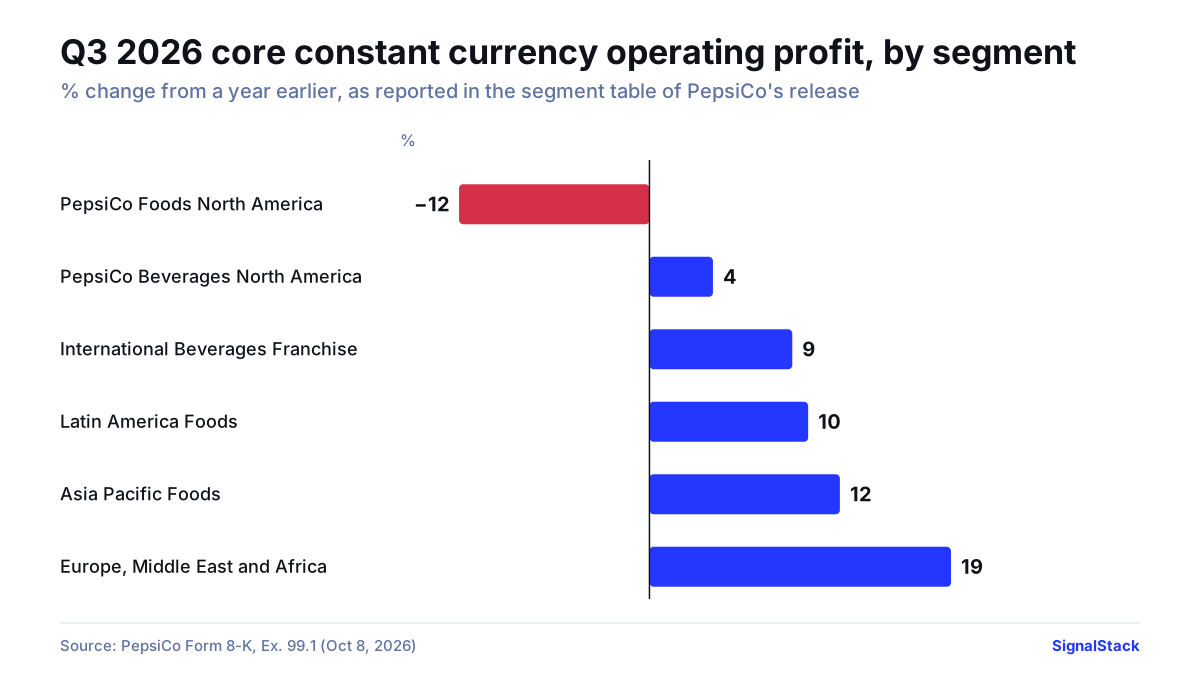
- The split is regional. In North America foods, core constant currency operating profit fell 12%, while every international segment grew organic revenue by 6% to 9%. Third-quarter core profit also included $178 million of tariff refunds; the 10-Q says PepsiCo has received substantially all of the refunds it claimed.
- After cutting snack prices this year, PepsiCo plans to raise some again. It lowered suggested U.S. prices on snacks such as Lay’s and Doritos by up to nearly 15% in February; in late September a company spokesperson told Reuters that prices on some chip brands will go up by a low- to mid-single-digit percentage, still below the pre-cut level.
What happened
PepsiCo filed its earnings release as Exhibit 99.1 to a Form 8-K on Oct. 8, 2026, and posted prepared management remarks before a question-and-answer call that morning. The quarter covers the 12 weeks ended Sept. 5, 2026.
Third-quarter net revenue was $25,274 million, up from $23,937 million a year earlier. Organic revenue, which strips out currency, acquisitions and divestitures, rose 3.1%, which the prepared remarks call the highest rate since the fourth quarter of 2023. Operating profit rose 19% to $4,260 million. Core operating profit rose 3% to $4,277 million, and core operating margin narrowed by 35 basis points to 16.9%.
Analysts surveyed by LSEG had expected adjusted EPS of $2.29 and revenue of $24.96 billion, according to CNBC.
In the release, Chairman and CEO Ramon Laguarta said more “structural cost reduction actions” are being identified and will be put in place in the coming months “to help fund investments” aimed at faster organic growth and to “mitigate the impacts of rising input cost inflation.” For the company’s recent quarters and filing links, see our PepsiCo earnings page.
What the 8-K and the prepared remarks show
1. The guidance table. PepsiCo gives guidance only on a non-GAAP basis, and the release prints the current and previous fiscal 2026 targets side by side:
| Fiscal 2026 target (non-GAAP) | Before Oct. 8 | Now |
|---|---|---|
| Organic revenue growth | between 2% and 4% | about 3% |
| Net revenue growth | between 4% and 6% | about 6% |
| EPS growth, core and at constant currency | the bottom of a 4%–6% range | 1% to 2% |
| EPS growth, core (including currency) | the bottom of a 5%–7% range | 2.5% to 3.5% |
| Core tax rate | about 22% | about 21% |
| Planned cash returns to shareholders | $8.9 billion | unchanged |
The net revenue outlook went up and the profit outlook went down. Organic growth of about 3% sits at the middle of the old range; the CFO tied the higher net revenue outlook to “a more favorable impact from foreign exchange translation and acquisitions.” In the prepared remarks, CFO Steve Schmitt wrote that the company is “moderating” its core constant currency EPS outlook, which “reflects the margin pressures we expect in the North America business.”
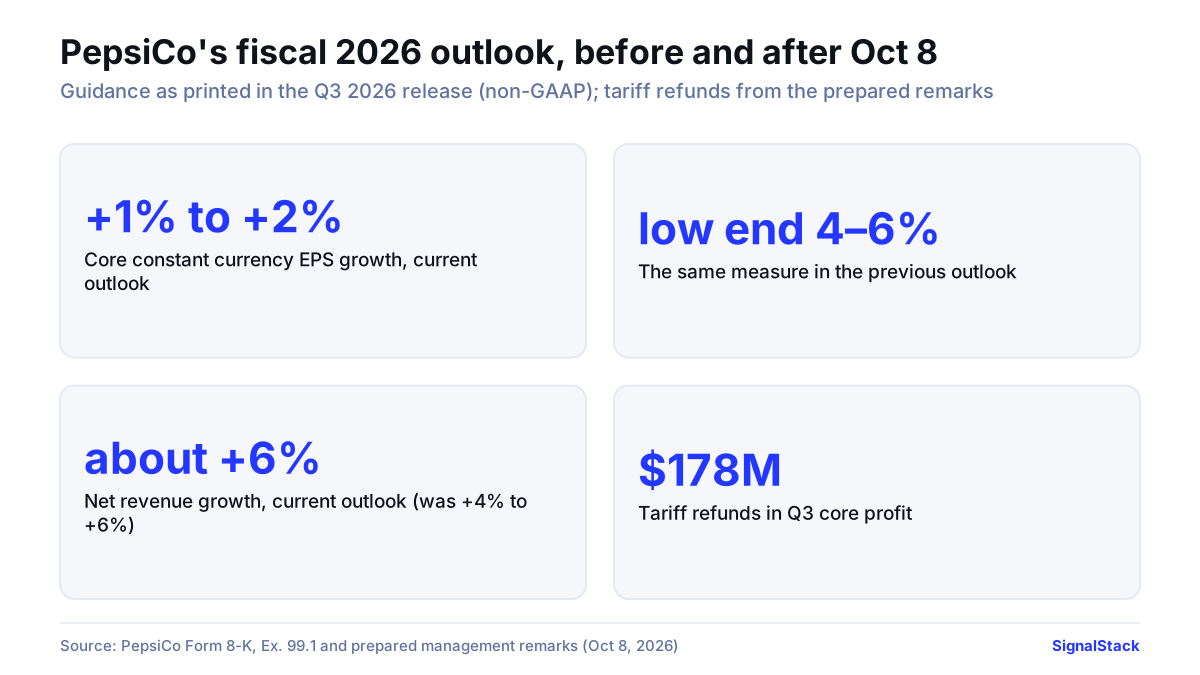
2. Two ways to count profit. Reported EPS rose 17% in the quarter; core EPS rose 2%, and core EPS at constant currency 1.5%. The release says reported operating profit was lifted mainly by a favorable net impact of acquisition- and divestiture-related charges and credits, and by mark-to-market gains on commodity derivatives. Both are excluded from “core.” Year to date, EPS was up 47% and core EPS up 5%; there, the release says reported profit mainly reflects prior-year impairment charges for the Rockstar and Be & Cheery brands, plus a favorable net impact of acquisition- and divestiture-related items. Our earnings season guide explains how companies build these adjusted figures.
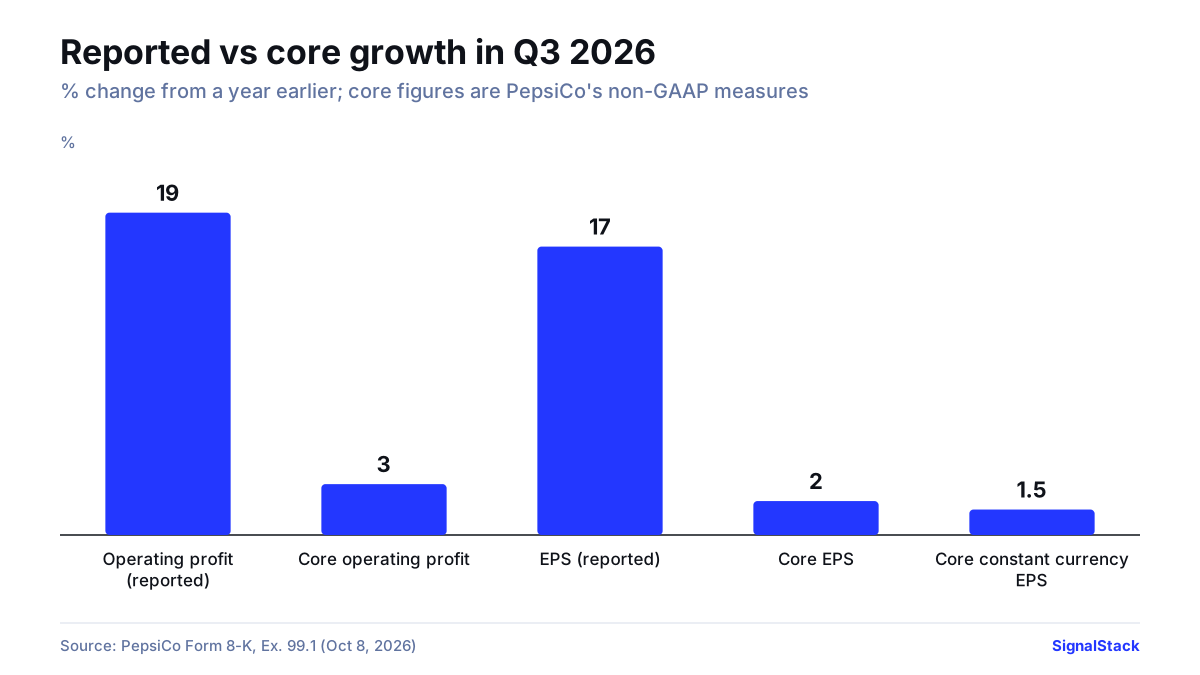
3. Tariff refunds. The release says core operating profit growth included “a 4-percentage-point favorable impact of tariff refunds.” The prepared remarks put the refunds at $178 million in the third quarter and say they partly offset margin pressure in North America beverages. The 10-Q explains the source: after the U.S. Supreme Court ruled that many tariffs imposed under the International Emergency Economic Powers Act were invalid, PepsiCo filed recovery claims with U.S. Customs and Border Protection and “received substantially all of the refunds” it sought. On the call, as transcribed by Investing.com, Schmitt said that once this benefit goes away, North America beverages will face “more underlying pressure” than it did in the third quarter.
4. North America versus everyone else. The segment table in the release shows where the pressure sits:
| Segment (Q3 2026) | Organic revenue | Core constant currency operating profit |
|---|---|---|
| PepsiCo Foods North America | about 0% (declined slightly) | −12% |
| PepsiCo Beverages North America | about 0% (declined slightly) | +4% |
| International Beverages Franchise | +7% | +9% |
| Europe, Middle East and Africa | +9% | +19% |
| Latin America Foods | +6% | +10% |
| Asia Pacific Foods | +9% | +12% |
Beverage volume in North America fell 2%. The prepared remarks say North America foods’ core operating margin narrowed by 280 basis points, reflecting affordability investments, a prior-year asset sale gain and higher advertising spending. Year to date, international businesses made up 41% of PepsiCo’s net revenue and 45% of its core segment operating profit. In the remarks, Schmitt wrote that improving North America’s growth and core operating margin “is taking more time than we planned.”
Background
From price cuts to planned increases. On Feb. 3, 2026, PepsiCo announced lower suggested retail prices, cut by up to nearly 15%, on many of its U.S. snacks, naming Lay’s, Doritos, Cheetos and Tostitos; it noted that stores set the final shelf price. According to USA TODAY, which published examples of the price reductions provided to it, PepsiCo was lowering the recommended everyday price of an 8-ounce bag of Lay’s Classic from $4.99 to $4.29, and that of an 8.5-ounce bag of Doritos from $6.29 to $5.49.
| Date | What PepsiCo said | Source |
|---|---|---|
| Feb. 3, 2026 | Suggested prices on many U.S. snacks cut by up to nearly 15% | PepsiCo press release |
| Late Sept. 2026 | Some chip brands to rise by a low- to mid-single-digit percentage; new prices still below pre-cut levels | PepsiCo spokesperson, per Reuters |
| Oct. 8, 2026 | Q3 (12 weeks to Sept. 5) North America convenient foods: net revenue trends improved sequentially on savory snacks volume growth and an improved volume market share; lower effective net pricing was the offset | Form 8-K, Ex. 99.1 |
In late September, after the quarter closed on Sept. 5 but before the results, a PepsiCo spokesperson told Reuters that a new round of increases, in line with inflation, would lift prices on some chip brands by a low- to mid-single-digit percentage, and that the new prices would remain below where they stood before this year’s cuts. According to Reuters, Bloomberg, which first reported the plan citing people familiar with the matter, said higher prices are expected by the end of 2026 or in early 2027 on items including Doritos and Ruffles chips in grocery-store-sized bags, plus some sodas.
For the third quarter, the release says North America convenient foods net revenue trends “improved sequentially,” reflecting savory snacks volume growth and a gain in volume market share, with lower effective net pricing as the offset. On the call, Laguarta said the North America snacks business went from “low single digit negative volume growth” last year to “low single digit positive volume growth” this year, and said of “the volume bet that we made in snacks North America, especially with the price reset,” that “we are happy with the turnaround in the volume performance.” He added that “it is the price, but it is also some of the innovation, some of the new platforms.” The picture is not uniform. The release’s Q3 summary table shows PepsiCo Foods North America volume flat and North America beverage volume down 2%, and Reuters wrote in September that “volumes in PepsiCo’s North America business have been negative through this year, despite the price cuts,” without separating snacks from beverages. The release’s year-to-date summary table shows PepsiCo Foods North America volume up 1% and North America beverage volume down 3%, and the release says year-to-date organic volume and volume market share increased in North America convenient foods.
Laguarta also said on the call that the company is “not competing well in soft drinks.” According to Reuters, the turnaround effort started after activist investor Elliott Investment Management took a stake of roughly $4 billion a year ago, and PepsiCo said in December that it was targeting a 100-basis-point margin improvement over three years.
The prepared remarks say international organic revenue rose 8%, the fastest since the first quarter of 2024.
For other recent results, see Nike’s first-quarter filing and the companies reporting next on our earnings this week page.
What could go right
- The company expects organic revenue of approximately +3% for 2026. On the call, asked about organic sales, Laguarta said the company is “expecting sequential improvement” going into the fourth quarter “and especially” into next year.
- The structural cost cuts, such as reductions in corporate costs and other spending not tied to growth, are meant, per the remarks, “to help support these investment priorities” in innovation and advertising, and per the release to “mitigate the impacts of rising input cost inflation.”
- International, already 45% of core segment operating profit year to date, kept growing organic revenue in every segment.
What could go wrong
- Input costs: Schmitt said on the call that PepsiCo’s hedges, typically 6 to 12 months, are rolling off and “commodities continue to ramp up.”
- Schmitt said on the call that the third-quarter tariff benefit in North America beverages will go away, and “once that goes away, that puts some more underlying pressure” on that business.
- The company expects North America’s core operating margin “to remain under pressure in the fourth quarter,” per the prepared remarks. PepsiCo said it will give 2027 expectations in February, with its fourth-quarter results.
FAQ
Q Did PepsiCo cut its 2026 guidance?
A Yes, for profit. On Oct. 8, 2026, PepsiCo said it now expects core EPS at constant currency to grow 1% to 2% in fiscal 2026; its earlier target was the bottom of a 4%–6% range. It raised its net revenue growth outlook to about 6%.
Q What were PepsiCo's Q3 2026 earnings per share?
A Reported EPS was $2.23, up 17% from $1.90. Core EPS, the company's non-GAAP measure, was $2.34, up 2% from $2.29.
Q Why is PepsiCo's reported EPS growth so much higher than core EPS growth?
A The release says reported operating profit was lifted mainly by a favorable net impact of acquisition- and divestiture-related charges and credits and by mark-to-market gains on commodity derivatives. Core results exclude those items.
Q How much did tariff refunds help PepsiCo in Q3 2026?
A PepsiCo's prepared remarks put tariff refunds at $178 million in the third quarter, and the release says they added 4 percentage points to core operating profit growth, which was 3%.
Q Is PepsiCo raising chip prices again?
A PepsiCo plans to, for some chip brands. In late September 2026 a PepsiCo spokesperson told Reuters the increases would be a low- to mid-single-digit percentage and that new prices would stay below their level before the February cuts, which PepsiCo's Feb. 3 release put at up to nearly 15%. Bloomberg, as cited by Reuters, said the increases are expected by the end of 2026 or in early 2027.
Q When is PepsiCo's next earnings report?
A PepsiCo did not give a date in its Oct. 8 release or prepared remarks. On the Oct. 8 call, the CFO said the company will give more detail on 2027 expectations in February, when it reports the fourth quarter.
Companies in this report: PepsiCo
Sources
- PepsiCo Form 8-K, Item 2.02 (Oct 8, 2026)
- Exhibit 99.1: PepsiCo Reports Third-Quarter 2026 Results (Oct 8, 2026)
- Third Quarter 2026 Earnings Prepared Management Remarks (Oct 8, 2026)
- PepsiCo Form 10-Q for the 12 and 36 weeks ended Sept. 5, 2026
- PepsiCo cuts earnings forecast as North American turnaround takes longer than expected
- PepsiCo to cut costs as weak North America business hurts annual core profit forecast
- Earnings call transcript: PepsiCo Q3 2026
- PepsiCo makes iconic snacks more affordable ahead of Super Bowl (Feb 3, 2026)
- PepsiCo to raise some chip prices (Sept 2026)
- Cheaper Doritos? PepsiCo to drop prices on these snacks. How much (Feb 4, 2026)
- PepsiCo Cuts Profit Forecast, Deepens Cost-Cutting Plan