

AI-generated illustration
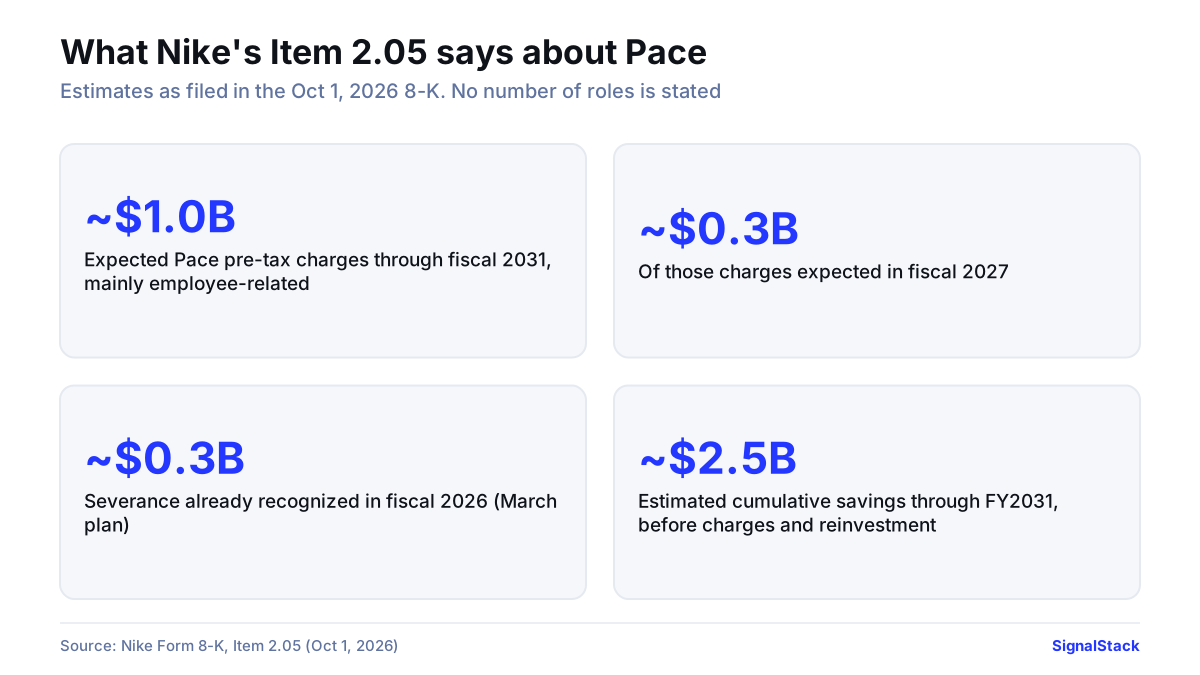
Nike reported revenue of $11.21 billion for the first quarter of fiscal 2027, the three months ended August 31, 2026, in a Form 8-K filed on October 1. GAAP net income was $712 million, or $0.48 per diluted share. The same 8-K includes an Item 2.05 disclosure for a restructuring program Nike calls Pace. It expects pre-tax charges of about $1.0 billion through fiscal 2031, on top of about $0.3 billion already booked in fiscal 2026, and estimates cumulative savings of about $2.5 billion. It does not give a job count.
TL;DR
- Pace, as filed under Item 2.05: about $1.0 billion of expected pre-tax charges, mainly severance and other employee-related costs. Nike expects roughly $0.3 billion in fiscal 2027 and the rest through fiscal 2031. Nike estimates most of it will be paid in cash.
- Savings and scope: about $2.5 billion of estimated cumulative savings through fiscal 2031, a figure the 8-K says is stated before the charges and before any reinvestment. No number of roles or share of the workforce is given. Nike had about 73,000 employees on May 31, 2026, per its 10-K.
- The quarter: revenue fell 4% from $11.72 billion a year earlier (5% currency-neutral). Gross margin was 42.8% against 42.2%. Inventories were $7.85 billion, down 3% from a year earlier but up from $7.50 billion on May 31. Nike expects fiscal 2027 revenue to “decline high-single digits.”
What happened
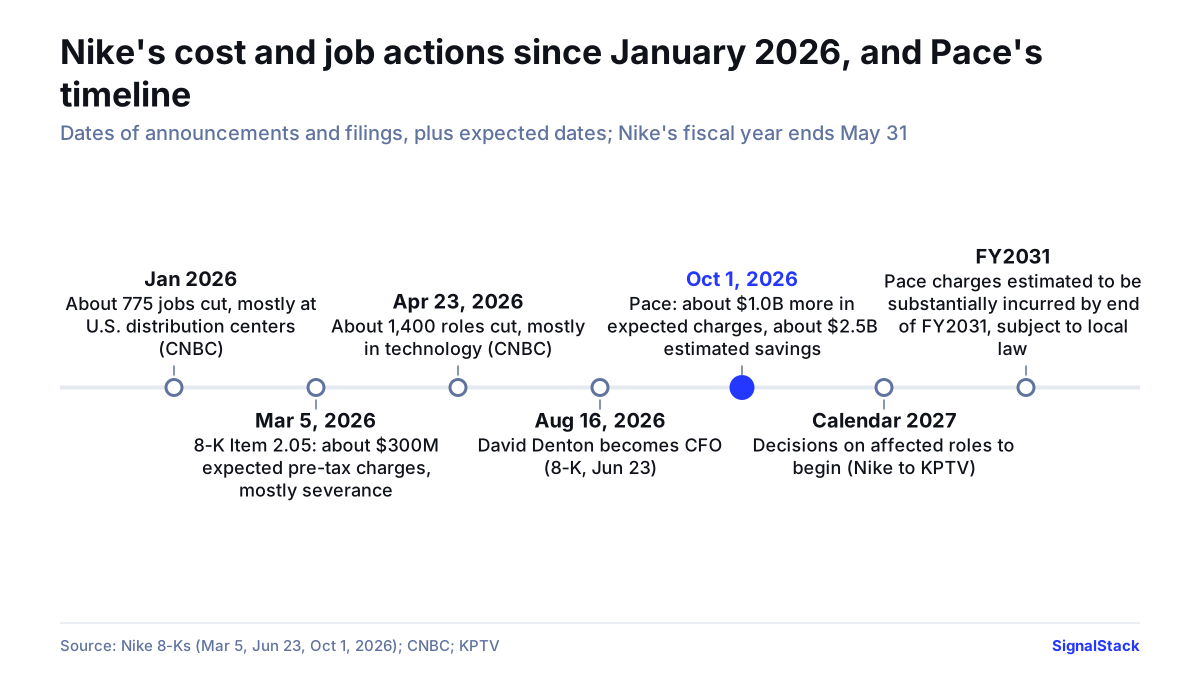
Nike released results after the U.S. market close on October 1. The 8-K furnishes the press release as Exhibit 99.1 under Item 2.02 and adds Item 2.05, which covers exit or disposal costs. It is signed by David Denton, who became chief financial officer on August 16 in place of Matthew Friend, according to a June 8-K.
CNBC, citing LSEG consensus, said analysts had expected $11.32 billion in revenue and 43 cents a share. Reuters cited an LSEG average that projected about a 2% decline in fiscal 2027 revenue. Those are analysts’ figures, not Nike’s.
Reuters reported that Nike plans to move from four geographies to three; CNBC listed the three: the Americas; Asia Pacific and Greater China; and EMEA. KPTV in Portland reported that the India campus will be in Bengaluru and that the Asia Pacific and Greater China leadership team will work out of Singapore. In a Nike statement quoted by KPTV, the company said it does not yet know the number or location of affected roles, that “any reports about specific figures are speculative,” and that decisions will begin in calendar 2027.
What the 8-K’s Item 2.05 actually says
When a company commits to an exit or disposal plan that will bring material charges, Item 2.05 asks for the estimated costs by major type and the part expected to be paid in cash. Here is what Nike’s filing states, and what it leaves out.
| Term | What the 8-K says |
|---|---|
| Program | Pace, a multi-year enterprise program that “includes and builds upon” the March 2026 cost realignment plan |
| Stated purpose | Raise productivity, improve organizational effectiveness and lower the cost structure |
| Initiatives | Further supply chain optimization; a new campus in India; an operating model realigned into three geographies; more streamlining of the organization |
| Approval | Board of Directors approved steps to implement it |
| Pre-tax charges | Expected: about $1.0 billion, in addition to about $0.3 billion of severance recognized in fiscal 2026 under the March plan |
| Type of cost | Mainly employee severance and other employee-related costs |
| Timing | Expected: about $0.3 billion in fiscal 2027; the remainder through fiscal 2031 |
| Cash or non-cash | Majority estimated to result in future cash expenditures; no split given |
| Savings | Estimated: about $2.5 billion cumulative through fiscal 2031, before charges and any reinvestment |
| Jobs | Not stated |
Source: Nike Form 8-K, Item 2.05 (Oct 1, 2026). Nike’s fiscal year ends May 31, so fiscal 2031 ends on May 31, 2031.
Four points follow from the filed numbers. First, charges across the March plan and Pace total about $1.3 billion (our arithmetic). Second, the 8-K states its roughly $2.5 billion savings estimate before charges and reinvestment, and the program includes the March plan; set against the ~$1.0 billion of expected new charges, the difference between the two estimates is about $1.5 billion, or about $1.2 billion against the full ~$1.3 billion (our arithmetic). Nike does not present a net figure. Third, Nike’s fiscal 2027 adjusted EPS outlook excludes about $0.15 a share of Pace restructuring costs. Fourth, most of the savings are expected later: Reuters reported that most savings are expected in fiscal 2029 and 2030, and MarketBeat’s call summary says Nike expects the three-geography structure to take effect in fiscal 2028.
The 8-K warns that actual savings, charges and cash spending “may differ, possibly materially,” and that local law requirements in various countries can affect timing.
The March plan it builds on
Nike filed a separate Item 2.05 on March 5, 2026. It said management had approved organizational changes on February 27 that, with earlier actions, were expected to result in pre-tax charges of about $300 million for the nine months to February 28, mostly severance. That filing also said Nike might take further actions with further charges. The fiscal 2026 10-K later put total severance for the year at $385 million: $231 million in operating overhead and $154 million in cost of sales. Of that, $142 million had been paid in cash by May 31, and $243 million sat in accrued liabilities.
Five quarters from Nike’s own releases
All figures below come from Nike’s Exhibit 99.1 releases. Net income and EPS are GAAP.
| Q1 FY26 | Q2 FY26 | Q3 FY26 | Q4 FY26 | Q1 FY27 | |
|---|---|---|---|---|---|
| Quarter ended | Aug 31, 2025 | Nov 30, 2025 | Feb 28, 2026 | May 31, 2026 | Aug 31, 2026 |
| Revenue | $11.72B | $12.43B | $11.28B | $10.97B | $11.21B |
| Change vs year earlier | +1% | +1% | 0% | -1% | -4% |
| Gross margin | 42.2% | 40.6% | 40.2% | 49.2%* | 42.8% |
| Net income | $727M | $792M | $520M | $1,069M* | $712M |
| Diluted EPS | $0.49 | $0.53 | $0.35 | $0.72* | $0.48 |
| Greater China revenue | $1.51B | $1.42B | $1.62B | $1.30B | $1.18B |
| Converse revenue | $366M | $300M | $264M | $244M | $263M |
| Inventories | $8.11B | $7.73B | $7.49B | $7.50B | $7.85B |
*Q4 FY26 includes a $986 million benefit in cost of sales for the expected recovery of IEEPA tariffs, after the U.S. Supreme Court ruled those tariffs unauthorized. Nike said it added about 900 basis points to gross margin and $0.52 to EPS. Sources: Nike Exhibit 99.1 releases (Sept 30, 2025; Dec 18, 2025; Mar 31, 2026; Jun 30, 2026; Oct 1, 2026) and the fiscal 2026 10-K.
What the table shows:
- Gross margin. 42.8% is 60 basis points above a year earlier, which Nike attributes mainly to lower warehousing and logistics costs. It is below Q4’s 49.2%, but without the tariff benefit Q4 would have been about 40.2% (our arithmetic: $5,393 million gross profit minus $986 million, over $10,972 million revenue).
- Inventories rose $345 million, or 4.6%, from May 31 (our arithmetic). Year over year they fell 3%, which Nike attributes to product mix. MarketBeat’s call summary says Nike is “working with wholesale partners to reduce excess inventory of certain aged footwear products.”
- Costs and profit. Demand creation expense rose 5% to $1.25 billion; operating overhead fell 6% to $2.66 billion. Pre-tax income was flat at $921 million, and net income fell 2% as the tax rate rose to 22.7% from 21.1%.
Where the revenue decline came from
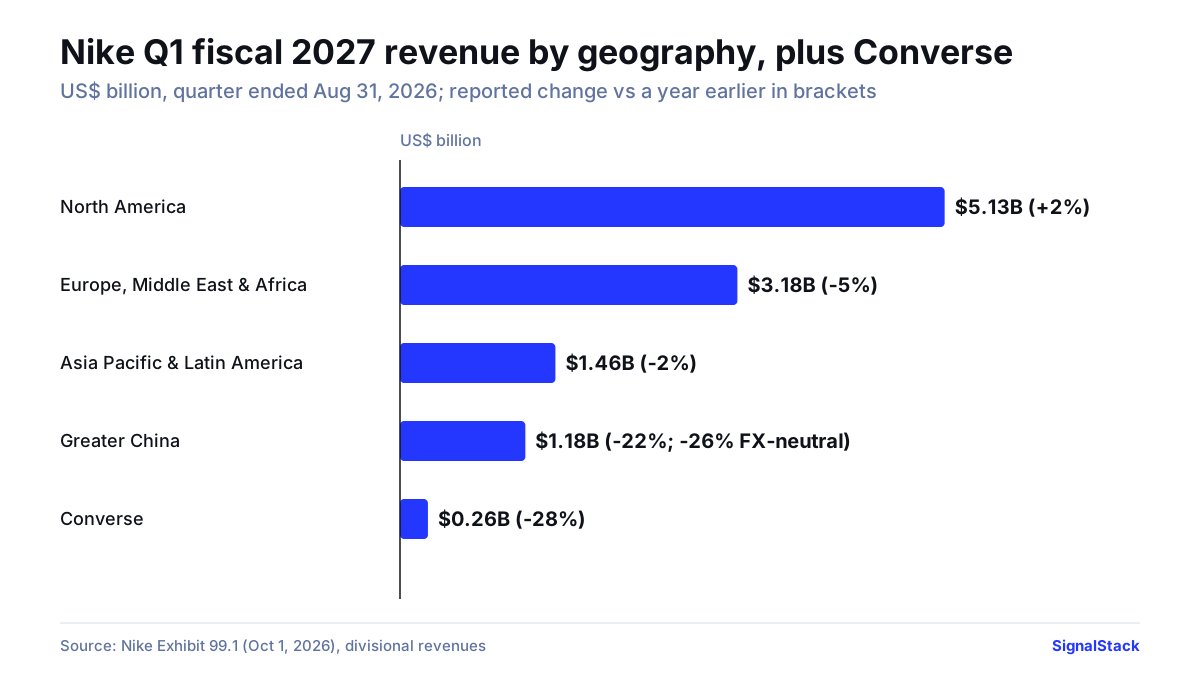
| Q1 FY27 | Revenue | Reported change | Currency-neutral |
|---|---|---|---|
| North America | $5.13B | +2% | +2% |
| Europe, Middle East & Africa | $3.18B | -5% | -5% |
| Asia Pacific & Latin America | $1.46B | -2% | 0% |
| Greater China | $1.18B | -22% | -26% |
| Converse | $263M | -28% | -28% |
Source: Nike Exhibit 99.1 (Oct 1, 2026), divisional revenues.
CNBC and MarketBeat cite a 26% drop in Greater China without giving the basis; Reuters labels it constant-currency. That is the currency-neutral change, a non-GAAP measure; the reported change in the release was 22%. By channel, North American wholesale sales rose 9% to $2.98 billion while Nike Direct there fell 6%. Across the Nike Brand, Direct fell 8% to $4.14 billion, with digital down 13% and Nike-owned stores down 5%. Nike Brand footwear fell 6% to $6.95 billion; apparel rose 2% to $3.38 billion. Greater China EBIT fell 34% to $248 million.
CNBC and MarketBeat reported that Sportswear, which CEO Elliott Hill said was just under half of revenue, fell at a low-double-digit rate. MarketBeat reported Jordan Brand fell at a mid-teens rate, and Hill said the performance business grew at a high-single-digit rate, according to MarketBeat.
Background: Pace is the latest of several cost rounds
CNBC reported layoffs of less than 1% of corporate staff in summer 2025, then 775 jobs in January 2026, mostly at U.S. distribution centers. In April it reported about 1,400 roles, mostly in technology, which CNBC reported was less than 2% of Nike’s total global headcount. CNBC calls Pace the third round of layoffs announced this year. The filings do not tie these headcount figures to specific charges.
Reuters noted that Nike withdrew its annual forecasts in October 2024; this release includes a fiscal 2027 outlook. Hill said Nike would update its targets during the year, beginning in November, Reuters reported. For another quarter read straight from the filings, see our report on Micron’s fiscal Q4 8-K. For the rate backdrop, see the Fed’s September 2026 decision. More: Global Markets & Policy and the earnings tracker.
Outlook, in Nike’s words
The release gives three fiscal 2027 items:
- Revenues “are expected to decline high-single digits in fiscal 2027.”
- An effective tax rate “in the mid-20 percent range.”
- Adjusted diluted EPS of $1.15 to $1.35, which excludes about $0.15 of Pace restructuring expenses. Nike defines adjusted EPS as diluted EPS excluding restructuring and severance charges, a non-GAAP measure.
For reference, fiscal 2026 GAAP diluted EPS was $2.10, which included Q4’s $0.52 tariff-recovery benefit; the 10-K says that benefit largely offset IEEPA tariff costs recognized during the year. According to MarketBeat’s call summary, Nike expects EBIT to decline by a greater percentage than revenue and SG&A to remain below prior-year levels, and that prior-year comparisons put a headwind of about 400 basis points on second-quarter revenue.
What could go right / What could go wrong
What could go right
- The 8-K’s savings estimate of about $2.5 billion, counted before charges and reinvestment, is about 2.5 times the ~$1.0 billion of expected new charges, or about 1.9 times the ~$1.3 billion including the fiscal 2026 March-plan severance (our arithmetic).
- North America grew 2%, gross margin rose 60 basis points and operating overhead fell 6% year over year.
- CFO Dave Denton said the outlook reflects deliberate supply cuts in Sportswear, Jordan and Greater China to improve full-price selling, per MarketBeat’s call summary.
What could go wrong
- The 8-K says savings, charges and cash spending may differ, possibly materially, and that timing is subject to local law requirements. Nike told KPTV it won’t finalize decisions until required consultations with employee representative bodies are complete.
- Greater China fell 26% currency-neutral, and Hill said the China digital cleanup will take “multiple seasons,” according to Reuters.
- Most savings are expected in fiscal 2029 and 2030, according to Reuters, while Nike expects about $0.3 billion of charges to be recognized in fiscal 2027.
- The 8-K gives no headcount. Nike told KPTV it does not yet know the number of roles and that decisions on affected roles begin in calendar 2027.
FAQ
Q What were Nike's Q1 fiscal 2027 results?
A Revenue of $11.21 billion for the quarter ended August 31, 2026, down 4% from $11.72 billion a year earlier. GAAP net income was $712 million, or $0.48 per diluted share, and gross margin was 42.8%.
Q What is Nike's Pace restructuring program?
A A multi-year program announced October 1, 2026, that includes and builds on Nike's March 2026 cost plan. It covers supply chain changes, a new campus in India, a move to three geographies and further streamlining, with about $2.5 billion of expected cumulative savings through fiscal 2031.
Q How much will Nike's restructuring cost?
A Nike estimates about $1.0 billion of pre-tax charges, mostly severance and other employee costs, with about $0.3 billion expected in fiscal 2027 and the rest through fiscal 2031. That is in addition to about $0.3 billion of severance recognized in fiscal 2026.
Q How many jobs is Nike cutting?
A Nike has not said. The 8-K gives no headcount, and Nike told KPTV it does not yet know the number of roles and that decisions will begin in calendar 2027. Nike had about 73,000 employees on May 31, 2026.
Q What is Nike's fiscal 2027 outlook?
A Nike expects revenue to decline high-single digits, an effective tax rate in the mid-20 percent range, and adjusted diluted EPS of $1.15 to $1.35, excluding about $0.15 of Pace restructuring costs.
Sources
- Nike Form 8-K, Items 2.02 and 2.05 (Oct 1, 2026)
- Exhibit 99.1: Nike fiscal 2027 first quarter results press release (Oct 1, 2026)
- Nike Form 8-K, Item 2.05 (Mar 5, 2026)
- Nike Form 10-K for the fiscal year ended May 31, 2026
- Exhibit 99.1: Nike fiscal 2026 fourth quarter and full year results (Jun 30, 2026)
- Exhibit 99.1: Nike fiscal 2026 third quarter results (Mar 31, 2026)
- Exhibit 99.1: Nike fiscal 2026 second quarter results (Dec 18, 2025)
- Exhibit 99.1: Nike fiscal 2026 first quarter results (Sep 30, 2025)
- Nike Form 8-K, Item 5.02: CFO appointment (Jun 23, 2026)
- Nike plans more job cuts, geographic changes after forecasting sharp revenue drop
- Nike (NKE) Q1 2027 earnings
- Nike restructuring to move some Oregon jobs overseas
- Nike cuts 1,400 roles in second round of layoffs this year
- Nike to lay off 775 as it consolidates US distribution centers
- NIKE Q1 earnings call highlights