
AI-generated illustration
Accenture reported revenue of $18.68 billion for the fourth quarter of fiscal 2026 and $74.18 billion for the full year ended August 31, 2026, in a Form 8-K filed on October 1. Both came in above the ranges the company had guided to. The release is also notable for what it leaves out. A year ago the same release put a number on generative AI bookings. This one has no AI bookings or AI revenue figure at all, and its risk language now says AI could reduce demand for Accenture’s services.
TL;DR
- The year: revenue of $74.18 billion, up 6% in U.S. dollars and 5% in local currency. New bookings were $84.54 billion. GAAP diluted EPS was $13.56 and adjusted EPS $13.97. Free cash flow was $11.62 billion, and $11.5 billion went back to shareholders.
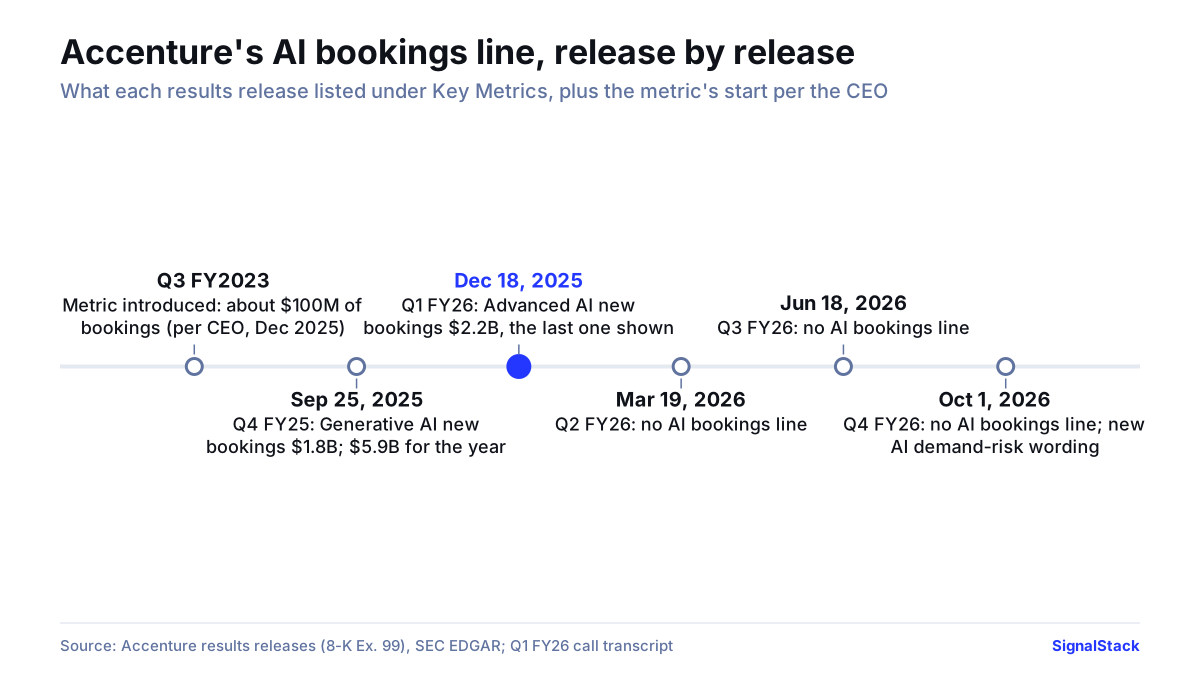
- AI, in the filing: the fiscal 2025 release listed “Generative AI new bookings” of $5.9 billion for the year. The last release with an AI bookings line was Q1 fiscal 2026 ($2.2 billion). CEO Julie Sweet said on that December call it would be the last quarter for “these specific metrics.”
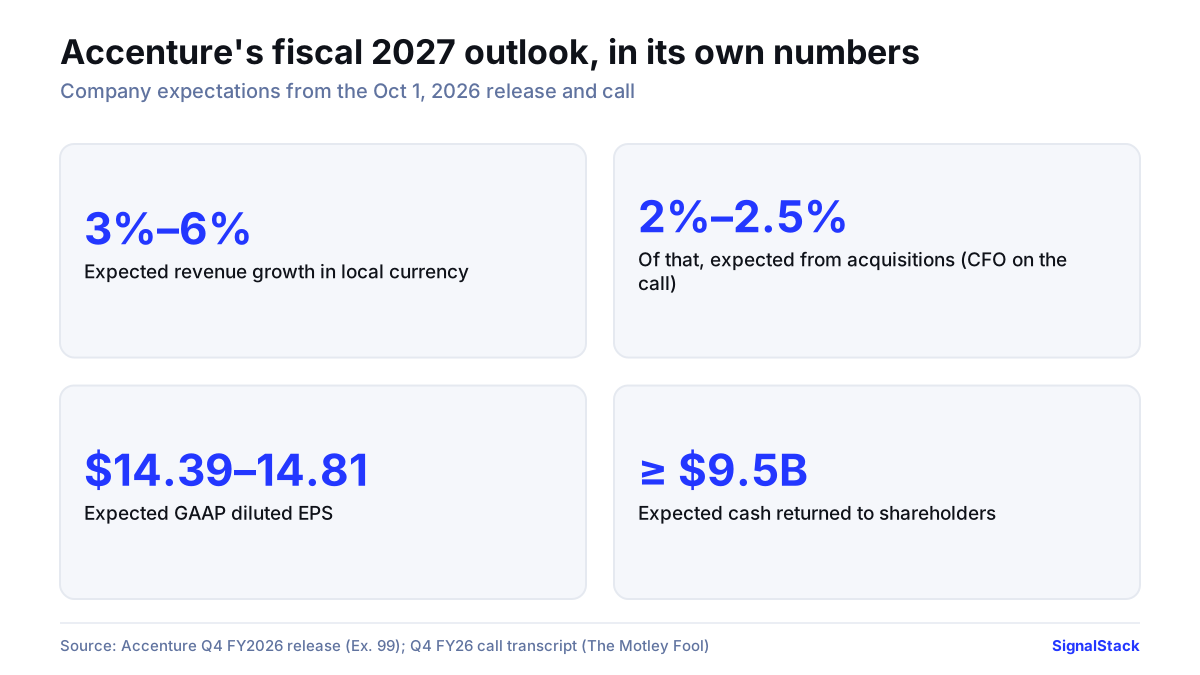
- Fiscal 2027 outlook: Accenture expects revenue growth of 3% to 6% in local currency. On the call, CFO Angie Park said that includes an expected 2% to 2.5% from acquisitions.
What happened
The fourth quarter ran from June through August 2026. Revenue of $18.68 billion rose 6% in U.S. dollars and 7% in local currency, above the guided range of $17.75 billion to $18.40 billion. New bookings were $22.17 billion, a book-to-bill of 1.2. Managed Services booked $12.77 billion and Consulting $9.40 billion.
GAAP operating margin was 15.3% for the quarter, against 11.6% a year earlier. The jump mostly reflects a comparison effect: the fiscal 2025 quarter carried $615 million of “business optimization” costs, primarily severance. Against the prior year’s adjusted margin of 15.1%, the increase was 20 basis points. GAAP diluted EPS was $3.29, up 46%, or 9% above the prior year’s adjusted $3.03.
For the year, all three geographic markets grew in local currency: Americas 4%, EMEA 4% and Asia Pacific 8%. Communications, Media & Technology was the fastest-growing industry group at 10% in local currency, and Health & Public Service the slowest at 2%. On the call, Sweet said the year absorbed an impact of about 1 percentage point from Accenture’s U.S. federal business, “which sunset at the end of Q3.” Park put organic growth at about 3%.
What the release says, and what it no longer says, about AI
On the December 18, 2025 call, Sweet said Accenture was “the first in our industry” to share bookings and revenue from what it calls advanced AI. She defined it as generative, agentic and physical AI, excluding data, classical AI and robotic process automation. The metric started in Q3 fiscal 2023 with about $100 million in bookings. By Q1 fiscal 2026, cumulative bookings had reached about $11.5 billion across 11,000 projects, with $4.8 billion in revenue.
Then she said: “This will be the last quarter in which we share these specific metrics.” Her reason was that “advanced AI is being embedded in some way across nearly everything we do,” so it “has become less meaningful” to isolate.
The filings bear that out. Here is what each release published as an AI bookings line:
| Results release | AI bookings line in the “Key Metrics” list |
|---|---|
| Q4 FY2025 (Sep 25, 2025) | Generative AI new bookings: $1.8B quarter, $5.9B year |
| Q1 FY2026 (Dec 18, 2025) | Advanced AI new bookings: $2.2B |
| Q2 FY2026 (Mar 19, 2026) | None |
| Q3 FY2026 (Jun 18, 2026) | None |
| Q4 FY2026 (Oct 1, 2026) | None |
In place of bookings, the Q4 call offered other AI numbers, all from Sweet:
- Nearly 100 clients started their first advanced AI work with Accenture in the quarter, bringing the fiscal 2026 total to more than 400.
- Bookings with its eight “emerging AI and data partners” more than tripled, and revenue from them more than doubled.
- Accenture now has “nearly 110,000 AI and data professionals,” above a three-year goal of 80,000.
None of these is a dollar figure for AI work.
A new clause in the risk language
The forward-looking statements in each of these releases include a line on AI risk. In the Q3 fiscal 2026 release, it said AI “could harm the company’s business, damage its reputation or give rise to legal or regulatory action.” The Q4 release adds a phrase. AI could now harm the business “including by reducing demand for our services or if AI investments fail to achieve anticipated benefits.” That exact wording does not appear in the Q3 fiscal 2026 or Q4 fiscal 2025 releases.
On the call, Sweet gave the company’s view: “We continue to believe the opportunities related to AI are greater than the impact of AI-related efficiencies in our business.” She also said that in Q4, “we saw lower pricing in many areas of our business.”
The balance sheet changed more than the income statement
Several numbers in the release show a company spending and borrowing more, even as revenue grew at a steady pace:
| Item (from the release) | FY2025 | FY2026 |
|---|---|---|
| Long-term debt (Aug 31) | $5.03B | $10.00B |
| Cash paid for businesses and investments | $1.47B | $4.94B |
| Share repurchases (cash) | $4.62B | $7.52B |
| Cash and equivalents (Aug 31) | $11.48B | $12.83B |
| Days services outstanding | 47 | 50 |
| Headcount (“approximately … people”, each Q4 release) | 779,000 | 814,000 |
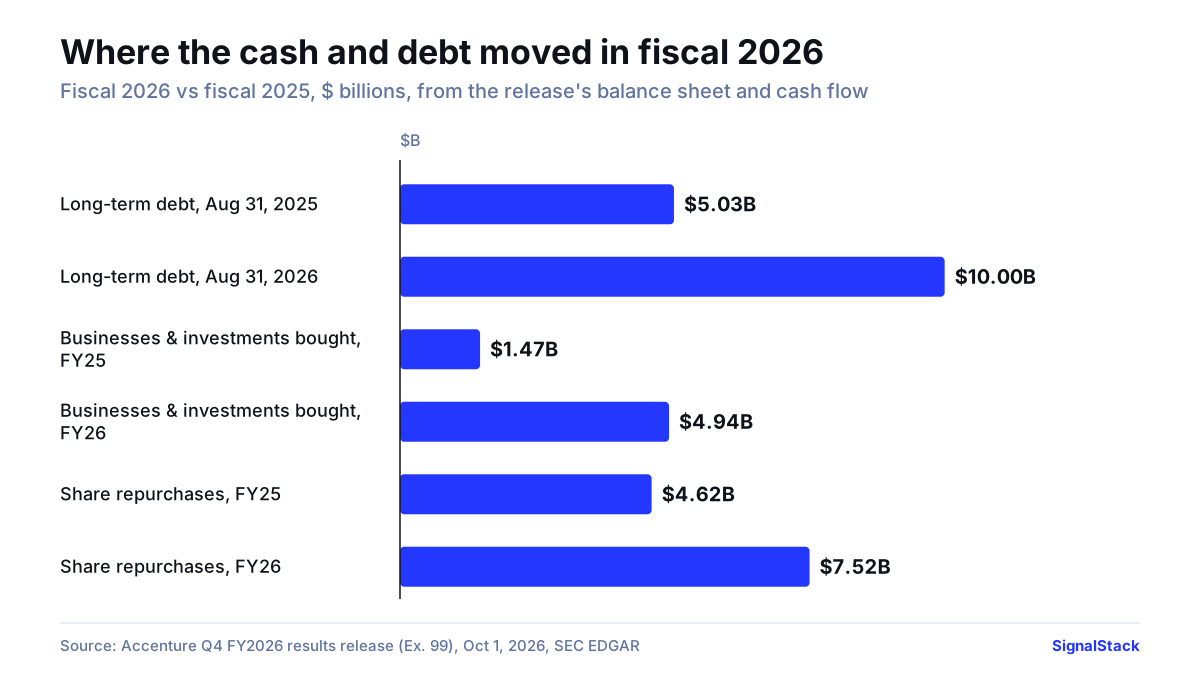
Net debt proceeds of $4.98 billion all came in the fourth quarter. Park said the company “deployed $4.9 billion of capital across 17 acquisitions” in fiscal 2026. Sweet said about $3 billion for operational-technology security deals, including Dragos, slipped into September because of regulatory timing, and those deals have now closed. The Q4 deals she named include Ookla, which she called a business with a “non-FTE commercial model,” meaning, in our words, revenue that isn’t tied to billing full-time-equivalent (FTE) staff hours.
Headcount rose by about 35,000, or about 4.5% (our arithmetic from the release’s rounded figures). Asked about that on the call, Sweet said revenue per person rose in fiscal 2026, an increase she said “you would expect in part due to AI,” and that Accenture expects “to hire in every market” in fiscal 2027, but below this year’s pace.
Background: the guidance path through fiscal 2026
Accenture’s own guidance moved several times during the year:
- In September 2025, it expected fiscal 2026 revenue growth of 2% to 5% in local currency, or 3% to 6% excluding a 1% to 1.5% federal impact.
- In March 2026, it raised that to 3% to 5%.
- In June 2026, it narrowed it to 3% to 4% (4% to 5% excluding an estimated 1% federal impact).
- The final figure was 5%, above the June range. Park said about 3 points of it was organic.
For fiscal 2027, the release expects 3% to 6% growth in local currency, GAAP EPS of $14.39 to $14.81, free cash flow of $11.0 billion to $11.8 billion, and at least $9.5 billion returned to shareholders. Park said the range includes “an inorganic contribution of 2% to 2.5%.” At the top end the company assumes stable to slightly improving discretionary spending, and “at the bottom, we allow for deterioration.” For a primer on reading the filing itself, see our guide to Form 8-K.
What could go right / What could go wrong
What could go right
- Q4 revenue beat the top of the guided range. Bookings of $84.54 billion included 141 quarterly client bookings of $100 million or more, which the release calls a new high. Sweet said that is 12 more than last year.
- Free cash flow of $11.62 billion covered the $11.5 billion returned to shareholders. The fiscal 2027 outlook expects $11.0 billion to $11.8 billion.
- Sweet said Accenture is “experiencing a lot of demand in new areas” and still expects to hire more entry-level staff.
What could go wrong
- Accenture’s own risk language now says AI could reduce demand for its services, and investors no longer get a dollar figure to track AI work separately.
- Sweet said pricing fell in many areas in Q4. Park said the low end of the fiscal 2027 range allows for weaker discretionary spending.
- By Park’s numbers, 2 to 2.5 points of the expected 3% to 6% growth is expected to come from acquisitions, and long-term debt nearly doubled, to about $10 billion, in fiscal 2026.
For another company’s results read straight from the filing, see our Nike Q1 fiscal 2027 report.
FAQ
Q What were Accenture's Q4 fiscal 2026 results?
A Revenue was $18.68 billion for the quarter ended August 31, 2026, up 6% in U.S. dollars and 7% in local currency, above the guided range. GAAP diluted EPS was $3.29 and new bookings were $22.17 billion.
Q Does Accenture still report AI bookings?
A No. The last results release with an AI bookings line was Q1 fiscal 2026 (December 2025), at $2.2 billion of advanced AI bookings. CEO Julie Sweet said then that it would be the last quarter for those specific metrics.
Q What does Accenture say about AI risk?
A Its October 1, 2026 release says AI could harm its business "including by reducing demand for our services or if AI investments fail to achieve anticipated benefits." That wording is new compared with the Q3 fiscal 2026 release.
Q How many employees does Accenture have?
A About 814,000, according to the fiscal 2026 fourth-quarter release, up from about 779,000 a year earlier. Sweet said it has nearly 110,000 AI and data professionals.
Q What is Accenture's fiscal 2027 guidance?
A Accenture expects revenue growth of 3% to 6% in local currency, GAAP diluted EPS of $14.39 to $14.81 and at least $9.5 billion returned to shareholders. CFO Angie Park said acquisitions are expected to contribute 2% to 2.5% of that growth.
Sources
- Accenture Form 8-K, Item 2.02 (Oct 1, 2026)
- Exhibit 99: Accenture fourth-quarter and full-year fiscal 2026 results (Oct 1, 2026)
- Exhibit 99: Accenture third-quarter fiscal 2026 results (Jun 18, 2026)
- Exhibit 99: Accenture second-quarter fiscal 2026 results (Mar 19, 2026)
- Exhibit 99: Accenture first-quarter fiscal 2026 results (Dec 18, 2025)
- Exhibit 99: Accenture fourth-quarter and full-year fiscal 2025 results (Sep 25, 2025)
- Accenture (ACN) Q4 2026 earnings call transcript
- Accenture (ACN) Q1 2026 earnings call transcript