
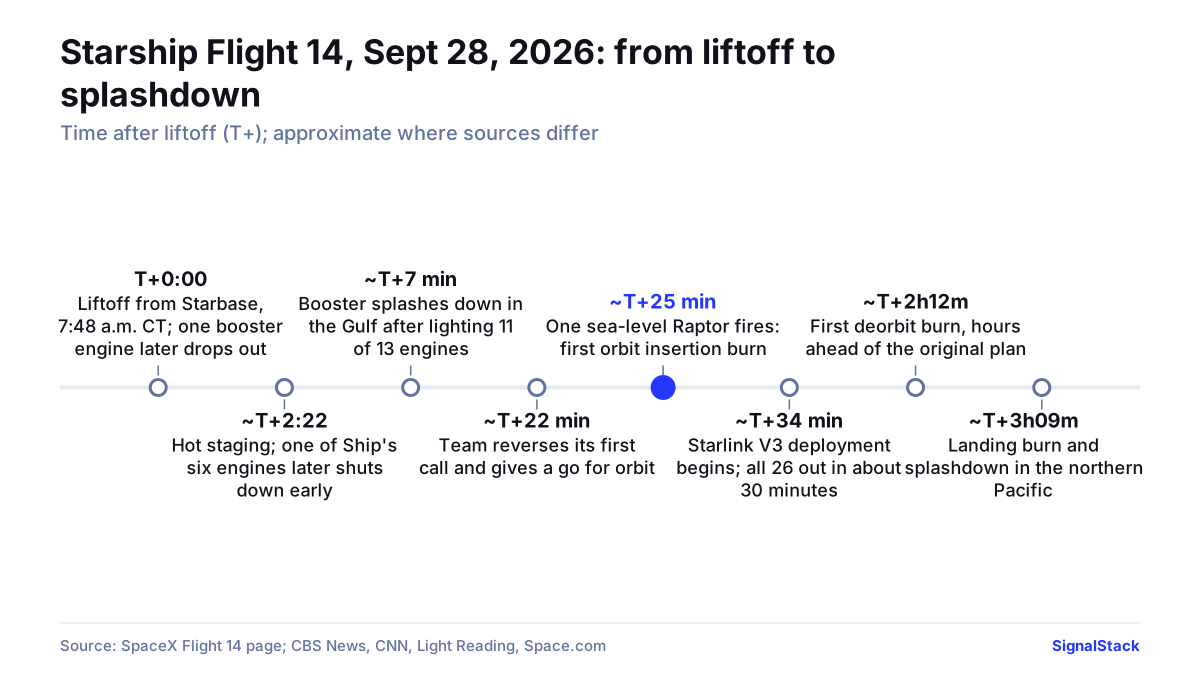
SpaceX’s Starship reached Earth orbit for the first time on September 28, 2026, on its 14th test flight. It released 26 Starlink V3 satellites, then came home after about three hours instead of nearly ten because an engine quit on the way up. Below: a T+ timeline built from SpaceX’s mission page and launch coverage, where the coverage disagrees, and what FAA and NASA documents say comes next.
TL;DR
- Orbit and payload: After a 7:48 a.m. CT liftoff from Starbase, Texas, Ship entered orbit about 25 minutes in and released all 26 Starlink V3 satellites, its first operational payload (SpaceX).
- Cut short: A Raptor vacuum engine shut down early. SpaceX flew on to orbit but landed Ship in the northern Pacific after roughly 3 hours 9 minutes, not six orbits.
- Still ahead: NASA’s lander plan needs ship-to-ship propellant transfer, never yet demonstrated, plus a 2027 docking test with Orion and an uncrewed lunar landing.
What happened on Flight 14
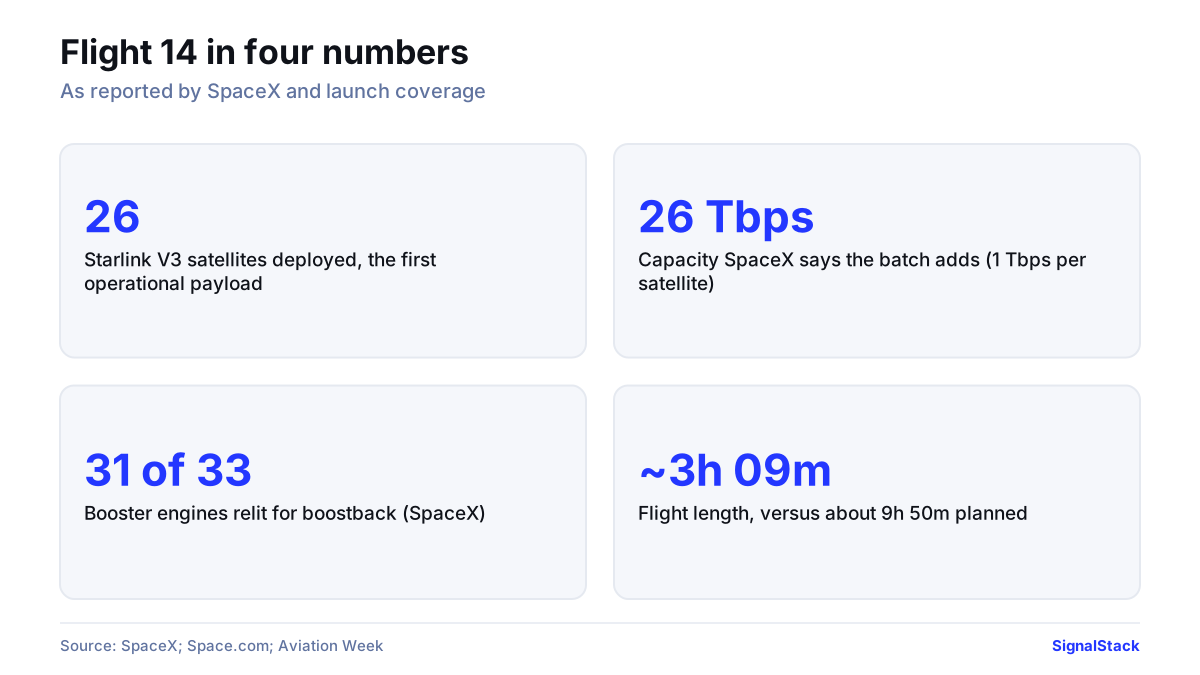
According to SpaceX’s post-flight summary, all 33 Raptor 3 engines on the Super Heavy booster lit at liftoff and one dropped out during the climb. After hot staging, the booster relit 31 of 33 engines for boostback, a burn SpaceX says was “intentionally designed to burn through the remaining liquid oxygen” to test performance limits. It lit 11 of 13 planned engines for the landing burn, splashed down in the Gulf about seven minutes after launch, and then SpaceX fired its flight termination system on purpose as a hardware test.
Ship lit all six engines at staging. One vacuum Raptor stopped early, so the other five burned longer to reach the usual “passively safe” suborbital path, which would have ended in the Indian Ocean. On the webcast, spokesperson Dan Huot first said the team would not commit to orbit; about 22 minutes after launch it reversed that call (Light Reading, NPR). SpaceX says the three sea-level engines needed later were healthy, and one of them fired for the first orbit insertion burn.
From about 34 minutes in, Ship pushed satellites out of its slot-shaped dispenser; all 26 were out within roughly 30 minutes, and SpaceX says it contacted every one. Three carry cameras that photographed Ship’s heat shield (Space.com).
SpaceX then cut the coast short “out of an abundance of caution,” choosing one of two landing zones cleared before launch. Huot put the deorbit burn, Starship’s first, at about T+2 hours 12 minutes (CNN). Ship survived reentry, relit three engines to flip and slow down, and landed on target north of Hawaii at 11:57 a.m. EDT (CBS News) before tipping over and exploding, which CBS called “a relatively normal occurrence” for ocean landings.
Where the reports differ
- Liftoff: SpaceX says 7:48 a.m. CT (12:48 UTC). CBS reported 8:49 a.m. EDT. Space.com’s main story said 8:48 a.m. EDT, matching SpaceX; its live blog gave 8:46 in the header and 8:49 in its liftoff entry.
- Hot staging: SpaceX’s pre-flight timeline planned T+2:22 and CBS put booster cutoff at T+2:20; Space.com’s live blog logged T+2:34.
- Boostback: SpaceX says 31 of 33 engines relit. CBS said a second engine appeared to quit during the burn.
- Orbit height: The plan was about 275 km (171 miles), per Space.com and Aviation Week. CBS reported a 180-mile orbit.
- Duration: Space.com gave 3 hours 8 minutes in its main story and 3 hours 9 minutes in its live blog, against about 9 hours 50 minutes planned (Aviation Week).
What was new compared with earlier flights
- Orbit: all 13 earlier flights were suborbital (Aviation Week).
- A working payload: Flight 13 in July released 20 V3 Starlinks that reentered soon after (Light Reading).
- Deorbit and the Pacific: earlier ships came down in the Indian Ocean (Space.com).
- Booster landing: on Flight 13 only eight of 13 engines fired for the landing burn (CBS); this time 11 of 13 lit.
What SpaceX, the FAA and NASA have said
SpaceX. Before launch, SpaceX said each V3 satellite adds 1 Tbps, or 26 Tbps for this batch, about ten times one Falcon 9 launch of V2 mini satellites (quoted by Space.com). Huot’s webcast comparison was different: about 20 Falcon 9 flights of bandwidth (CNN). Light Reading attributes the 20x figure to a full Starship load of up to 60 V3 satellites. The satellites must finish checkout and raise their orbits before serving customers; Light Reading says SpaceX expects service “within a few weeks” but gave no date.
SpaceX, now listed on Nasdaq as SPCX, says in its latest Form 10-Q that Space segment R&D mainly covers Starship. That spending was $2,006 million in the first half of 2026, up from $1,219 million a year earlier, and every Starship launch so far has been classified as internal rather than a customer launch.
FAA. The FAA said it issued the Flight 14 launch and reentry license authorization on September 26 (statement quoted by Aviation Week). A final environmental assessment on its Starship page covers expanded Central and Southeast Pacific landing areas and a new Northern Pacific contingency area “for an Eastern Range to Starbase trajectory”; nobody has said which area the splashdown fell in. On September 29 the FAA’s statements page had no Flight 14 mishap finding. By comparison, Flight 12 on May 22 triggered a mishap investigation that closed on July 13 with four corrective actions. A separate FAA review covers up to 25 Starship launches a year from Boca Chica.
NASA. Administrator Jared Isaacman praised SpaceX on X for “getting Ship to orbit” (CNN, CBS News). We found no formal NASA release on the flight as of September 29.
Why orbit matters for NASA’s Moon lander
Starship is also NASA’s Human Landing System (HLS). NASA’s Office of Inspector General (OIG) reported on March 10, 2026 that SpaceX’s lander contract, first valued at about $4.3 billion, had grown about 6%. NASA expects to spend $18.3 billion on HLS through fiscal 2030.
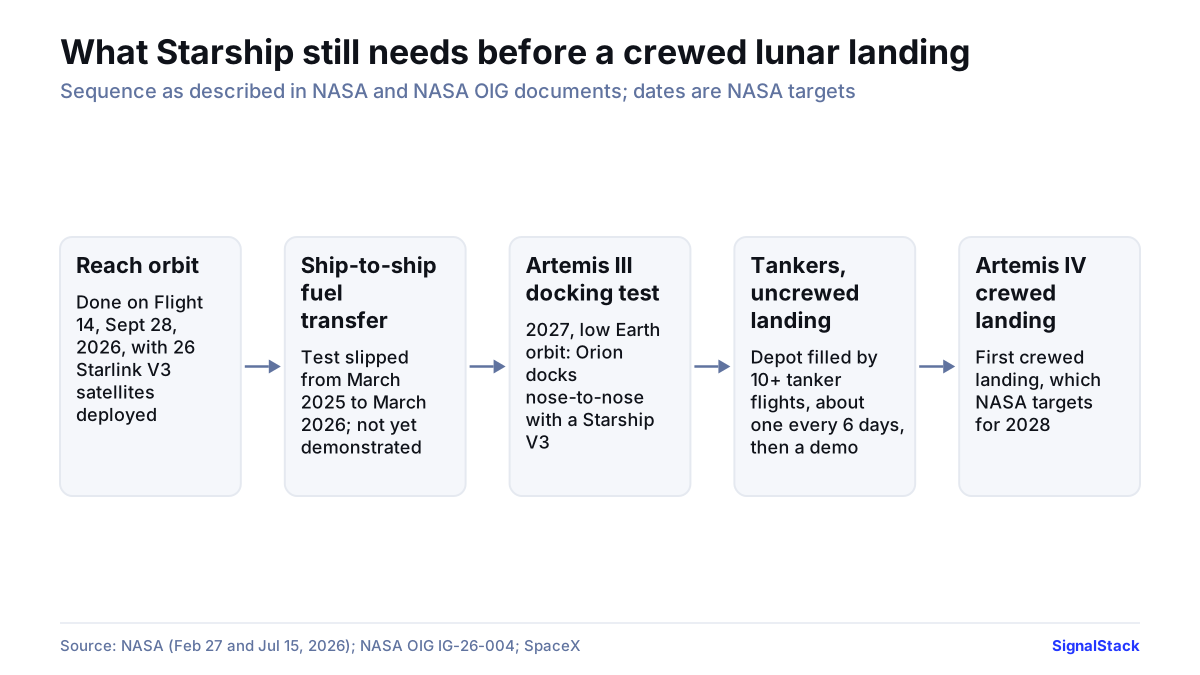
In SpaceX’s plan as the OIG describes it, a depot in low Earth orbit is filled by more than 10 tanker flights, about one every 6 days, starting over 200 days before the crew launches. CBS put the count at up to about 15. The OIG reports that NASA’s HLS Program considers ship-to-ship propellant transfer “one of the most significant technical challenges facing the provider”; the test slipped from March 2025 to March 2026, and Space.com says orbital refueling has still not been shown. The OIG also noted SpaceX had not yet shown the 12- to 24-day pad turnaround the tankers need.
NASA then reshaped the sequence. On February 27, 2026, it made Artemis III a 2027 test in low Earth orbit and moved the first landing to Artemis IV in 2028. Its July 15 update says Orion will dock nose-to-nose with a Starship V3 test article, and astronauts will not enter the Starship. The OIG’s dates reflect the older plan, which still had a June 2027 Artemis III landing.
What comes next
- Flight 15: Before launch, Aviation Week reported SpaceX’s first attempt to return Ship to the launch tower was moved to Flight 15, depending on Flight 14’s results. CNN said after the flight it is unclear whether the engine issues push back those goals, and no date is set.
- Florida: CBS says three Starship pads are under construction there, with a first launch in late 2026 or early 2027.
- Regulators: any FAA post-flight determination.
What could go right / What could go wrong
What could go right
- A ship-to-ship propellant transfer would clear a step NASA’s HLS Program counts among the most significant technical challenges.
- The V3 satellites could finish checkout and add the 26 Tbps SpaceX describes.
- Faster pad turnaround would move launch rates toward the 25 a year the FAA review covers.
What could go wrong
- Engines: both stages lost an engine (SpaceX); CNN said it is unclear whether that delays landing both stages on land.
- Schedule: CBS reported many observers doubt a tested lander by 2028; NASA also funds Blue Origin’s lander.
- Regulators: HLS managers estimate each Starship mishap costs 1 to 3 months of schedule (OIG).
- Cost claims: Elon Musk says Starship will cut launch costs by “orders of magnitude”; a source told CNN there is no sign savings will reach customers.
More coverage: Tech & Security, including our report on OpenAI’s agent incidents.
FAQ
Q Did Starship reach orbit on Flight 14?
A Yes. SpaceX says Ship fired one sea-level Raptor for an orbit insertion burn about 25 minutes after the September 28, 2026 liftoff, the first orbital flight after 13 suborbital tests.
Q Why did Starship Flight 14 end early?
A A Raptor vacuum engine shut down during ascent, so SpaceX limited time in orbit and landed Ship in the northern Pacific about three hours after launch instead of nearly ten.
Q How many Starlink satellites did Starship Flight 14 deploy?
A 26 Starlink V3 satellites. SpaceX says it contacted all of them and that each adds about 1 Tbps of capacity.
Q Is the FAA investigating Starship Flight 14?
A As of September 29, 2026, the FAA had announced no mishap investigation. It licensed the flight on September 26.
Q What does Starship reaching orbit mean for the Artemis Moon landing?
A It is a prerequisite. NASA's plan still needs ship-to-ship propellant transfer, a 2027 Artemis III docking test with Orion in low Earth orbit, and an uncrewed lunar landing before Artemis IV, targeted for 2028.
Sources
- Starship Flight 14: mission page, timeline and post-flight summary (Sep 28, 2026)
- SpaceX Starship Super Heavy Project at the Boca Chica Launch Site (environmental reviews and license modifications)
- FAA General Statements (Starship Flight 12 mishap investigation opened and closed)
- NASA Adds Mission to Artemis Lunar Program, Updates Architecture (Feb 27, 2026)
- How NASA's Artemis III Lander Test Will Pave Way for Moon Landings (Jul 15, 2026)
- NASA's Management of the Human Landing System Contracts, IG-26-004 (Mar 10, 2026)
- SpaceX Form 10-Q for the quarter ended June 30, 2026
- FAA Clears SpaceX For Starship 14 Flight
- SpaceX launches Starship into orbit for 1st time on dramatic Flight 14 test
- SpaceX Starship Flight 14 live updates (syndicated)
- What time will SpaceX launch its 1st orbital Starship test on Flight 14? (Full mission timeline)
- SpaceX launches Starship on giant rocket's first flight to orbit
- Highlights: SpaceX reaches orbit in unprecedented Starship test flight
- SpaceX's Starship launches on first orbital mission from Texas
- Starship reaches orbit, releases 26 high-capacity 'V3' Starlink satellites