
Nvidia’s board has added $150 billion to the company’s stock repurchase program, the chipmaker said on September 28, 2026. With the unused balance of earlier approvals, Nvidia may now buy back up to $235 billion of its common stock, and it expects to use all of it through fiscal 2028, which ends in late January 2028.
TL;DR
- $150 billion added, $235 billion available. Nvidia calls it the largest buyback authorization increase ever. Reuters notes it tops the $110 billion Apple approved in 2024.
- The pace would have to rise. Nvidia’s 10-Q shows $39.8 billion of repurchases in the six months to July 26, 2026. Using $235 billion by the end of fiscal 2028 implies a much faster monthly rate (SignalStack arithmetic, not a forecast).
- The share count falls slowly. Nvidia bought 795 million shares between late January 2024 and July 2026, yet shares outstanding fell by only about 496 million, because employee stock plans keep adding shares.
What happened
The board authorized an extra $150 billion under the existing program, the remaining total rose to $235 billion, and Nvidia expects to finish it by the end of fiscal 2028. CEO Jensen Huang pointed to the company’s “cash generation” and said it lets Nvidia invest in AI while also returning capital to shareholders. On CNBC he said Nvidia wants to return more cash each year as it generates more.
Reuters, citing LSEG data, said the increase alone exceeds the market value of about 84% of S&P 500 companies. It also reported that stock buybacks fell about 50% between July and September 23. The same day, Nvidia separately launched an Open Agent Safety Platform, open software for monitoring and containing AI agents.
What the release and filings say
As of September 29, Nvidia had filed no Form 8-K on the increase (its latest on SEC EDGAR is dated September 3), so the press release is the primary document. Earlier increases later appeared in the next 10-Q or 10-K.
| Item | What Nvidia disclosed | Source |
|---|---|---|
| New increase | $150 billion | Press release, Sep 28, 2026 |
| Total remaining after the increase | $235 billion | Press release |
| Remaining just before the increase | About $85 billion ($235B minus $150B) | SignalStack arithmetic |
| Remaining at July 26, 2026 | $99.3 billion | Q2 fiscal 2027 10-Q |
| Timeline | Through fiscal 2028 | Press release |
| Expiration | Not stated; the four earlier increases had none | 10-Ks, 10-Q |
SignalStack’s own illustration, not a forecast: the fall from $99.3 billion at the end of July to an implied $85 billion points to roughly $14 billion of purchases between July 27 and September 28. The next 10-Q will show the actual figure.
How it compares with earlier approvals
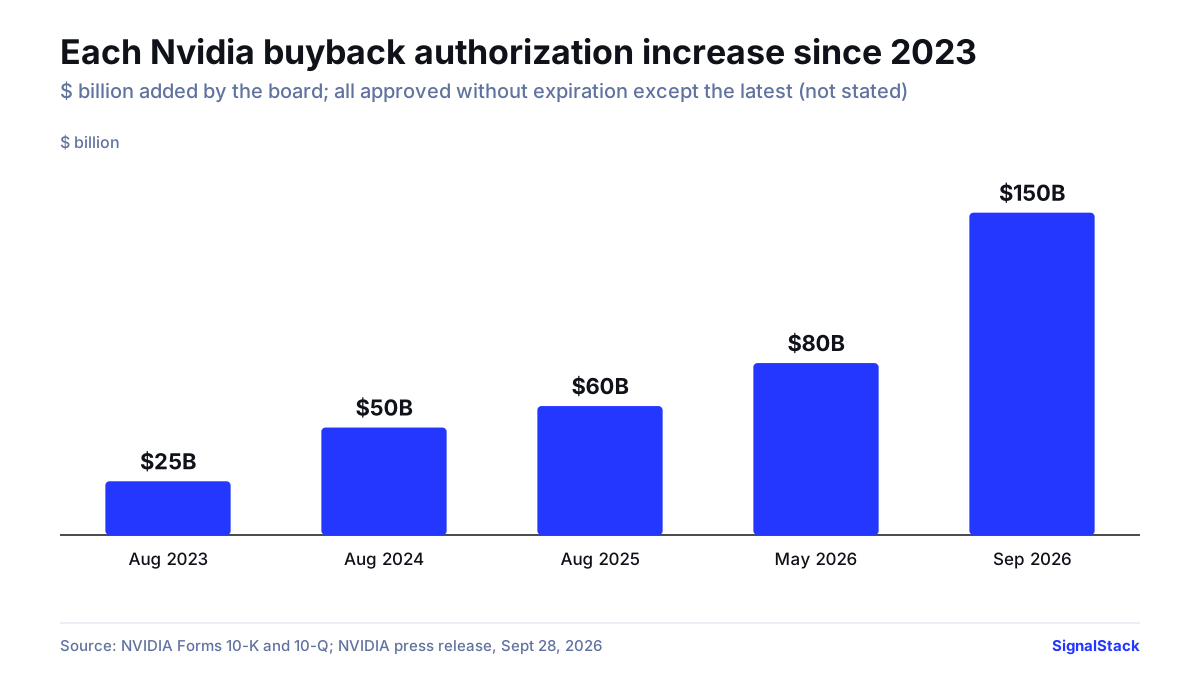
The board added $25.0 billion in August 2023, $50 billion on August 26, 2024, $60.0 billion on August 26, 2025, and $80.0 billion on May 18, 2026. The new $150 billion is nearly twice the May increase and came about four months later.
What Nvidia has actually bought
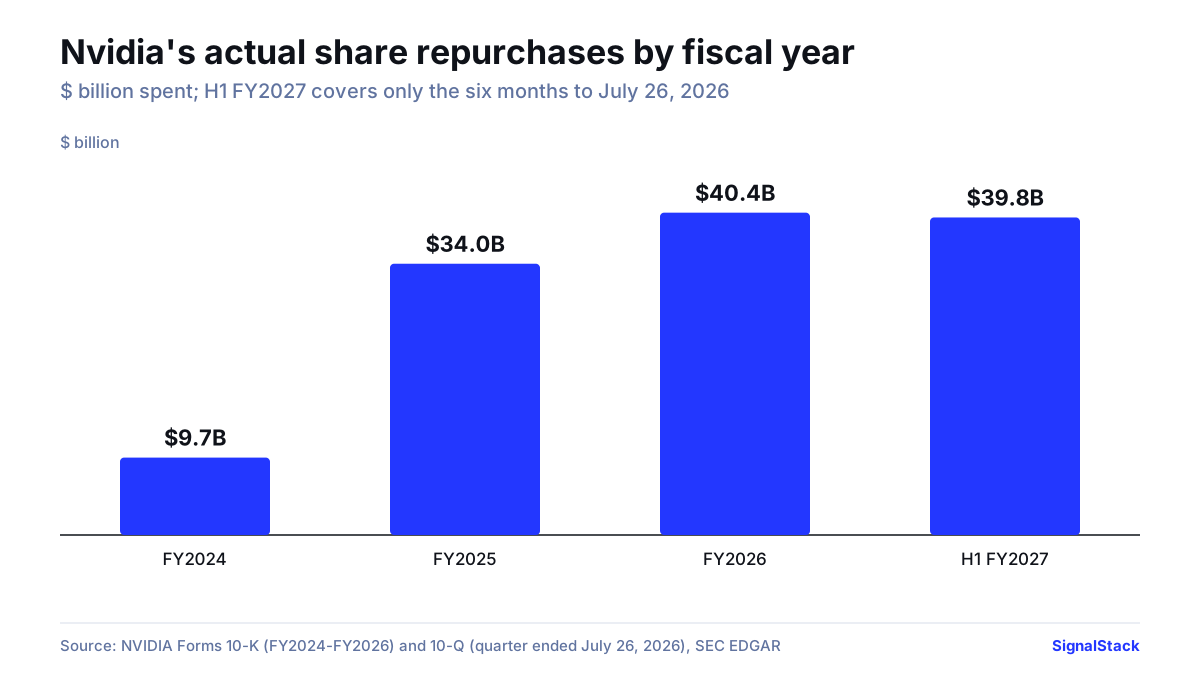
Actual repurchases, from the 10-K and 10-Q equity statements:
- Fiscal 2024 (ended January 28, 2024): 210 million shares (split-adjusted) for $9.7 billion.
- Fiscal 2025: 310 million shares for $34.0 billion.
- Fiscal 2026: 282 million shares for $40.4 billion.
- First half of fiscal 2027 (to July 26, 2026): 203 million shares for $39.8 billion.
SignalStack’s own illustration, not a forecast: spending $235 billion over the roughly 16 months to the end of fiscal 2028 works out to about $14.7 billion a month, more than twice the $6.6 billion monthly average of the first half of fiscal 2027. Nvidia has published no schedule.
Cash, dividends and share count
| Item | Figure | Source |
|---|---|---|
| Operating cash flow, first half of fiscal 2027 | $74.4 billion | 10-Q |
| Cash, equivalents and marketable debt securities, Jul 26, 2026 | $56.6 billion | 10-Q |
| Marketable equity securities, Jul 26, 2026 | $42.8 billion | 10-Q |
| Senior notes outstanding, Jul 26, 2026 | $33.5 billion | 10-Q |
| Debt issued, net of costs, first half of fiscal 2027 | $24.9 billion | 10-Q |
| Dividends paid, first half of fiscal 2027 | $6.3 billion | 10-Q |
| Quarterly dividend | Raised from $0.01 to $0.25 on May 18, 2026 | 10-Q |
The $22.44 billion cash figure Reuters cited is cash and cash equivalents only.
Shares outstanding went from 24,643 million (January 28, 2024) to 24,477 million, 24,304 million and 24,147 million (July 26, 2026). SignalStack’s own arithmetic: that is a net decline of about 496 million shares, or 2.0%, while Nvidia repurchased 795 million shares over the same stretch. The gap is stock issued to employees, net of shares withheld for taxes. The fiscal 2025 10-K names offsetting that dilution as a program goal.
How a buyback authorization works
No obligation. An authorization caps spending. Nvidia’s filings say purchases depend on market conditions, “operating requirements and other investment opportunities,” and the program can be suspended at any time.
Several ways to buy. The 10-Q lists open-market purchases, privately negotiated deals, structured repurchase agreements and Rule 10b5-1 trading plans.
Rule 10b5-1 plans. A company sets the plan up in advance, while it holds no material nonpublic information, and trades then follow the preset terms. The SEC calls this an affirmative defense against insider trading claims. Nvidia’s fiscal 2026 10-K shows 8 million shares bought for $1.5 billion between January 26 and February 20, 2026 under what the 10-K calls a “pre-established trading plan.”
Rule 10b-18 safe harbor. This SEC rule is voluntary. It shields a company from manipulation claims over how, when, at what price and in what volume it buys, if all purchases that day meet four conditions: one broker or dealer per day; no opening trade and, for large liquid stocks, nothing in the session’s last 10 minutes (30 minutes for others); no price above the higher of the highest independent bid or the last independent trade price; and volume of no more than 25% of average daily trading volume, with one weekly block exception.
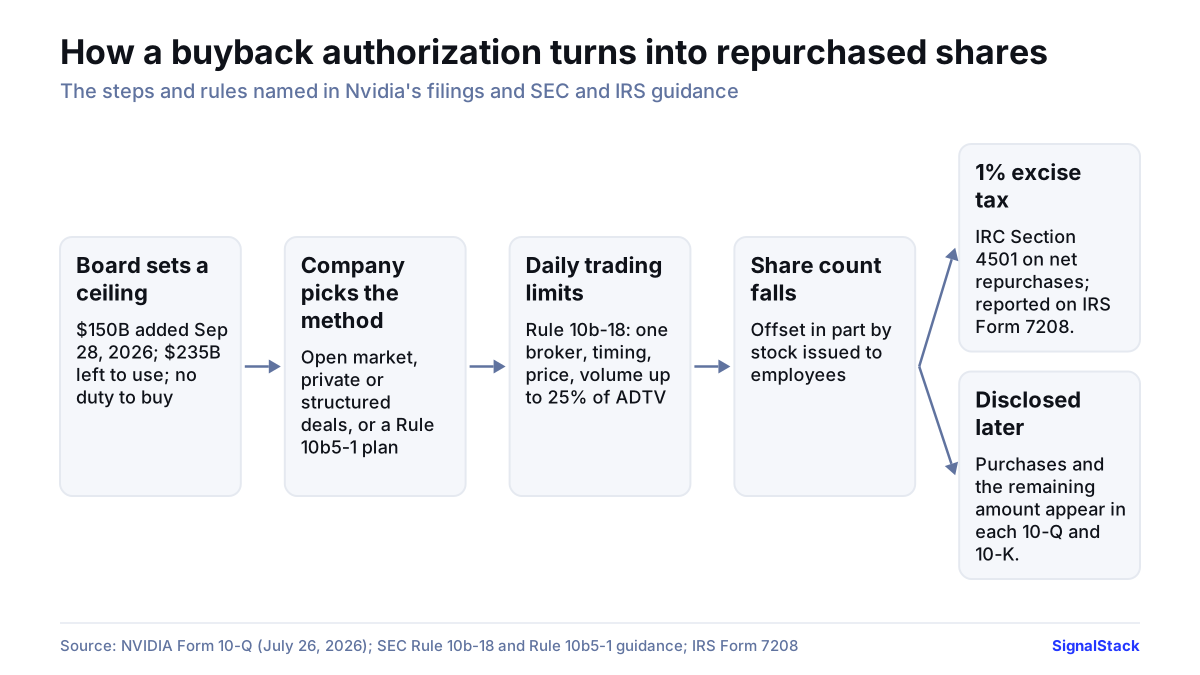
The 1% excise tax. Section 4501 of the Internal Revenue Code, added by the Inflation Reduction Act of 2022, taxes buybacks by covered companies at 1% of fair market value, reduced by the value of stock issued, such as to employees. Companies report it on IRS Form 7208. Nvidia includes it in repurchase cost and called it not significant for the first half of fiscal 2027. SignalStack’s own illustration, not a forecast: before netting, 1% of $235 billion is $2.35 billion.
Why now: context from the coverage
- Cash generation. First-half fiscal 2027 net income was $118.0 billion (10-Q). Reuters and Bloomberg cited Nvidia’s August projection of about 70% revenue growth next fiscal year.
- The AI spending debate. CNBC cited S&P Global Ratings’ projection that combined hyperscaler capital spending will top $1.3 trillion by 2027. Reuters noted doubts about how long that lasts, and scrutiny of Nvidia’s investments in AI startups and cloud providers.
- How others framed it. Quilter Cheviot’s Ben Barringer compared the move to Apple’s use of buybacks as growth slows (Reuters).
See the Nvidia company hub for filings and financials, our AMD World Labs 8-K report for a rival paying with its own stock, and more AI chip coverage.
What could go right / What could go wrong
What could go right
- If operating cash flow stays near first-half fiscal 2027 levels, it would cover a large share of the planned buybacks and dividends. Nvidia also raised $24.9 billion of debt in that half (10-Q).
- Steady purchases could keep offsetting employee-stock dilution, the goal named in the fiscal 2024 and 2025 10-Ks.
- With no obligation, Nvidia can slow down if needs change.
What could go wrong
- Slower AI data center spending would shrink available cash, and the fiscal 2028 timeline could slip.
- Cash used for buybacks is unavailable for supply commitments or strategic investments.
- Higher prices during execution mean the same dollars remove fewer shares.
FAQ
Q How big is Nvidia's new stock buyback authorization?
A Nvidia's board added $150 billion on September 28, 2026, raising the remaining authorization to $235 billion, which Nvidia expects to use through fiscal 2028.
Q Does Nvidia have to buy back all $235 billion of stock?
A No. An authorization is a ceiling, not an obligation, and Nvidia's filings say the program can be suspended at any time.
Q How much stock has Nvidia repurchased in recent years?
A Per its SEC filings, $9.7 billion in fiscal 2024, $34.0 billion in fiscal 2025, $40.4 billion in fiscal 2026 and $39.8 billion in the first half of fiscal 2027.
Q What is SEC Rule 10b-18?
A A voluntary safe harbor from manipulation claims for companies buying their own shares, if each day's purchases meet conditions on broker, timing, price and volume (at most 25% of average daily volume).
Q Is there a tax on stock buybacks in the US?
A Yes. Section 4501 of the Internal Revenue Code imposes a 1% excise tax on the fair market value of shares repurchased after 2022, net of stock issued, reported on IRS Form 7208.
Companies in this report: NVIDIA
Sources
- NVIDIA Announces a $150 Billion Share Repurchase Authorization Increase (Sep 28, 2026)
- NVIDIA Form 10-Q for the quarter ended July 26, 2026
- NVIDIA Form 10-K for fiscal 2026 (ended Jan 25, 2026)
- NVIDIA Form 10-K for fiscal 2025 (ended Jan 26, 2025)
- NVIDIA Form 10-K for fiscal 2024 (ended Jan 28, 2024)
- Answers to Frequently Asked Questions Concerning Rule 10b-18
- 17 CFR 240.10b-18 (Purchases of certain equity securities by the issuer)
- SEC Adopts Amendments to Modernize Rule 10b5-1 Insider Trading Plans (Press Release 2022-222)
- About Form 7208, Excise Tax on Repurchase of Corporate Stock
- NVIDIA Launches Open Agent Safety Platform (Sep 28, 2026)
- Nvidia share buyback plan gets $150 billion boost
- Nvidia sets biggest-ever buyback plan as AI chip competition weighs on stock performance
- Nvidia Boosts Share Buyback Authorization by $150 Billion
- Nvidia announces jaw-dropping $150 billion stock buyback, largest single authorization in history
- What Nvidia's $150 billion stock buyback means for shareholders and potential investors