Security
Android Sideloading ‘Advanced Flow’: 24-Hour Delay, Verification, and Coercion Breaks
TLDR
SignalStack Tech Report · March 20, 2026 · Security / Mobile / Policy
Why this is on SignalStack: we analyze platform security when it trades user agency for abuse mitigation at scale—here, delay as a primitive against urgency-driven scams.
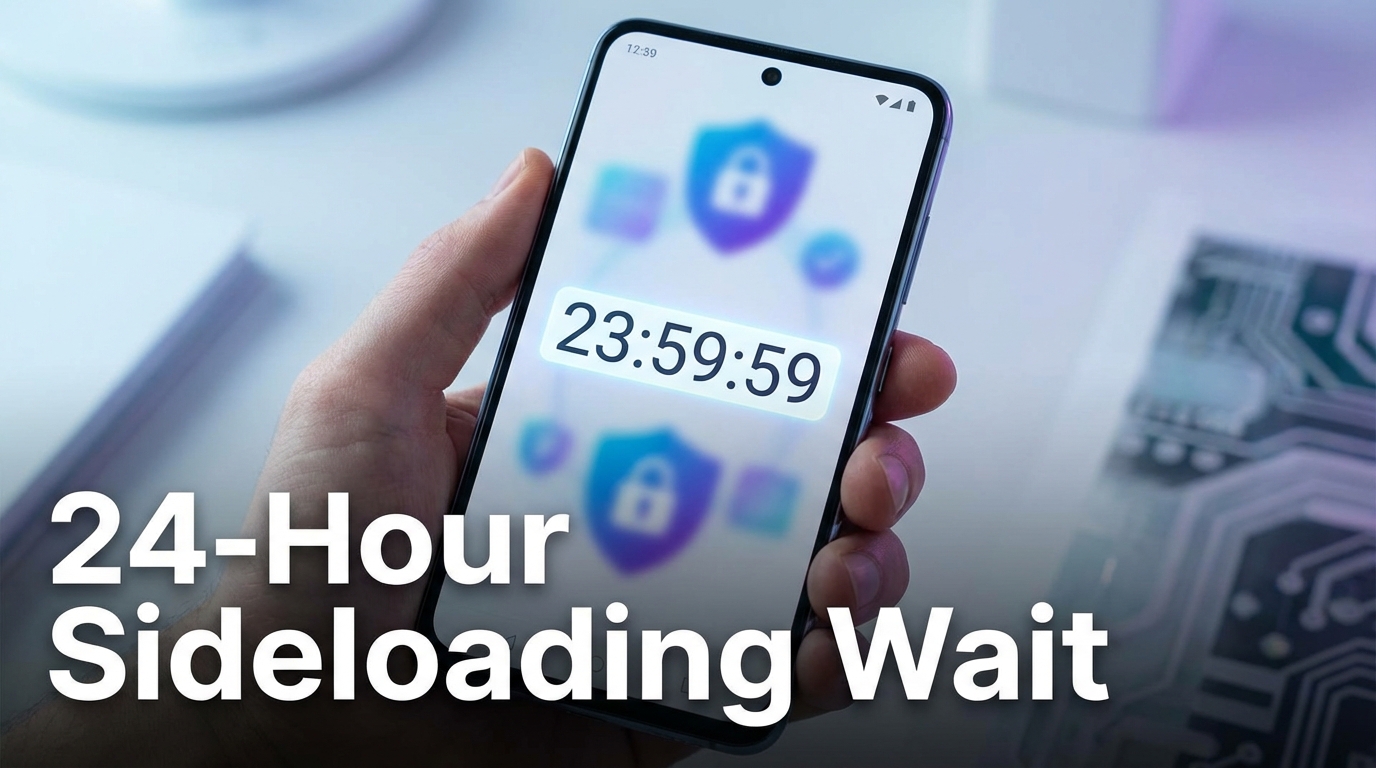
Google’s new “Advanced Flow” for sideloading unverified Android apps introduces a mandatory 24-hour delay.
This is more than a policy tweak. It marks a philosophical shift in Android security: friction is now a deliberate defense mechanism against social-engineering pressure.
Power users can still sideload, but only through a high-friction sequence designed to interrupt scam-driven urgency.

What happened
For years, Android sideloading was effectively governed by a simple "Unknown Sources" style permission model.Starting in late 2026, Google is replacing that era with a Developer Verification Program for apps distributed outside Play: identity verification, signing key submission, and a $25 fee.
To preserve advanced-user flexibility, Google introduced the “Advanced Flow,” a bypass path that is intentionally harder and slower.
The flow is structured as a security ritual:
Enable Developer Options (including the build-number tap sequence), find the hidden unverified-package toggle, confirm no coercion, enter device credentials, reboot, wait 24 hours, then return to complete final biometric confirmation.
At the final step, users choose either a temporary 7-day allowance or an indefinite allowance for unverified packages.
Enforcement begins in September 2026 in Brazil, Singapore, Indonesia, and Thailand, with broader rollout planned in 2027.
Those markets are not random draws on a map: they combine large Android populations with acute mobile-scam and social-engineering pressure in public reporting—useful as a high-signal testbed for whether delay-based interrupts move success rates before Google hardens the same defaults more broadly in 2027. The strategy is empirical: measure coercion breakage where abuse is worst, then export the lesson globally.
The Core Shift: Friction as a Security Tool
Google's thesis is not "block sideloading."It’s “interrupt coercion.”
Scammers typically exploit urgency: install this app now, or lose access, funds, or account control.
A forced 24-hour delay breaks that urgency loop.
It creates space for second thoughts, external advice, or institutional verification (bank, support desk, family member).
That is the same cooling-off logic used in consumer-finance and contract law—here applied to install-time coercion. The defense is cognitive as much as cryptographic: it denies scammers a same-session “do it now” closure, even if the eventual APK is unchanged.
In other words, Android is treating delay itself as a security primitive.
Reputation lanes: verified vs unverified
Outside Play, Google is steering Android toward a two-lane model: Play-verified developers get a lighter distribution path, while unverified packages inherit Advanced Flow friction. That is a shift from “permission bit” security to reputation- and identity-backed security—closer to how app stores have always priced trust, now extended to sideloading policy.
For independent and power users, the cost is not only taps and time—it is identity proof, key custody, and ongoing compliance surface area. Those create real privacy and access questions (who must prove what, under which jurisdiction, with what retention) even when the public goal is scam reduction.
Why it matters
At ecosystem scale, this is a major architectural stance.Google cites that users face significantly higher malware risk outside Play, and with billions of Android devices in circulation, social-engineering mitigation becomes a platform-level priority.
For mainstream users, the new flow likely reduces high-pressure scam success rates.
For power users and independent developers, however, it adds operational friction and policy concerns around identity retention, gatekeeping, and geographic accessibility.
That tension defines the new Android debate: open by capability, secure by default, and intentionally slower at the point of highest risk.
Key details at a glance & rollout
| Area | Detail | Note |
|---|---|---|
| Mechanism | “Advanced Flow” + 24-hour delay for some unverified sideloads | Interrupts urgency-driven social engineering |
| Preconditions | Developer Options, toggles, credential + reboot steps (as described) | High-friction by intent |
| Verified path | Play-verified developers reportedly avoid this heavy path | Two-tier access model |
| Developer program | Verification, signing, $25 fee (per reporting) | Confirm current terms with Google |
| Hobby/student lane | Limited distribution accounts (~20 devices, timing per press) | Check official eligibility |
| Rollout | Sep 2026: Brazil, Singapore, Indonesia, Thailand; broader 2027 | Geography drives first empirical data |
| Thesis | Friction as security primitive, not total sideload ban | Nuance often lost in headlines |

What to watch next
- Rollout — Brazil, Singapore, Indonesia, Thailand (September 2026) and broader 2027 expansion—observe real-world friction and false positives.
- Developer verification — Identity retention, signing requirements, and limited-distribution accounts for small groups.
- Rights and markets — Pushback on fees, geography, and independent software access versus scam rates.
The SignalStack angle
What we are not doing: claiming sideloading ended. What we are doing: treating delay as a security control aimed at interrupting coercion—with tradeoffs for privacy and access.
1. Friction is a product decision
At billions of devices, social-engineering scale justifies platform-level interrupts. SignalStack’s read: measure scam success rate and legitimate developer pain in the same dashboards.
2. Verified vs. unverified paths diverge
If Play-verified distribution avoids the Advanced Flow, independent channels bear most UX cost—shaping who can ship software outside stores.
3. Security or platform control?
NIST-style mobile-device guidance treats layered controls and user education as normal enterprise hygiene—delay and attestation can be justified in that vocabulary. Digital-rights critics read the same knobs as platform gatekeeping that shifts sovereignty from the device owner to the identity broker. SignalStack’s closing question is not which slogan wins—it is whether measured scam reduction and measured legitimate-access harm are published with equal seriousness.
Disclaimer: Policy details evolve; verify against Google primary documentation.
Power-user perspective
Critics from open-source and digital-rights circles argue that the model raises two structural issues.First, privacy and governance: independent developers now enter an identity-linked compliance layer.
Second, participation barriers: fees and verification steps may disproportionately impact hobbyists or developers in constrained jurisdictions.
Supporters counter that sideloading remains available and that the new path targets coercion-driven abuse rather than legitimate technical users.
Context & primary sources
Official Android distribution and security docs; federal mobile baseline; Google security research blog; civil-liberties critique. Statista and other paywalled market pages omitted unless you cite a specific chart with methodology.
- Android Developers Blog: android-developers.googleblog.com — policy and platform announcements.
- Distribute apps (Android Developers): developer.android.com/distribute — publishing and program context adjacent to verification.
- Play Console (product hub): Play Console — About — console-centric onboarding and policies (verify current verification fees/terms).
- Android Open Source Project — security: source.android.com/docs/security — platform security documentation.
- Google security blog: blog.google/security — research and incident narratives (security.googleblog.com redirects here).
- Mobile security baseline — NIST: NIST SP 800-124 Rev. 2 — mobile device security guidance for risk officers.
- Digital rights — EFF: EFF — mobile devices — user autonomy and platform critique (not Google policy).
Bridge: pair Developers Blog + distribute for product teams; pair AOSP security + NIST 800-124 for enterprise architecture reviews; pair EFF with policy stakeholders asking “who owns the device?”
FAQ
Q Is sideloading dead on Android? A No. It remains possible, but it becomes deliberate through the Advanced Flow and its 24-hour delay for unverified sources.Q Why 24 hours specifically? A Scam operations rely on immediate compliance. A full-day delay materially weakens pressure tactics and increases chances of intervention.
Q Will this affect apps I already sideloaded? A Existing installed apps are generally unaffected; the new process applies to future unverified installations after enforcement.
Q What changes for small developers? A Standard unverified distribution moves toward identity and signing compliance, though limited distribution accounts are intended to preserve small-group sharing use cases.