Science
arXiv Leaves Cornell: Nonprofit Independence, Budget Pressure, and AI Slop
TLDR
SignalStack Tech Report · March 21, 2026 · Science / Infrastructure / Policy
Why this is on SignalStack: we treat global research plumbing—preprints, moderation, funding—as systems work alongside AI governance; arXiv’s move is both balance-sheet and quality-control story.
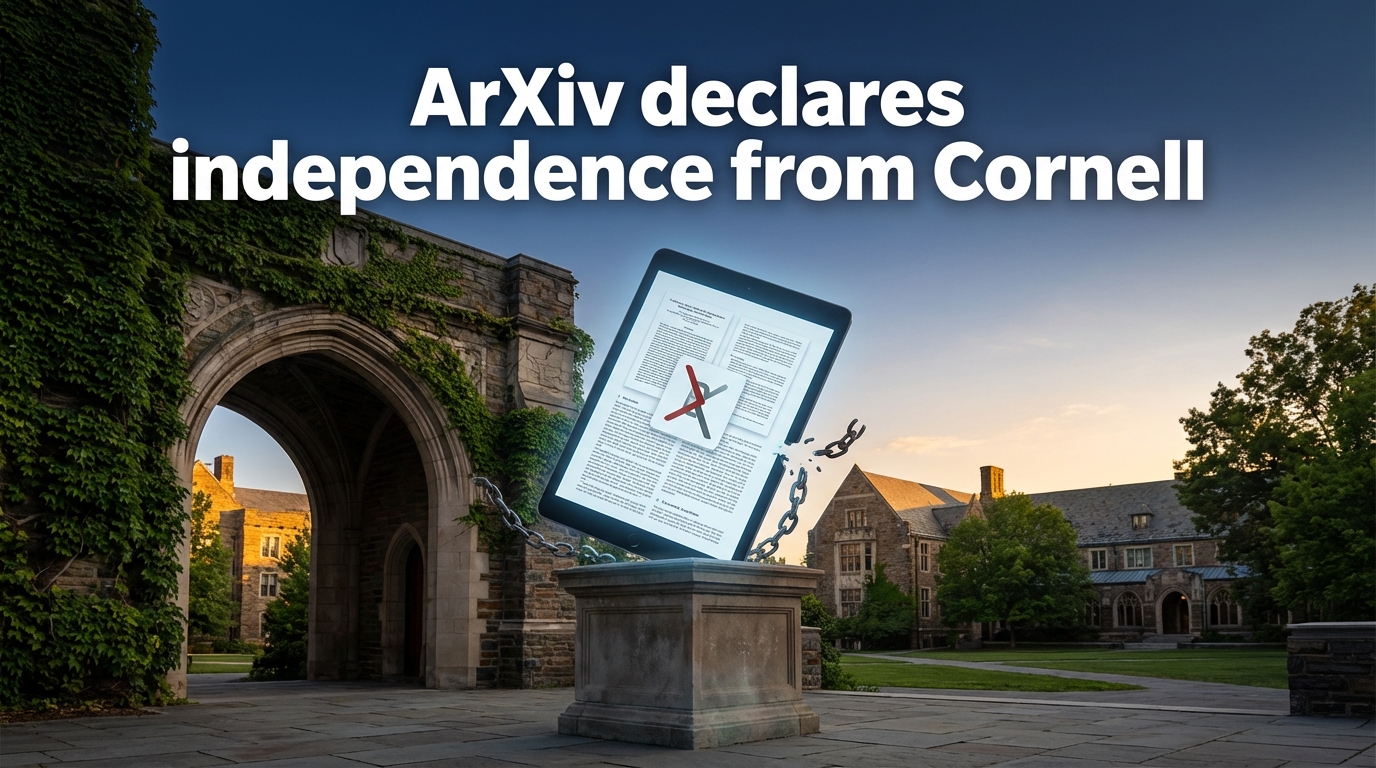
arXiv.org—the preprint server that helped reshape scholarly communication since 1991—is preparing to stand on its own. After more than two decades hosted under Cornell University, it will transition to an independent nonprofit corporation, effective July 1, 2026.
The move is framed as both financial necessity and strategic survival: operating costs have climbed to roughly $6.7 million annually, with a reported near–$300,000 deficit in 2025, while the platform battles a surge in fraudulent and low‑quality AI‑generated submissions.

What happened
Cornell has been arXiv’s institutional home since 2001, but the service’s scale has long since outgrown a typical university back office. Leaders describe independence as a way to raise funds more flexibly, hire specialized engineering talent, and reassure global donors who were uneasy about underwriting infrastructure perceived as tied to a single campus.
Alongside the governance shift, arXiv has tightened moderation in response to “AI slop”—manuscripts that look plausible but lack scientific substance. Reports cite Ralph Wijers, chair of the arXiv editorial council, noting that rejection rates rose from a historical ~4% to nearly 12% since the start of 2025. That jump is a throughput and trust signal, not a footnote: it hints at heavier human triage, possible automated screening experiments, and the ever-present false-positive risk if “AI detector” style tools are over-weighted—legitimate work (including from non-native English authors) can be noisier in metadata and style. The sustainable path is almost always layered review—software assists, humans decide—while metrics stay transparent.
Concrete policy changes include:
Endorsement for newcomers. As of January 21, first‑time submitters can no longer rely solely on a reputable institutional email; they must be endorsed by an established author in their field.
Stricter CS categories. Following a wave of low‑quality AI papers, arXiv is said to no longer accept certain computer science “reviews” or “position papers” unless they have already been vetted through a formal conference or journal process.
The independence path parallels other nonprofit hosts such as bioRxiv and medRxiv (now under openRxiv), though commentary has also surfaced questions about executive compensation and long‑term commercialization risks.
Public-good math
Roughly $6.7M a year in operating cost (as reported) is small next to a national research budget, but it is not small as a single-university line item when endowments, teaching missions, and political headwinds already compete for attention. A near–$300k deficit in 2025 (per coverage) makes the same point in red ink. Independence is partly a liability and governance move: let a purpose-built nonprofit raise and spend like global infrastructure, not an academic sub-budget. The open question is what funding mix follows the library/consortium base—grants, sponsors, and (if ever) API or value-add services—without turning the commons into a paywall. That is the strategic watch, not the press-release date.
Why it matters
arXiv is not a niche archive—it is global research infrastructure. If submission quality erodes, trust in preprints as an early signal of scientific progress erodes with it.
Independence could unlock sustainable funding and faster product investment, but it also shifts accountability: donors, institutions, and researchers will watch whether fees, policies, and governance stay aligned with open, nonprofit mission.
The AI angle is unavoidable. Tools that help researchers write clearly are welcome; fabricated or hollow papers are not. arXiv’s challenge is to enforce norms without choking legitimate, cross‑disciplinary participation.
Endorsement and equity: requiring established authors to vouch for first-time submitters may reduce spam—but it can also raise access friction for early-career researchers, independent scholars, and communities with weaker network density (including parts of the Global South) if endorsements function as a social graph gate. Post-independence arXiv will be judged on whether “open preprints” still reads as open in practice, not only on the masthead.
Key details at a glance
| Area | Detail | Source / caveat |
|---|---|---|
| Effective date | Nonprofit independence July 1, 2026 (reported) | Confirm on arXiv/Cornell primary releases |
| Operating scale | ~$6.7M/year costs; ~$300k deficit in 2025 (coverage) | Reporting-derived; verify in filings/annual reports |
| Moderation | Rejection rate cited ~4% → ~12% (editorial council voice in press) | Methodology varies; treat as directional |
| Policy | Newcomer endorsement (from Jan. timeline in article); stricter CS category rules | Read current arXiv policy pages before citing |
| Governance | Standalone nonprofit; parallels openRxiv family noted in coverage | Compare structures, don’t equate missions |
| User impact | No immediate broad disruption reported for core flows/fees | Long-term fee/governance still open |
| Founder framing | Paul Ginsparg on professionalizing leadership at global scale | Interpretation in press, not a filing quote |
What to watch next
- Fundraising and revenue mix — Beyond library/consortium membership: grants, sponsors, and any non–mission-creep services—visibility into budgets matters as much as slogans.
- Moderation tooling — How much automation (including detector-style signals) vs human adjudication; track appeals and false-positive narratives in the community.
- Policy effects — How endorsement and category rules affect early-career researchers and global participation.
- AI-assisted writing — Whether assistance stays bounded by scientific substance—the line arXiv says it wants to hold.
The SignalStack angle
What we are not doing: treating arXiv as “just a website.” What we are doing: reading independence as infrastructure finance meeting integrity under volume.
1. Preprint quality is a network externality
If junk submissions rise, trust in early signals of scientific progress falls for everyone. SignalStack’s read: moderation spend is R&D infrastructure, not overhead trivia.
2. Nonprofit governance will be tested
Donors and institutions will watch fees, policies, and mission alignment. Closing metric: transparent budgets and predictable researcher experience across regions.
Disclaimer: Figures and dates follow published reporting; confirm on arXiv and Cornell primary announcements.
Context & primary sources
Official arXiv documentation first; cross-sector ethics and open bibliometrics for ecosystem context. Royal Society–style “future of publishing” reports exist but vary by year—use society search if you need a cited secondary.
- arXiv news: blog.arxiv.org — announcements and leadership notes.
- Governance: About governance — boards, stewardship, and structural context.
- Submission / endorsement: Submit help index — authoritative rules for endorsement and categories.
- Publication ethics (cross-publisher): COPE — AI and authorship norms across scholarly publishing (not arXiv-specific policy).
- Open bibliometrics: OpenAlex — open corpus for sizing arXiv’s role in the global graph (methodology-sensitive).
Bridge: pair governance + submit pages when briefing faculty councils; pair COPE with ethics committees; pair OpenAlex with “how big is the funnel?” data discussions.
FAQ
Q Why leave Cornell now? A Scale, cost, and the need to fundraise and hire like a purpose‑built nonprofit rather than a university‑hosted project.
Q What is “AI slop” in this context? A Fraudulent or low‑quality manuscripts that look credible but fail scientific scrutiny—distinct from legitimate AI‑assisted editing.
Q Will submission fees spike immediately? A Press coverage so far has not described an immediate broad fee spike for libraries; long‑term sustainability plans remain the open question.
Q Does arXiv ban AI entirely? A Coverage frames the stance as banning hollow AI‑generated content, not necessarily AI tools used responsibly to clarify language—especially for non‑native English speakers.
Q Will automated detectors decide fate? A Unlikely as the sole gate: detectors show false-positive risk; credible workflows combine signals with human review and clear appeals—especially where legitimate papers resemble “odd” templates.
Q Does endorsement hurt inclusion? A It can, if endorsements are scarce in a field or region. Watch whether arXiv publishes clear appeal paths and monitors participation by career stage and geography—not only rejection counts.