AI-generated illustration
TL;DR: At a Netflix panel during the Busan International Film Festival on Oct. 10, a Netflix production executive said AI had been used across about 300 Netflix titles. The next day, Oct. 11, an A.V. Club headline told viewers they had “already ingested AI-generated content.” The number is not new. Netflix has confirmed AI-generated footage on screen in a few named titles but has not said how many of the 300 contain any. Netflix disclosed it to shareholders on July 16: generative AI workflows were used in “roughly 300 of our titles” in 2026, with the largest share of the work in post-production. Netflix’s production guidance says AI output in final deliverables, any actor’s likeness and third-party IP need written approval. We found no Netflix rule or statement about labeling AI use for viewers.
What was said in Busan
The remarks came at Netflix’s Creative Asia event with the Busan festival on Oct. 10, on a panel about AI in filmmaking. Netflix’s Asia-Pacific production chief, senior director Sung Q Lee, listed where the tools were used: previsualization, production design, set-dressing concepts, editing and visual effects, according to The Hollywood Reporter and Variety. Variety quotes him saying “around 300” titles. The Hollywood Reporter gives “about 300” as a paraphrase.
Korean director Kang Yun-sung, also on the panel, said that when his team calculated savings on his film “The Gulf of Aden” for financing, the reduction came to around 40 percent, The Hollywood Reporter reported. Variety quotes the same “around 40%”; Netflix’s own recap puts it at 30-40%. Variety separately reports Kang saying AI workflows could take 30% to 40% off a feature film’s production budget. The around-40% figure is Kang’s own calculation for his own film; the 30%–40% range in Variety is his general estimate for feature films. None of the reports describe either as a Netflix title or a Netflix number.
What Netflix told shareholders
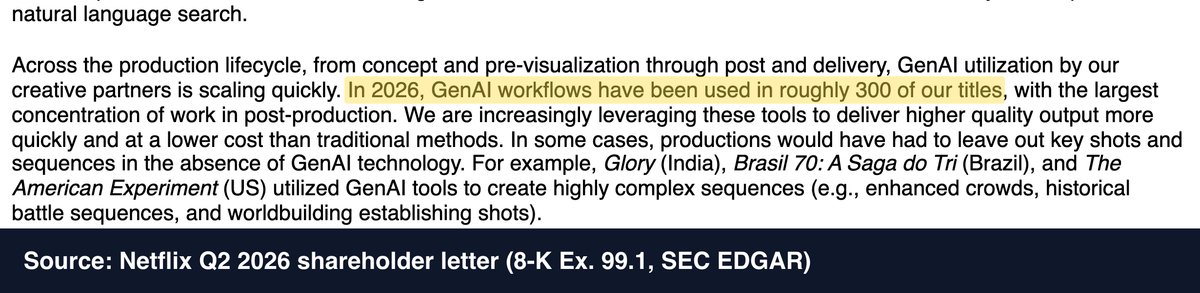
The figure first appeared in Netflix’s second-quarter letter to shareholders, filed with the SEC on July 16, 2026.
- The figure: generative AI workflows were used in “roughly 300 of our titles” in 2026, with “the largest concentration of work in post-production.”
- Where it shows on screen: the letter names three productions that used the tools for complex sequences: Glory (India), Brasil 70: A Saga do Tri (Brazil) and The American Experiment (U.S.). Its examples are enhanced crowds, historical battle sequences and worldbuilding establishing shots.
- Why, in Netflix’s words: the letter says the tools deliver higher quality faster and at lower cost. It also says some productions would otherwise have had to drop key shots.
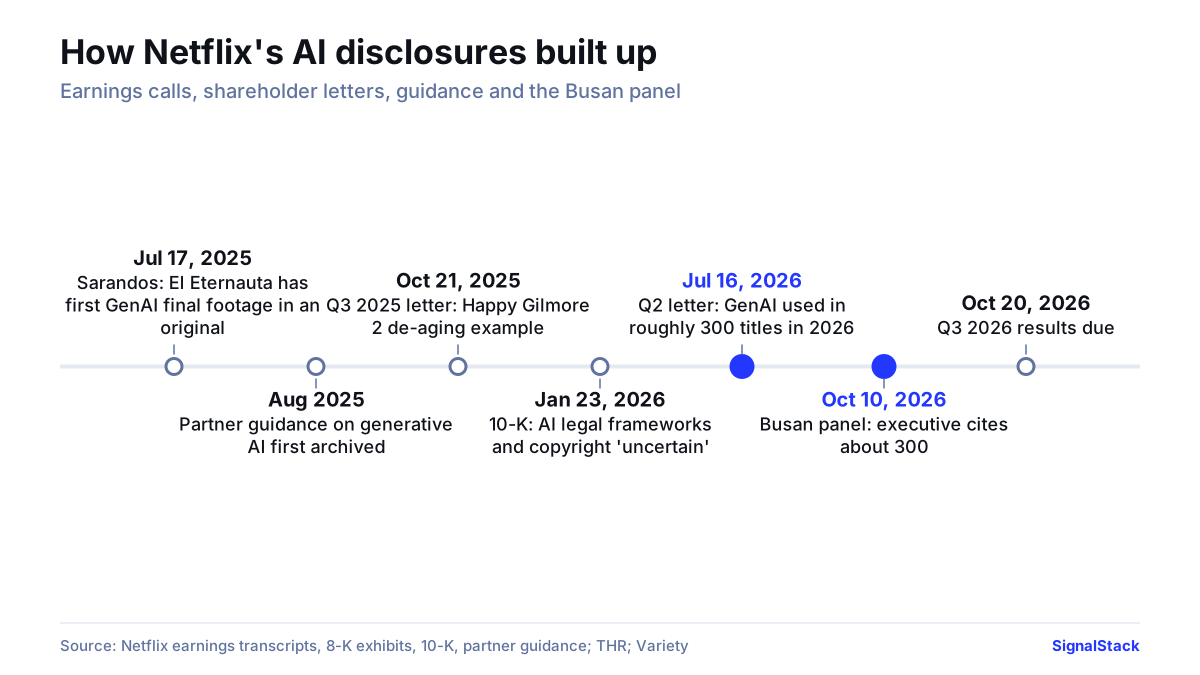
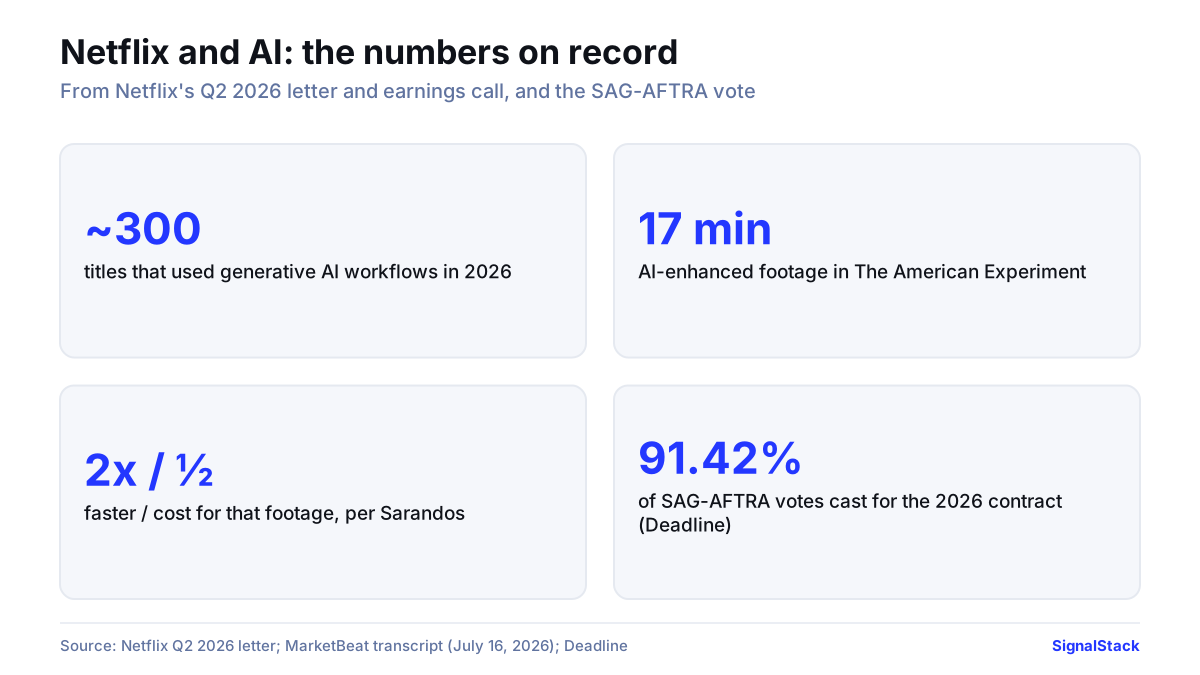
On the earnings call that day, co-CEO Ted Sarandos said The American Experiment contains 17 minutes of AI-enhanced footage. He said those 17 minutes took half the time and half the cost of previous options, according to a third-party transcript published by MarketBeat. Netflix’s Oct. 21, 2025 letter cited generative AI de-aging in Happy Gilmore 2. Earlier, on July 17, 2025, Sarandos had called a building-collapse sequence in the Argentine series El Eternauta the first generative AI final footage in a Netflix original.
Netflix’s annual report for 2025, filed Jan. 23, 2026, flags the risks in its own words. It says the legal frameworks for generative AI are uncertain, and so is copyright protection for AI-generated material.
Netflix’s rules for productions
Netflix publishes guidance for production partners titled “Using Generative AI in Content Production.” It was first archived in August 2025, and the version we quote was archived on April 17, 2026. The live page no longer loads as plain text, so we could not check whether it has changed since. The archived guidance says:
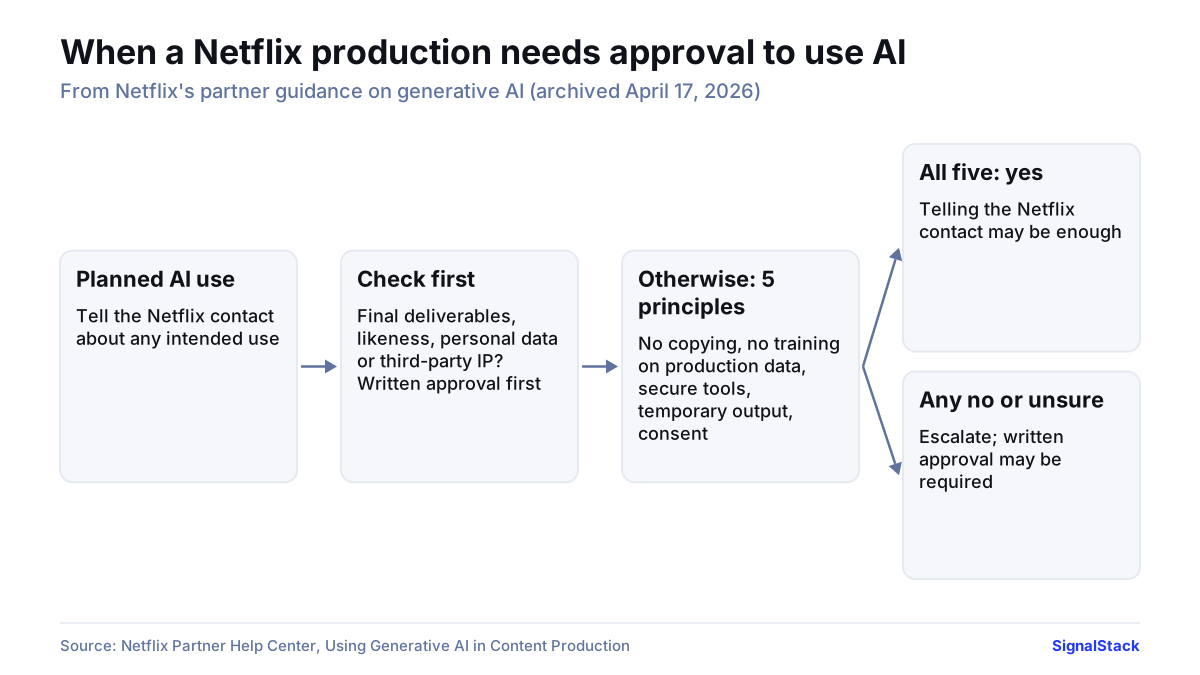
- Notify Netflix. Partners are expected to tell their Netflix contact about any intended use of generative AI.
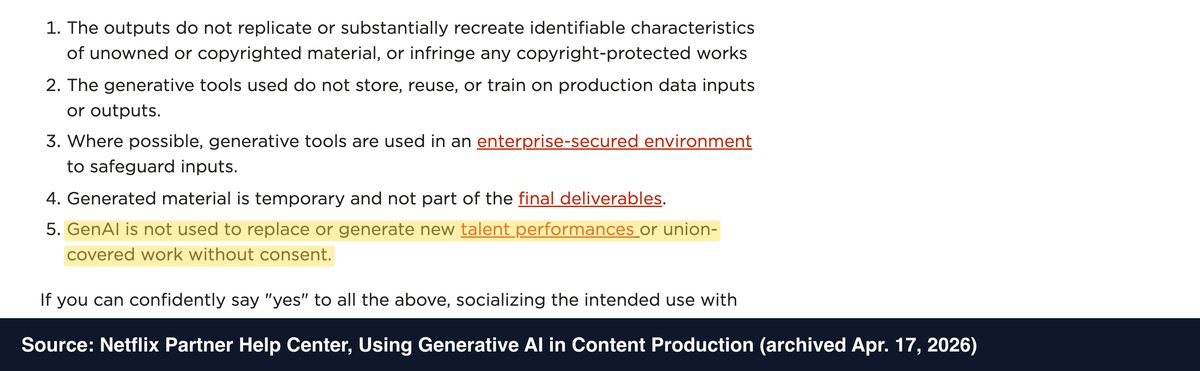
- Five guiding principles to check first: outputs don’t copy or infringe copyrighted work; the tools don’t keep, reuse or train on production data; secure enterprise tools are used where possible; generated material is temporary rather than part of the finished deliverables; and AI doesn’t replace or create talent performances or union-covered work without consent. If all five are a yes, telling the Netflix contact “may be sufficient.” Any “no” or “unsure” means escalating, and written approval may be required.
- Written approval: it is required for AI output that ends up in the finished product, uses a performer’s likeness, involves personal data or draws on someone else’s intellectual property. Approval is also needed before AI is used to create a lead character, a key visual element or a fictional setting the story depends on.
- Digital replicas of real performers need documented consent and must comply with guild rules where applicable.
The guidance asks partners to tell Netflix about AI use. We found no Netflix requirement or statement about telling viewers, whether by on-screen labels or credits.
Where coverage differs from Netflix’s record
| Claim in coverage | What Netflix’s record says |
|---|---|
| ”You’ve already ingested AI-generated content” (A.V. Club headline) | Netflix has confirmed generative AI footage on screen in a few named titles (El Eternauta; 17 minutes in The American Experiment). It has not said how many of the roughly 300 titles include AI-generated material on screen; it says the largest concentration of work is in post-production. Separately, Fortune paraphrased Netflix AI executive Ritwik Kumar as saying he doesn’t believe Netflix has anything wholly generated by AI. |
| The 300 titles span “the past few years” (A.V. Club) | Lee’s quoted remarks gave no timeframe; Netflix’s July figure is “In 2026." |
| "More than 300” (Screen Daily) | Netflix and other outlets say roughly, about or around 300. |
The panel also produced conflicting attributions. The Hollywood Reporter and Screen Daily credit Lee with a line about the human touch being “critical and necessary.” Netflix’s own recap gives that line to Wētā FX’s Kimball Thurston, another panelist. The outlets’ quotations of the panel differ in wording.
Background: the union rules
The Writers Guild’s 2026 contract, effective May 2, 2026, keeps the AI protections negotiated in 2023, including that AI cannot write or rewrite literary material. It adds a new rule: companies must give the guild written notice if they license writers’ work to train a commercial AI system. SAG-AFTRA members ratified a new contract with the major studios (AMPTP) in June 2026, with 91.42% of votes cast in favor, Deadline reported. It runs from July 1, 2026 to June 30, 2030. Netflix’s guidance points productions to guild requirements for digital replicas of performers. Our report on Nicolas Cage’s AI waiver goes through what the actors’ contract requires.
What could go right / What could go wrong
What could go right, according to Netflix:
- Netflix says the tools let productions finish complex shots faster and at lower cost. It says some shots would otherwise have been cut.
- Its guidance keeps final footage, performers’ likenesses and third-party material behind written approval.
What could go wrong, according to Netflix’s own filings and the record:
- The 10-K says the copyright status of AI-generated material is uncertain.
- Beyond the few titles it has named, we found no Netflix list or viewer label showing which of the roughly 300 titles used AI, or how, so outsiders cannot check how the tools were used.
Netflix reports third-quarter results on Oct. 20 at about 1:01 p.m. Pacific. See our Netflix earnings page for the schedule, and more reports in our entertainment section.
FAQ
Q Has Netflix used AI in 300 shows and movies?
A Netflix told shareholders on July 16, 2026 that generative AI workflows were used in roughly 300 of its titles in 2026, with the largest share of the work in post-production. Fortune paraphrased Netflix's Ritwik Kumar as saying he doesn't believe Netflix has anything wholly generated by AI.
Q Which Netflix titles used generative AI?
A Netflix has named a few. Glory, Brasil 70: A Saga do Tri and The American Experiment appear in its Q2 2026 letter. El Eternauta and Happy Gilmore 2 appeared in earlier statements, and its Q3 2025 letter cited Billionaires' Bunker for pre-production use. We found no full list.
Q Does Netflix label AI-generated content?
A We found no Netflix requirement to label AI use for viewers. Its production guidance asks partners to tell Netflix about planned AI use. Written approval is required when AI output goes into final footage or involves a performer's likeness or outside intellectual property.
Q Who said Netflix used AI in 300 titles at Busan?
A Sung Q Lee, Netflix's senior director of production for Asia-Pacific, at the Netflix Creative Asia event on Oct. 10, 2026, according to The Hollywood Reporter and Variety.
Companies in this report: Netflix
Sources
- Netflix Q2 2026 shareholder letter (8-K Ex. 99.1, July 16, 2026)
- Netflix Q3 2025 shareholder letter (8-K Ex. 99.1, Oct. 21, 2025)
- Netflix Form 10-K for 2025 (risk factors)
- Netflix Q2 2025 earnings interview transcript (July 17, 2025)
- Using Generative AI in Content Production (archived Apr. 17, 2026)
- Creative Asia with BIFF 2026 recap
- Netflix to announce third quarter 2026 financial results
- Summary of the 2023 WGA MBA
- Summary of the 2026 WGA MBA
- Netflix exec says about 300 titles used AI (Busan)
- Netflix: AI used across around 300 titles; Kang Yoon-sung on 40% budget cut
- You've already ingested AI-generated content, boasts Netflix exec
- How Netflix is using AI to personalize streaming
- Netflix Q2 2026 earnings call transcript
- Human touch remains essential to film in the age of AI, says Netflix panel
- SAG-AFTRA members approve 2026 AMPTP deal