# GPT-6 Comes to Free ChatGPT: The Model Split and Safety Scores
> GPT-6 rolls out to free ChatGPT users from Oct. 8 as GPT-6 Luna; paid plans get Sol. What changed, the 44% speed claim, and what the system card shows.
**TL;DR**
- OpenAI started rolling out GPT-6 in ChatGPT's Chat tab on Oct. 7, 2026: paid plans (Plus, Pro, Business, Enterprise) get a model called GPT-6 Sol, and Free and Go users start getting GPT-6 Luna as the rollout expands from Oct. 8. The models behind ChatGPT Work and Codex are not part of this change.
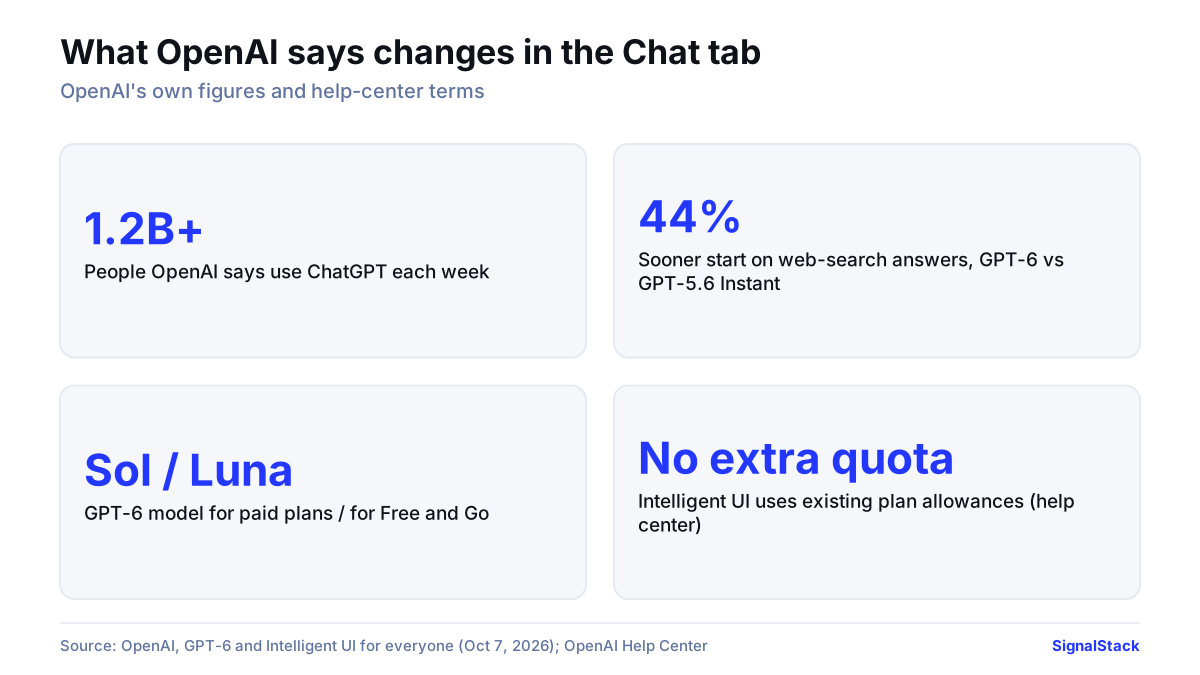
- The release adds "Intelligent UI," answers built from charts, buttons, forms and small tools, and lets ChatGPT start answering while it is still thinking. OpenAI says GPT-6 Instant begins web-search answers 44% sooner on average than GPT-5.6 Instant.
- OpenAI's system card reports better jailbreak resistance, but also statistically significant regressions against the GPT-5.6 models on some safety tests, including three under-18 categories for both models. OpenAI says the production-benchmark failures it reviewed were "borderline but still generally safe," and that a teen classifier for self-harm, sexual content and gore is not counted in the under-18 scores.
## What happened
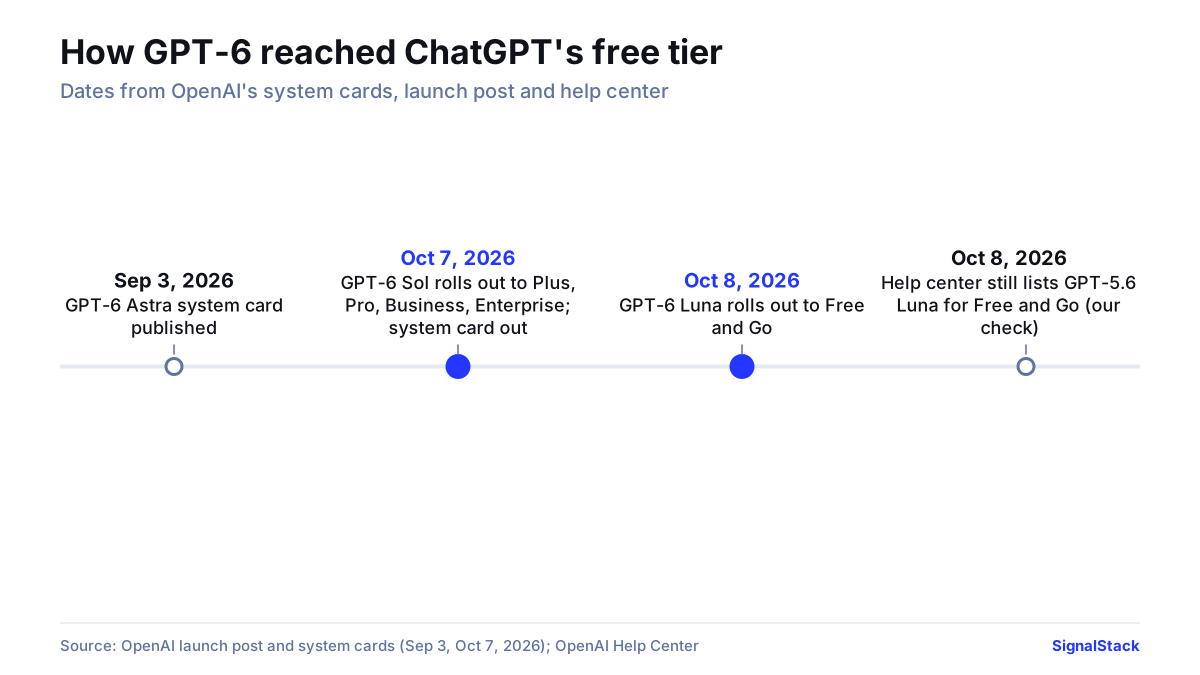
On Oct. 7, OpenAI published "GPT-6 and Intelligent UI for everyone." The post says the first GPT-6 models went to paying customers last month, and that this release brings a GPT-6 model to the more than 1.2 billion people it says use ChatGPT each week. The GPT-6 Astra system card, which opened the family, was published on Sept. 3, a date Technology.org also reports.
Paid plans went first; Free and Go followed a day later with a different model. Source: OpenAI launch post and system cards (Sep 3, Oct 7, 2026); OpenAI Help Center.
Two things change in the Chat tab. First, answers can be assembled from interface pieces: OpenAI's examples include a cooking timeline next to a recipe, a road trip on a map, explanations where you change an input and watch the result, and a bill splitter built on request. Second, the model can show part of an answer while it keeps reasoning. OpenAI built a library of streamable components and a compiler so the interface appears as the model writes it.
The Decoder says Google shipped a similar feature in its Gemini app in May; other outlets date Google's version differently. For how Google prices and gates its own models, see our [Gemini 4 Argon report](/blog/google-gemini-4-argon-launch/).
## Who gets which model
| Plan | Model in the Chat tab | Rollout start |
|---|---|---|
| Plus, Pro, Business, Enterprise | GPT-6 Sol | Oct. 7, 2026 |
| Free and Go | GPT-6 Luna | Oct. 8, 2026 |
| Pro, Business, Enterprise ("Pro" effort) | GPT-6 Pro, powered by GPT-6 Astra | already available |
OpenAI says both Sol and Luna are tuned for everyday conversation. Enterprise access depends on admin settings. According to the system card, people using Sol and Luna inside Codex and ChatGPT Work stay on the September versions.
The headline numbers in the launch post are OpenAI's own. Source: OpenAI, GPT-6 and Intelligent UI for everyone (Oct 7, 2026); OpenAI Help Center.
Three details from OpenAI's help center:
- Intelligent UI works from the Instant through Extra High thinking levels, not with "Pro" effort, and it has no separate usage quota.
- On the web, turning off **Layout and visuals** in Settings reduces visual elements, though some may still appear; it is not a text-only mode.
- Ordinary text chat has no cap on the Free and Go plans, though OpenAI keeps safeguards against abuse; file uploads, image generation, voice and other tools have their own limits.
When we checked on Oct. 8, the same help article still named GPT-5.6 Luna as the default model for Free and Go users, while the launch post says GPT-6 Luna reaches those tiers from Oct. 8. Check the model menu in your own account.
## What the system card says
OpenAI published a system card for the October versions of GPT-6 Sol and GPT-6 Luna alongside the launch. Its summary lists gains: compared with the GPT-5.6 models, GPT-6 showed stronger resistance to jailbreaks, including multi-turn attacks, and fewer instances of dishonesty and deception. Under its Preparedness Framework, OpenAI treats both models as High capability in cybersecurity and in biological and chemical risks, and says it applied the same safeguards as for GPT-5.6.
The card also reports regressions. On its "production benchmark" prompts, which OpenAI says were deliberately created to be difficult, Sol showed a statistically significant regression on standard self-harm, and Luna on standard self-harm, gore and sexual content. OpenAI says these tests run on the model without system-level safeguards, that their error rates do not represent average production traffic, and that they leave out features such as Trusted Contact, localized crisis helplines and Parental Controls. For these production-benchmark regressions, it says it reviewed the failing responses by hand and found them "borderline but still generally safe": the models are more willing to answer informational self-harm questions while pointing to professional help, and OpenAI says that, based on its evaluations, they do not comply with requests to facilitate self-harm. It adds that they "are more likely to engage with requests for gore and sexual content rather than refuse outright," though the outputs it reviewed were "lower severity," and that adversarial red teaming found no high-severity risks under its evaluation criteria.
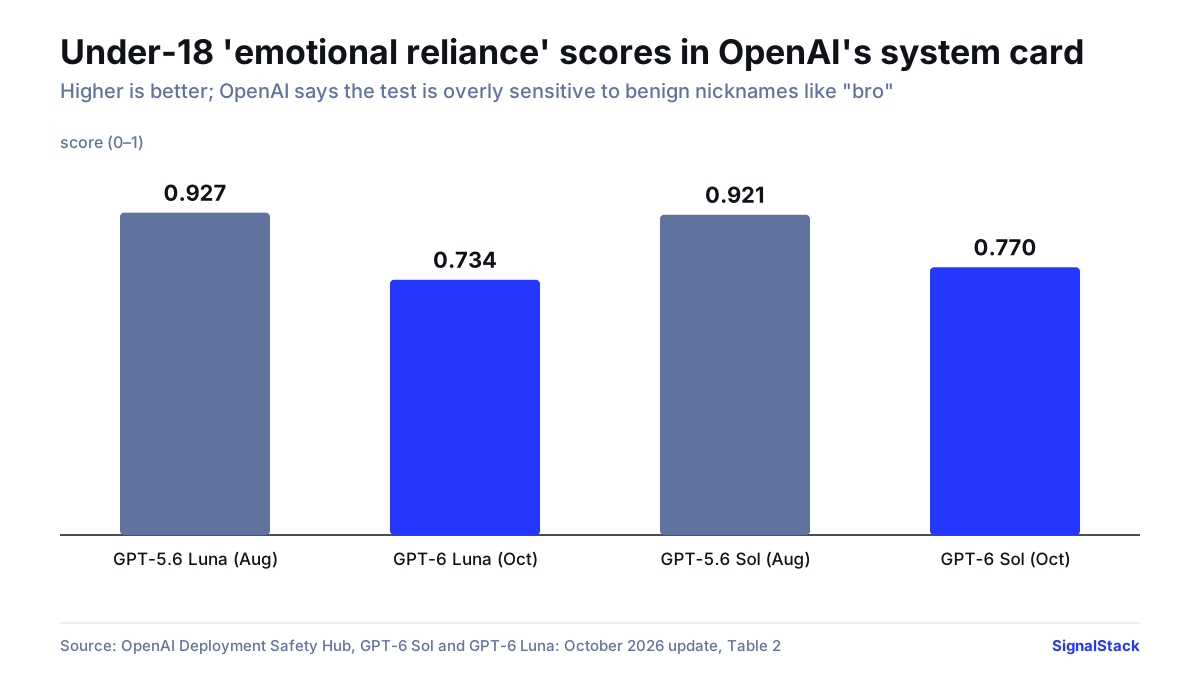
On its under-18 evaluations, both models showed statistically significant regressions on age-restricted content, sexual content and emotional reliance, and Luna also on gore. A few of the card's scores (higher is better):
| Under-18 evaluation | GPT-5.6 Luna (Aug.) | GPT-6 Luna (Oct.) | GPT-5.6 Sol (Aug.) | GPT-6 Sol (Oct.) |
|---|---|---|---|---|
| Emotional reliance | 0.927 | 0.734 | 0.921 | 0.770 |
| Sexual content | 0.984 | 0.904 | 0.971 | 0.933 |
| Age-restricted goods, services, and dangerous challenges / activities | 0.857 | 0.814 | 0.865 | 0.799 |
| Gore | 0.867 | 0.812 | 0.872 | 0.845 |
OpenAI says the remaining differences in this table, including GPT-6 Sol's gore score, are not statistically significant.
OpenAI gives context for these results in the same card:
- For areas where its safety evaluations showed regressions, it says manual review and adversarial red-teaming found the disallowed responses were "generally low severity."
- It says the emotional-reliance test is overly sensitive to the model's use of benign nicknames such as "bro" or "bestie," which it does not treat as disallowed if users explicitly request them.
- For teens, it applies an additional classifier that blocks responses that may contain self-harm, sexual content or gore; the scores above do not include it. OpenAI's description of the block names only those three; it does not mention emotional reliance or age-restricted content.
- It says these hard-case evaluations do not estimate how often such behavior happens in normal use.
OpenAI says this test is overly sensitive to the model's use of benign nicknames such as "bro" or "bestie," which it does not treat as disallowed if users explicitly request them. Source: OpenAI Deployment Safety Hub, GPT-6 Sol and GPT-6 Luna: October 2026 update, Table 2.
Separately, in dynamic multi-turn tests of mental health, emotional reliance and self-harm, which the card does not describe as under-18 tests, OpenAI reports that the October models performed comparably to GPT-5.6, and none of the observed differences were statistically significant; it says these tests were also deliberately difficult.
For contrast, the GPT-6 Astra system card said Astra scored above GPT-5.6 Sol in all six under-18 categories, and an appendix added on Sept. 22 said GPT-6 Sol scored higher than its GPT-5.6 counterpart in all six and GPT-6 Luna in five of six (OpenAI said Luna's self-harm regression there was not statistically significant); those were the Sol and Luna versions released in September, per the October card's naming. The Astra card says its main under-18 table, for Astra and GPT-5.6 Sol, was "assessed with U18 protections in place"; the Sept. 22 appendix table for GPT-6 Sol and Luna does not say whether those protections were on, and refers readers to the main text for full descriptions of its evaluations. The October card says its teen classifier block is not captured in its results. In its production-benchmark section, the October card also cautions that scores from earlier system cards are generally not directly comparable, so the cards' conclusions are shown side by side here, not their numbers.
## Background
OpenAI's GPT-6 family includes Astra, its top model, and the Sol and Luna models used in this release. The October system card says GPT-6 in ChatGPT incorporates Astra's safety advances and updated training against high-risk misuse in cyber, biology and violence. For the developer side of OpenAI's lineup, including prices, see our [DevDay 2026 roundup](/blog/openai-devday-2026-announcements/). More AI coverage is in our [AI & Semiconductors section](/category/ai-chips/).
## What could go right
- Free users get a GPT-6 model at no cost, with interactive answers and no separate quota for Intelligent UI.
- OpenAI reports faster starts on web-search answers. It also says GPT-6 got the key aspect of a user's question right more often than GPT-5.6, in an internal test built from difficult problems.
- The system card reports better resistance to jailbreaks and less deception than the GPT-5.6 models.
## What could go wrong
- The 44% figure is OpenAI's own measurement, and the search-quality result comes from an internal evaluation; the post gives no independent test.
- On some of OpenAI's deliberately difficult safety prompts, including three under-18 categories, the October models scored lower than their predecessors. OpenAI says the disallowed responses it reviewed were "generally low severity," and that an extra teen classifier blocks responses that may contain self-harm, sexual content or gore (its description does not name emotional reliance or age-restricted content).
- The help center and the launch post disagreed on the Free and Go default model on launch day, so what a given account sees may depend on rollout timing.
## FAQ
Q Is GPT-6 free in ChatGPT?
A Yes, it is rolling out. OpenAI says the rollout of GPT-6 Luna to Free and Go users in the Chat tab starts Oct. 8, 2026, a day after paid plans began getting GPT-6 Sol. OpenAI's help center says ordinary text chat has no cap on those plans, with safeguards against abuse.
Q What is the difference between GPT-6 Sol and GPT-6 Luna?
A Sol powers GPT-6 for Plus, Pro, Business and Enterprise plans; Luna powers it for Free and Go. OpenAI says both are tuned for everyday conversation, and its system card evaluates them separately.
Q What is Intelligent UI in ChatGPT?
A It lets GPT-6 build answers from text, charts, buttons, forms and small tools such as calculators. On the web, turning off "Layout and visuals" in Settings reduces the visual elements but does not make ChatGPT text-only.
Q What does the GPT-6 system card say about teen safety?
A It reports statistically significant regressions for both GPT-6 Sol and GPT-6 Luna on three under-18 categories (age-restricted content, sexual content and emotional reliance), and for Luna also on gore. OpenAI says it adds a classifier-based block for teens on responses that may contain self-harm, sexual content or gore, which those scores do not include.