Securities
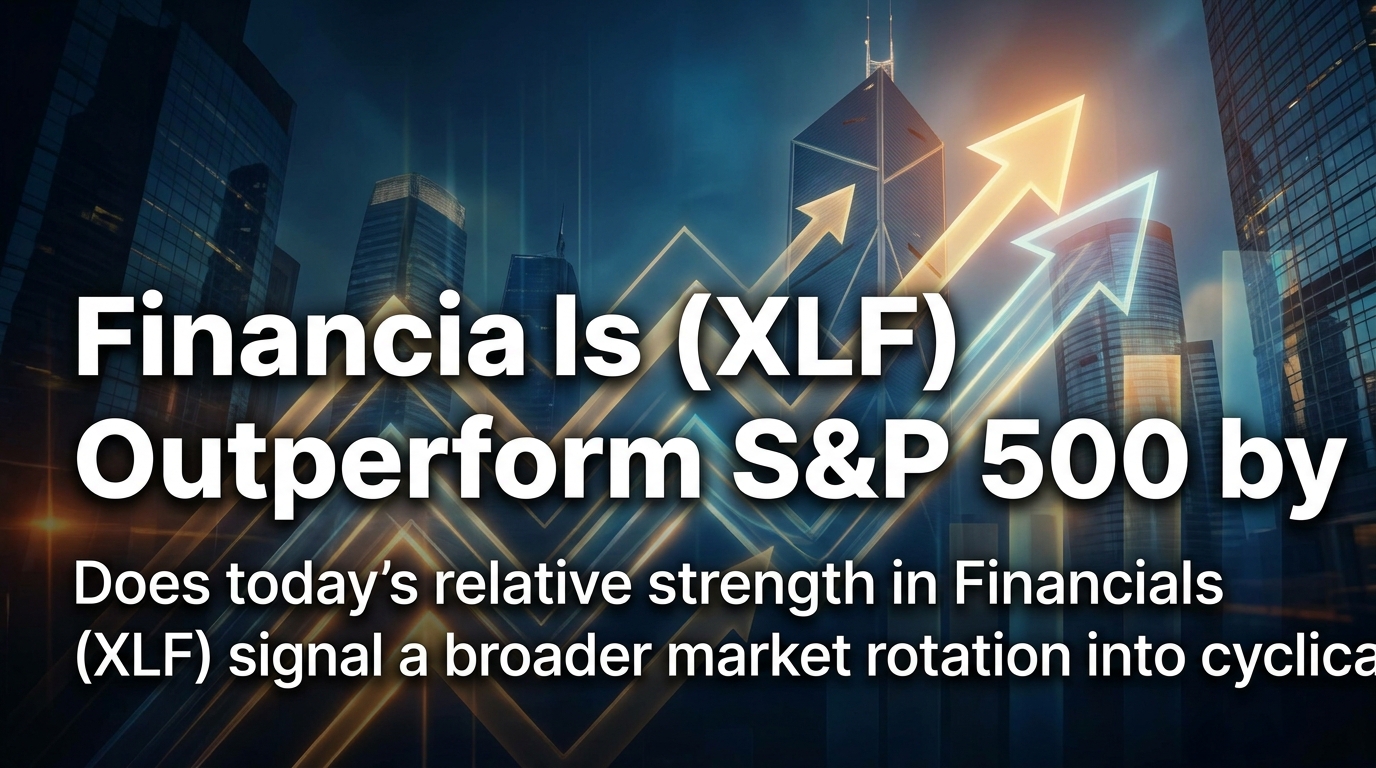
Financials (XLF) Outperform S&P 500 by +0.60% as Tech Leads
In focus: Financials (XLF) Outperform S&P 500 by +0.60% Amid Mixed 'Risk-On' Market
SignalStack · Securities brief · Jun 17, 2026, 2:31 PM UTC
Key takeaways

01 · Catalyst
02 · Tape
03 · Watch
What Happened to AAPL Stock?
The Financials Select Sector SPDR Fund (XLF) traded higher, posting a gain of +0.79% to reach $54.78. This performance positioned XLF as one of the stronger sectors, notably outperforming the S&P 500 (SPY), which saw a more modest increase of +0.19%. The broader market experienced a mixed day, characterized by a 'risk-on' tape regime, with Technology (XLK) leading the sectors with a +1.51% advance, while Energy (XLE) and Health Care (XLV) lagged, declining -0.79% and -0.72% respectively. Recent news headlines indicated a general advance in financial stocks, aligning with today's positive tape.
Why AAPL Is Rising (AI Demand & Peers)
The relative outperformance of the financial sector is a key signal for broader economic sentiment and capital flows. Financial institutions are highly sensitive to interest rate environments, economic growth forecasts, and credit conditions. A sustained rally in the Financials ETF could suggest market participants anticipate stable to improving economic conditions or a more favorable interest rate trajectory. This shift could signal a rotation towards cyclical value names, impacting portfolio allocations and potentially challenging the singular dominance of growth-oriented sectors. For portfolio managers, this tape suggests a nuanced 'risk-on' tilt in some cyclical areas, contrasting with the 'tech as safe haven' narrative seen in some recent headlines, requiring a careful assessment of sector leadership.
Is This a Risk-On Market?
Portfolio context only — not investment advice.
For portfolio managers and risk officers, the relative strength in the Financials sector suggests a potential broadening of market participation beyond mega-cap technology. This performance, especially when contrasted with lagging sectors like Energy and Health Care, could indicate a 'risk-on' regime for certain cyclical segments. Understanding these cross-sector dynamics is crucial for assessing liquidity flows, managing duration risk, and informing rebalancing decisions, but this is context for judgment, not a recommendation to buy, sell, or hold any security.
AAPL Stock Snapshot (Figures)
Key levels cited in this note — AI chip demand, sector ETFs, and broad indices. Not investment advice.
Sector ETF
XLF
The Financials Select Sector SPDR Fund (XLF) advanced +0.79% to $54.78 (packet).
Sector ETF
SPY
XLF outperformed the S&P 500 (SPY), which gained +0.19%, by +0.60 percentage points (packet).
Sector ETF
XLK
Technology (XLK) led all sectors, rising +1.51% (packet).
Sector ETF
XLE
Energy (XLE) was the weakest sector, declining -0.79% (packet).
Market
QQQ
The Nasdaq 100 (QQQ) increased by +0.69% (packet).
Equity
AAPL
Apple (AAPL) gained +0.44%, while NVIDIA (NVDA) rose +0.25% (packet).
Market
The Dow Jones Industrial Average
The Dow Jones Industrial Average hit record highs as oil prices dropped to $77 (article headline).
Cross-check (packet vs. headlines)
Editorial self-check: when headlines disagree with live prints, defer to the snapshot packet for levels and percentages.
- XLF's +0.79% gain and $54.78 price are directly from the packet's quote data.
- Sector performance figures for XLK (+1.51%), XLE (-0.79%), and XLF (+0.79%) are verified against packet's sector heat data.
- The 'risk_on' tape regime is explicitly noted in the packet's quality signals.
- Specific equity changes for AAPL (+0.44%) and NVDA (+0.25%) are from packet's sector hot spotlights.
- The packet does not contain specific valuation metrics or forward-looking estimates for XLF or its constituents.
Alignment vs. tension: The packet's real-time data for XLF shows a clear positive performance today, with the ETF gaining +0.79%. This generally aligns with the sentiment from several older Finnhub news headlines, which indicated financial stocks advancing in previous sessions. While one headline mentioned 'The Iran Shock Reinvented Tech As The New Safe Haven,' implying a shift towards technology, the current packet data shows both Technology (XLK) and Financials (XLF) as leading sectors relative to SPY, suggesting a mixed 'risk-on' environment rather than a clear rotation exclusively into tech as a safe haven. The packet numbers are prioritized for current market levels, highlighting a nuanced leadership dynamic.
Bull vs Bear Case for AAPL
Question: Does today's relative strength in Financials (XLF) signal a broader market rotation into cyclicals, or is Technology's continued leadership the more enduring trend?
Tape read: Financials (XLF) showed notable relative strength today, signaling a potential broadening of market leadership beyond tech, even as a mixed 'risk-on' regime persists.
Bull case
- Improving economic data and stable interest rates could boost bank profitability and loan growth, driving XLF higher.
- A sustained rotation from growth to value stocks would favor financials, attracting further capital inflows.
- Strong earnings reports from major financial institutions in upcoming quarters could validate current valuations and provide upward momentum.
Bear case
- Unexpected economic slowdowns or rising credit defaults could negatively impact financial sector earnings and asset quality.
- Rapid shifts in central bank policy or an inverted yield curve could compress net interest margins for banks.
- Increased regulatory scrutiny or new capital requirements could dampen profitability and investor sentiment for financials.
Is AAPL Stock Overvalued Right Now?
Unexpected economic slowdowns or rising credit defaults could negatively impact financial sector earnings and asset quality. Treat valuation as context tied to sources and the packet—not advice to buy, sell, or hold. Investment decisions are the reader's alone.
What to Watch Next
Investors should monitor upcoming economic reports, particularly those related to inflation and employment, as these can influence central bank policy and interest rate expectations. Key earnings reports from major financial institutions in the coming weeks will also provide insights into sector-specific fundamentals and outlooks. Any shifts in global geopolitical stability could also impact risk appetite and sector flows.
Near-term catalysts (calendar-style):
- June 18: US Housing Starts and Building Permits data release.
- June 19: Federal Reserve FOMC meeting minutes publication.
- June 20: Weekly Unemployment Claims report.
- June 21: Flash PMI data for manufacturing and services.
Key Details

Company & fundamentals
- The Financials Select Sector SPDR Fund (XLF) closed at $54.78, up +0.79%.
- XLF's performance outpaced the S&P 500 (SPY), which rose +0.19%, by +0.60 percentage points.
- Technology (XLK) was the strongest sector, advancing +1.51% and exceeding SPY's gain by +1.32 percentage points.
- Energy (XLE) was the primary laggard, declining -0.79% and underperforming SPY by -0.98 percentage points.
Market & sectors
- The Nasdaq 100 (QQQ) also showed relative strength, increasing by +0.69%.
- Apple (AAPL) and NVIDIA (NVDA) saw modest gains of +0.44% and +0.25% respectively within the Technology sector.
- Consumer Discretionary (XLY) lagged, down -0.44% against the SPY.
What would change this read
Near-term evidence that would materially revise the interpretation — not a trading checklist.
- A significant and sustained decline in long-term interest rates would challenge the bull case for financials.
- Consistent underperformance of XLF relative to the broader market (SPY) for several consecutive weeks would indicate a weakening trend.
- A notable increase in credit default swap spreads or other credit market stress indicators would signal rising systemic risk.
Why SignalStack covers this now
Editorial framing for tech readers — not a recommendation.
SignalStack covers the Financials sector's performance as it offers crucial insights into broader market dynamics, particularly for our tech-focused readers. Understanding how traditional sectors like financials are performing against technology leaders helps in assessing overall market risk appetite and potential shifts in capital flow. A resilient financial sector can underpin a stable economic environment, which indirectly benefits technology companies by supporting consumer and business spending. This cross-sector view is essential for discerning macro trends that can influence portfolio construction and risk management beyond specific tech names, especially when distinguishing between headline narratives and actual capital flows in a 'risk-on' regime.
FAQ
Q What factors are driving the Financials sector currently?
A The Financials sector's performance is influenced by interest rate expectations, economic growth, and credit market conditions. Positive sentiment can arise from expectations of stable economic growth or a favorable interest rate environment.
Q How does XLF compare to the broader market today?
A Today, XLF gained +0.79%, outperforming the S&P 500 (SPY) which rose +0.19%. This indicates relative strength in the financial sector compared to the overall market benchmark.
Q What risks should investors consider for the Financials sector?
A Risks for the Financials sector include unexpected changes in interest rates, economic downturns leading to increased loan defaults, and regulatory shifts.
Further reading
- Impact of Interest Rate Cycles on Bank Profitability
- Sector Rotation Strategies in Volatile Markets
- Global Economic Outlook and Financial Stability
- Understanding Exchange-Traded Funds (ETFs)