# Earnings Season Explained: 8-K, 10-Q, Guidance and Non-GAAP
> How US earnings reports work: the Item 2.02 8-K, the 40- and 45-day 10-Q deadlines, how guidance is given, and how GAAP and adjusted EPS are reconciled.
Many US public companies tell investors each quarter how they did in two separate documents. First comes the earnings release, furnished to the SEC on a [Form 8-K](/glossary/form-8-k/) under Item 2.02, often with a call shortly after. Weeks later, or sometimes the same day, comes the [Form 10-Q](/glossary/form-10-q/), the formal quarterly report. Companies that give guidance often give it in the release, and that is where "adjusted" profit appears next to the GAAP number. This guide works from the SEC's own forms and rules and from three recent sets of results we have covered: Accenture, Micron and Nike.
## TL;DR
- **Two documents, two clocks:** an earnings release triggers Item 2.02 of Form 8-K, and the release goes in as an exhibit. The 10-Q is due 40 days after the quarter ends for large accelerated and accelerated filers and 45 days for everyone else. There is no 10-Q for the fourth quarter; the 10-K covers it.
- **Guidance is voluntary:** neither Form 8-K nor Form 10-Q asks for a forecast, and the SEC's policy on projections in filings treats them as management's option. Accenture, Micron and [Nike](/blog/nike-q1-fiscal-2027-results-restructuring/) all gave outlooks in their latest releases, and each did it differently.
- **GAAP vs non-GAAP:** an adjusted figure must come with the comparable GAAP figure and a reconciliation, and in a filing or earnings release the GAAP figure must be shown with equal or greater prominence. Accenture's fiscal 2026 GAAP EPS was $13.56 and its adjusted EPS $13.97. The $0.41 difference is "business optimization costs," primarily severance.
## Step 1: the release and the Item 2.02 8-K
Item 2.02, "Results of Operations and Financial Condition," applies when a company, or anyone acting for it, publicly announces material non-public information about its results of operations or financial condition for a **completed** quarter or year (including an update of an earlier release). The company must give the date of the release, identify it briefly and attach its text as an exhibit. The SEC created this requirement as Item 12 in January 2003 (Release 33-8176). That release notes the item "does not require that companies issue earnings releases"; it applies once they do. In 2004, Release 33-8400 moved it to Item 2.02 and kept "all of the substantive requirements" of the old item. Most 8-K items are due within four business days. In our three examples, the 8-K went in on the day of the release.
Three details in the form matter for readers:
- **Furnished, not filed.** Under General Instruction B.2, Item 2.02 material is not deemed "filed" for Section 18 liability unless the company specifically states that it is to be treated as filed, or incorporates it by reference into another SEC filing. Accenture's October 1, 2026 8-K says: "All information in the news release is furnished but not filed."
- **The call doesn't need its own 8-K** if it meets four conditions in Item 2.02(b). It must initially take place within 48 hours after a written release already furnished on Form 8-K. It must be open to the public by dial-in, webcast or similar means. The financial and other statistical information discussed, with the GAAP comparison and reconciliation Regulation G requires, must be posted on the company's website. And a widely disseminated press release must have said when and how to join and where on the website the information would be. Accenture's call was at 8:00 a.m. EDT on the day of its release, Micron's at 2:30 p.m. Mountain Time on September 30 and Nike's at about 2:00 p.m. Pacific Time on October 1.
- **It is not only for profit numbers.** Tesla furnished its third-quarter production and deliveries release under Item 2.02 on October 2, 2026, 19 days before its financial results. That release also set the results date: October 21, after market close. See [Tesla's Q3 deliveries report](/blog/tesla-q3-2026-deliveries-production/).
Investor.gov notes that many companies announce results "simultaneously in a press release and an 8-K," and that the figures typically summarize statements that appear later in the 10-Q or 10-K. Our [guide to Form 8-K](/blog/how-to-read-form-8-k/) covers the other items.
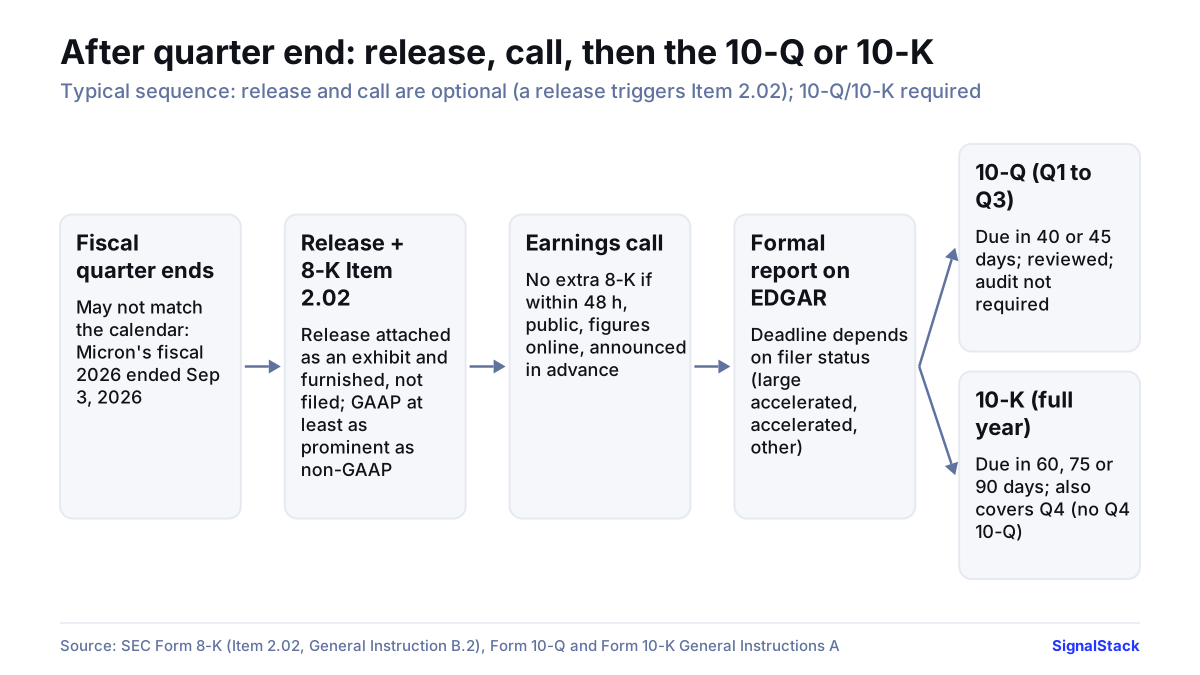
The documents behind one quarterly report and the deadlines the SEC's forms set for each. Source: SEC Form 8-K (Item 2.02, General Instruction B.2), Form 10-Q and Form 10-K General Instructions A.
## Step 2: the 10-Q (or 10-K) and its deadline
General Instruction A.1 of Form 10-Q sets the deadline after each of the **first three** fiscal quarters: 40 days for large accelerated filers and accelerated filers, and 45 days for all other companies. Form 10-K is due 60 days after the fiscal year ends for large accelerated filers, 75 days for accelerated filers and 90 days for everyone else.
Filer status is defined in SEC Rule 12b-2 by public float, the market value of common equity held by non-affiliates, measured on the last business day of the second fiscal quarter. A company is a large accelerated filer at $700 million or more and an accelerated filer from $75 million up to that level. There are other conditions too, including at least 12 months of reporting and one annual report filed. Accenture, Micron and Nike all tick "Large accelerated filer" on their 10-Q cover pages.
What the 10-Q adds to the release:
- **Reviewed financial statements.** Rule 10-01(d) of Regulation S-X says the interim statements in a 10-Q must be reviewed by an independent public accountant before filing. A review is not an audit.
- **MD&A, market risk and controls** (Part I, Items 2 to 4), plus Part II items such as legal proceedings and material changes to risk factors.
- **Item 5, "Other Information,"** which must include anything that should have been reported on Form 8-K during the quarter but wasn't, and the Rule 10b5-1 plan disclosures. Nike's latest 10-Q says no director or officer adopted or ended such a plan in the quarter.
A company that can't file on time must file Form 12b-25 (often called an NT 10-Q) no later than one business day after the due date. If it states that the 10-Q will follow within five calendar days and meets the rule's other conditions, the 10-Q is treated as filed on time when it arrives no later than the fifth calendar day after the due date.
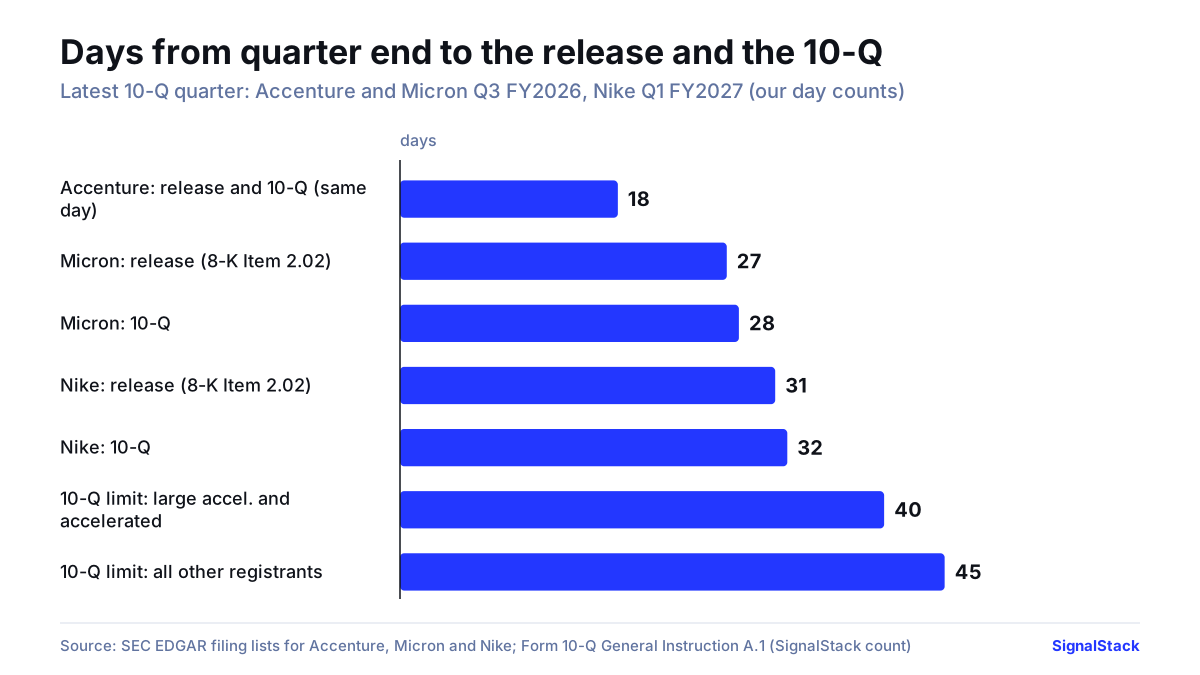
How quickly the 10-Q follows the release varies. EDGAR shows that Accenture filed its 10-Q for the quarter ended May 31, 2026 on June 18, the same day as its Item 2.02 8-K. Micron's 10-Q for the quarter ended May 28 came one day after its release, and Nike's for the quarter ended August 31 also came one day after.
All three companies filed their latest 10-Q within 32 days of quarter end, inside the 40-day limit for large accelerated filers (our day counts). Source: SEC EDGAR filing lists for Accenture, Micron and Nike; Form 10-Q General Instruction A.1 (SignalStack count).
The fourth quarter works differently. With no fourth-quarter 10-Q, the full-year numbers arrive in the release, and the full annual statements come later in the 10-K. As of October 5, EDGAR listed no fiscal 2026 10-K yet for Accenture (year ended August 31) or Micron (year ended September 3). By our count, the 60-day limits fall on October 30 and November 2. A year earlier, Accenture's 10-K came 40 days after its year end and Micron's 36. This is also why our [earnings pages](/earnings/) mark some fourth quarters "from annual report": the quarter is the annual total minus the three reported quarters.
Not everyone on the calendar files these forms. TSMC, ASML and Spotify, which have confirmed results dates of October 15, October 14 and October 22 (per our [earnings calendar](/earnings/)), file Form 6-K reports on EDGAR rather than 8-Ks. Form 6-K is for foreign private issuers. It is furnished "promptly" after the company makes the information public under its home-country rules, files it with an exchange that makes it public, or sends it to security holders, and EDGAR lists an annual report on Form 20-F for each of them, and no 10-Qs.
## Step 3: guidance, and the legal fine print around it
Item 10(b) of Regulation S-K describes the SEC's policy on projections. It says management "must have the option" to present in Commission filings its good-faith assessment of future performance, with "a reasonable basis." It also says ranges "should not be so wide as to make the disclosures meaningless." Nothing in the 8-K or 10-Q forms requires guidance, so the format varies from company to company:
| Company (release date) | What it guided | Basis |
|---|---|---|
| Accenture (Oct 1) | Fiscal 2027 revenue growth of 3% to 6% in local currency; GAAP diluted EPS of $14.39 to $14.81; Q1 revenue of $18.95B to $19.60B | GAAP EPS; growth in local currency, which its 8-K lists as a non-GAAP measure |
| Micron (Sep 30) | Fiscal Q1 2027 revenue of $61.5B ± $1.5B; EPS of $37.84 ± $1.00 GAAP, $38.15 ± $1.00 non-GAAP | Both, with a reconciliation table: stock-based compensation of $427 million less $65 million of tax effects and other tax adjustments, $362 million in total |
| Nike (Oct 1) | Fiscal 2027 revenue expected to decline high-single digits; adjusted diluted EPS of $1.15 to $1.35 | Adjusted EPS, which excludes about $0.15 of expected Pace restructuring expenses |
Sources: each company's Item 2.02 exhibit.
The call can add context the table can't. Accenture CFO Angie Park said the top of the range allows for "a stable to slightly improving discretionary spend environment, while at the bottom, we allow for deterioration," according to The Motley Fool's transcript. Micron's prepared remarks say they use non-GAAP figures "unless otherwise specified." So the EPS in the call's prepared remarks, $38.15, is the non-GAAP one; the GAAP range is in the release table.
**The safe harbor.** Releases carry a "forward-looking statements" section for a legal reason. The Private Securities Litigation Reform Act of 1995 added a safe harbor to the Exchange Act. In private lawsuits, subject to exclusions (for example, statements made in connection with an IPO or tender offer, or included in GAAP financial statements), a company is not liable for a forward-looking statement that is identified as one and "accompanied by meaningful cautionary statements," or that is immaterial. It is also not liable if the plaintiff can't prove the statement was made or approved by an executive officer with actual knowledge that it was false or misleading. The law's definition of a forward-looking statement includes projections of revenue, income and earnings per share. Accenture's release cites the 1995 Act by name. Micron's points readers to the risk factors in its 10-K and 10-Q.
**Mid-quarter updates and Regulation FD.** If a company discloses material non-public information to market professionals (such as broker-dealers, investment advisers and investment companies) or to shareholders likely to trade on it, Regulation FD requires it to make the information public, unless an exception applies, for example the recipient owes it a duty of trust or confidence, has expressly agreed to keep it confidential, or the disclosure is made in certain registered-offering communications. For an intentional disclosure (the speaker knows, or is reckless in not knowing, that the information is material and non-public) it must be public at the same time. For a non-intentional one it must be done "promptly," which the rule defines as "as soon as reasonably practicable," and in any case no later than the later of 24 hours or the start of the next New York Stock Exchange trading day, counted from when a senior official learns of the disclosure. A Form 8-K is one way to do that; another method of broad, non-exclusionary public distribution also works.
## Step 4: GAAP vs non-GAAP
GAAP figures follow US accounting standards. Regulation G defines a non-GAAP financial measure as a number about past or future performance, financial position or cash flows that excludes amounts included in the most directly comparable GAAP measure, or includes amounts excluded from it. Ratios and operating measures calculated only from GAAP figures or operating data are not covered. The category is wider than "adjusted EPS." Accenture's 8-K names three non-GAAP measures in its release: free cash flow, growth "on a local currency basis," and the adjusted figures that exclude business optimization costs.
The rules come in two layers:
- **Regulation G** applies whenever a company publicly discloses material information that includes a non-GAAP measure (with narrow exceptions, such as some foreign private issuers' disclosures outside the US). It must present the most directly comparable GAAP measure and a quantitative reconciliation. For forward-looking measures, the reconciliation must be quantitative "to the extent available without unreasonable efforts." The measure must not be misleading.
- **Item 10(e)(1)(i) of Regulation S-K** adds that the GAAP measure be shown "with equal or greater prominence," that management say why the measure is useful and, to the extent material, any other purposes for which management uses it. Item 2.02's Instruction 2 applies this paragraph to earnings releases even though they are furnished. The list of prohibited practices in Item 10(e)(1)(ii) is written for SEC filings. One example is adjusting a non-GAAP performance measure to remove a charge or gain labelled non-recurring, infrequent or unusual when a similar one is reasonably likely within two years or occurred in the prior two.
The SEC staff's interpretations, last updated December 13, 2022, give examples of what it treats as undue prominence. They include a headline that leads with a non-GAAP figure, and a reconciliation that starts from the non-GAAP number. The staff also says excluding "normal, recurring, cash operating expenses" is one example of a measure that could be misleading.
In practice, the reconciliation tables show what was taken out:
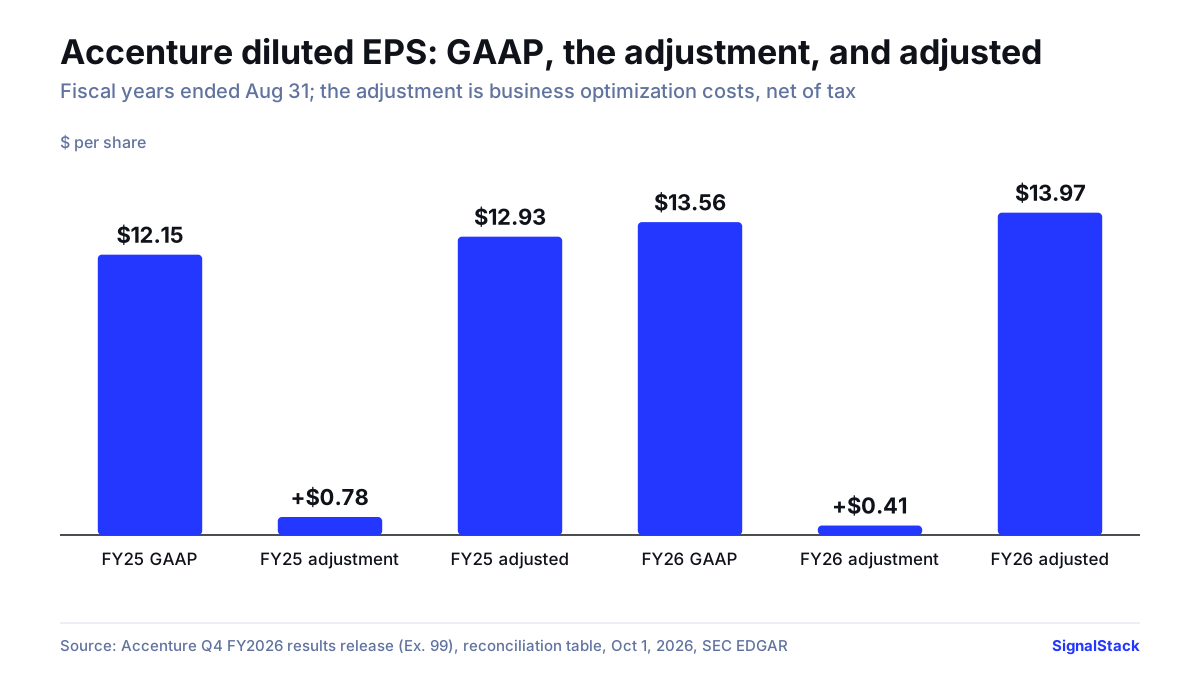
- **Accenture, fiscal 2026:** GAAP diluted EPS of $13.56, plus $0.41 of business optimization costs, equals adjusted EPS of $13.97. The $0.41 is shown net of a $0.09 tax effect. The release says the costs were for actions begun in the fourth quarter of fiscal 2025 and completed in the first quarter of fiscal 2026, primarily employee severance. Operating income was $11.41 billion GAAP and $11.71 billion adjusted. Fiscal 2025 had a larger adjustment: $12.15 GAAP, $12.93 adjusted.
- **Micron, fiscal Q4 2026:** GAAP diluted EPS of $32.87, plus $0.55 of adjustments, equals $33.42 non-GAAP. The net income bridge adds back $364 million of stock-based compensation, $500 million of patent license charges, a $9 million loss on debt prepayments and $22 million of other items, then subtracts $198 million of estimated tax effects. Stock-based compensation appears in every column of the table, and the release says its adjustments "may or may not be infrequent or nonrecurring in nature."
- **Nike, fiscal Q1 2027:** the release reports GAAP diluted EPS of $0.48 and uses non-GAAP measures elsewhere: currency-neutral revenue, EBIT and, for the outlook, adjusted EPS that excludes restructuring and severance charges.
Accenture's adjusted EPS is GAAP EPS plus business optimization costs, net of tax, in both years. Source: Accenture Q4 FY2026 results release (Ex. 99), reconciliation table, Oct 1, 2026, SEC EDGAR.
For a full read of one release, see our [Accenture Q4 fiscal 2026 report](/blog/accenture-q4-fiscal-2026-results/) and [Micron fiscal Q4 2026 report](/blog/micron-fiscal-q4-2026-results/).
## What the earnings documents don't tell you
- **Analyst estimates aren't in them.** "Beat" and "miss" in headlines compare results with third-party consensus, which is not part of any SEC filing. The filings do show results against the company's own guidance. Accenture's fourth-quarter revenue of $18.68 billion was above its guided range of $17.75 billion to $18.40 billion.
- **Adjusted figures aren't standardized.** Micron's release says its non-GAAP amounts "may not be comparable" to other companies' figures. Accenture adjusts for severance programs, and Micron for stock-based compensation in every period shown.
- **The release is not the final word.** The fuller statements come in the 10-Q or 10-K. A new release of material information about the same completed period triggers another Item 2.02 8-K.
Upcoming confirmed dates are on our [earnings calendar](/earnings/), with each company's GAAP quarters from SEC XBRL data and links to its Item 2.02 releases. More explainers: [Guides](/category/guides/).
## FAQ
Q What is the difference between an earnings release and a 10-Q?
A The earnings release is the company's announcement, furnished to the SEC as an exhibit to a Form 8-K under Item 2.02. The 10-Q is the formal quarterly report, with financial statements reviewed by an independent accountant, MD&A and, except for smaller reporting companies, any material changes to risk factors. It is due 40 or 45 days after the quarter ends, depending on filer status.
Q When is a 10-Q due?
A Within 40 days after the end of each of the first three fiscal quarters for large accelerated and accelerated filers, and 45 days for all other companies, under General Instruction A.1 of Form 10-Q. No 10-Q is filed for the fourth quarter; the annual 10-K covers it.
Q What does non-GAAP mean in an earnings report?
A It is a figure that adds or removes amounts compared with the closest US GAAP measure, such as adjusted EPS, free cash flow or growth in local currency. Regulation G requires the comparable GAAP figure and a reconciliation, and in SEC filings and earnings releases furnished under Item 2.02 the GAAP figure must be at least as prominent.
Q Are companies required to give earnings guidance?
A Forms 8-K and 10-Q don't ask for guidance. Item 10(b) of Regulation S-K treats projections in filings as management's option, which must have a reasonable basis. Companies that give guidance usually label it as forward-looking, with cautionary statements under the 1995 Private Securities Litigation Reform Act's safe harbor.
Q Why is adjusted EPS higher than GAAP EPS?
A Usually because the company excludes certain costs, such as severance, restructuring or stock-based compensation, and shows the removed amounts in a reconciliation table. Accenture's fiscal 2026 adjusted EPS of $13.97 was its GAAP EPS of $13.56 plus $0.41 of business optimization costs, net of tax.