# Can Claude Report You to Police? What Anthropic's Policies Say
> A Florida arrest followed Anthropic reporting a Claude chat to police. What its privacy policy, retention rules and data-request reports say, line by line.
**TL;DR**
- A Bonita Springs, Florida woman was arrested after Anthropic's human review team reported her messages on its AI platform to police, according to an arrest report described by WINK News; Tom's Hardware and TechSpot identify the platform as Claude. A Sept. 26 message allegedly said she was going to "shoot up" the Lee County Sheriff's Office; a message the next day allegedly said she had gotten a new gun.
- Anthropic's privacy policy, effective Sept. 10, 2026, lets it share personal data with police if it believes in good faith that this is reasonably needed to "prevent serious harm" to a person or property.
- According to Anthropic's privacy center, a chat its automated systems flag under the Usage Policy can be retained for as long as 2 years, with its safety scores held for as long as 7.
## What happened
WINK News reported on Sept. 30 that a Bonita Springs woman had been arrested after investigators said she made threats against the Lee County Sheriff's Office while using an Anthropic AI platform. According to the arrest report, a user made a statement on Sept. 26 saying she was going to "shoot up" the sheriff's office, and the same user said the next day that she had gotten a new gun.
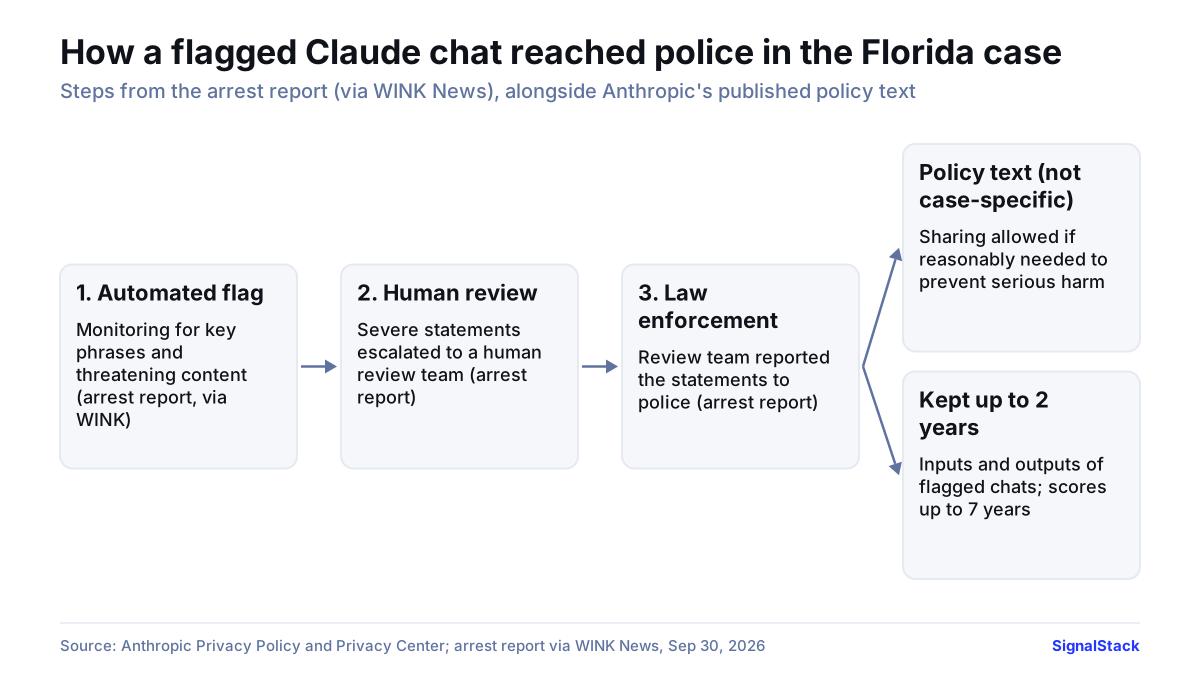
Per the arrest report, as WINK summarized it, Anthropic's system watches for threatening phrases. Given how serious these messages were, they went to a human review team, and that team alerted police. Deputies detained the woman at her home without incident. Sheriff Carmine Marceno told WINK that she later said she uses AI like a "diary." He also said users should understand they are "never truly anonymous."
The path the arrest report describes, alongside Anthropic's published policy text; Anthropic has not said which clause applied. Source: Anthropic Privacy Policy and Privacy Center; arrest report via WINK News, Sep 30, 2026.
Tom's Hardware reported that court records list a Sept. 30 felony charge under Florida Statute 836.10, booked as a written or electronic threat of a mass shooting or act of terrorism, and that the arraignment is set for Nov. 2. The charge is an allegation; the case is pending. Tom's Hardware reported that no comment from Anthropic on the case is on record; WINK said it had asked Anthropic for comment. We are not naming the woman.
Tom's Hardware counted this as at least the third chatbot conversation to reach police since August. One was an Aug. 14 Claude chat in which a user made threats against Dario Amodei, Anthropic's chief executive. According to Tom's Hardware, Anthropic notified police, and the user was not arrested or charged.
## What Anthropic's own documents say
Four Anthropic documents describe when a chat can leave the company. Read together, they show who decides, on what standard, and for how long the material is kept.
**1. The privacy policy (effective Sept. 10, 2026).** In a clause on safety and the rights of others, Anthropic lists four purposes for which it may hand personal data to "law enforcement" or other parties, when it believes in good faith that doing so is reasonably needed. One purpose: to "prevent serious harm" to a person or to property. The test is Anthropic's own belief, "based on the information available to us." Preventing harm is listed as its own purpose, separate from complying with "legal process" or an enforceable government request.
**2. The government-request policy.** For requests that come *from* governments, Anthropic's privacy center says it does not disclose user information "except in accordance with valid legal process," such as a subpoena or warrant. It makes an exception for an emergency that "may result in imminent physical harm or death." It says it notifies users when their data is requested, with exceptions that include emergencies.
**3. The Usage Policy (effective Sept. 15, 2025).** It says Anthropic's Safeguards Team "will implement detection and monitoring to enforce our Usage Policy." Its rules bar using Claude to promote "violence or intimidation" aimed at people, animals or property. The policy applies to anyone who can submit inputs to Anthropic's products.
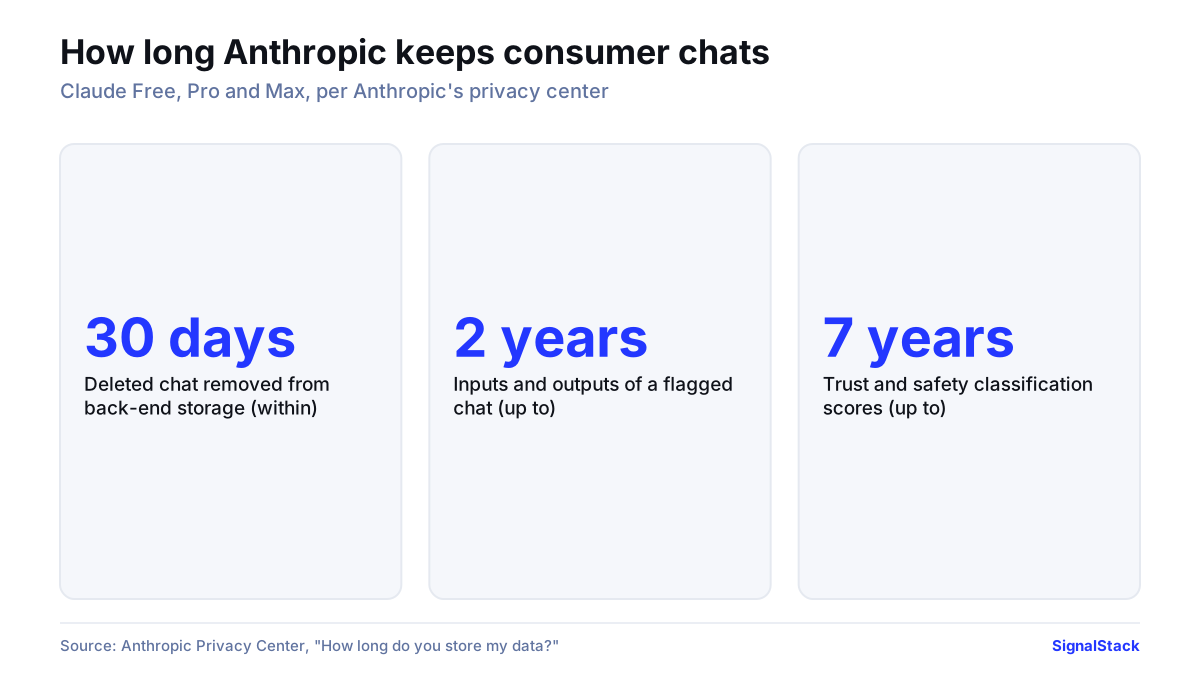
**4. The retention rules.** For consumer plans (Free, Pro, Max), Anthropic's privacy center says deleting a chat clears it from your history at once and from back-end storage within 30 days. Flagged chats run on a longer clock: when automated trust and safety systems mark a chat as a Usage Policy violation, Anthropic keeps the chat itself for as long as 2 years and the classification scores for as long as 7. The same page adds that Anthropic may keep chats longer where required by law, to resolve disputes or to combat Usage Policy violations. The privacy policy adds that, even if you opt out of model training, conversations "flagged for safety review" will still be used to improve its models.
How long Anthropic says it keeps consumer chats, depending on whether they were flagged. Source: Anthropic Privacy Center, "How long do you store my data?".
## What Anthropic's transparency reports count, and what they don't
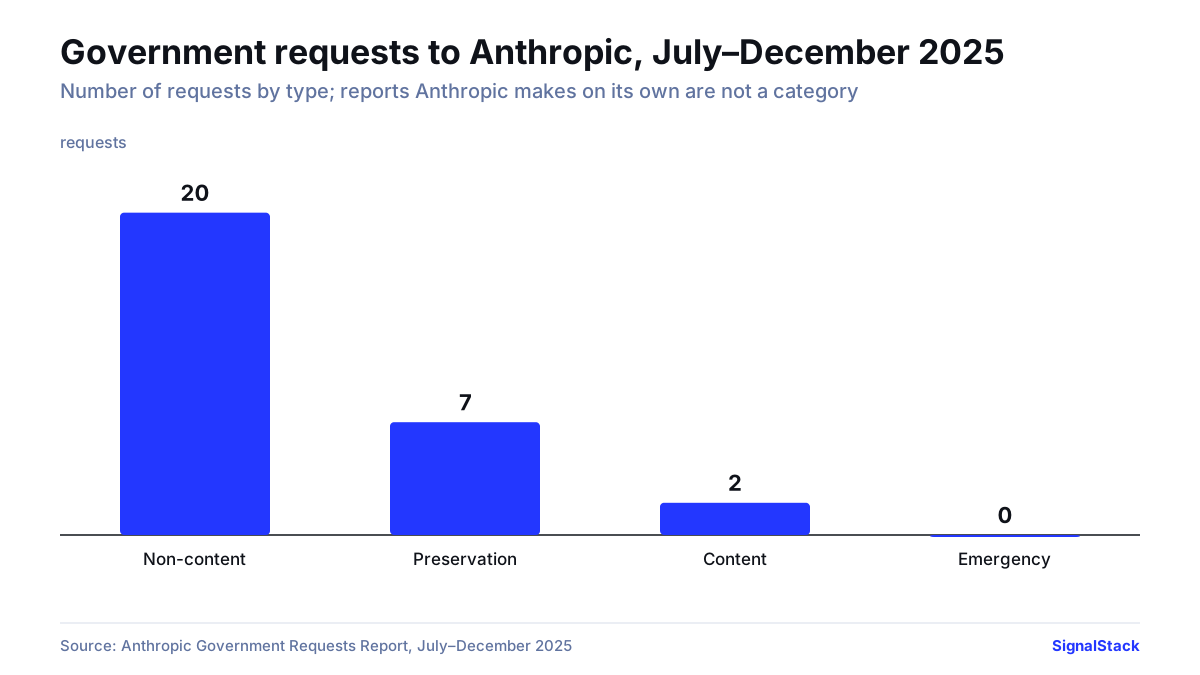
Anthropic publishes periodic reports on government requests for user data, each covering six months. In the latest, for July to December 2025, it lists 2 content requests (covering 8 accounts; data provided for 2 requests), 20 non-content requests (55 accounts; data provided for 7), 7 preservation requests (29 accounts) and 0 emergency requests. In the January to June 2025 report, every line was zero.
The report defines emergency requests as cases where Anthropic believes disclosure is needed to head off "danger of death or serious physical injury to a person." That is a narrower test than the privacy policy's "serious harm to any person or to property," as Tom's Hardware also noted.
There is a second gap. Every row in the report is a request *from* a government agency. A report that Anthropic makes on its own, like the one in this case, is not a government request, so the table has no line for it, a point Tom's Hardware also made. The zero for emergency requests says nothing either way about how often Anthropic contacts police itself.
Requests Anthropic received from governments in the second half of 2025; reports it makes on its own are not a category in this table. Source: Anthropic Government Requests Report, July–December 2025.
## Background: the Florida law
Florida Statute 836.10 makes it unlawful to "send, post, or transmit" a written or electronic record that threatens to kill or do bodily harm to another person, or to conduct a mass shooting or an act of terrorism, "in any manner in which it may be viewed by another person." It is a second-degree felony. A separate subsection shields internet and hosting providers that provide the transmission, storage or caching of other people's messages.
Whether a chat with an AI counts as a record that "may be viewed by another person" is a question for the court, not this report. The arrest report, as WINK described it, says the statements were escalated to a human review team at Anthropic.
For more on how AI companies handle safety incidents, see our report on [an OpenAI safety leader's resignation essay](/blog/openai-safety-leader-resignation-culture-essay/) and on [OpenAI's review of its AI agents' activity on SEC and Census Bureau sites](/blog/openai-agents-sec-commerce-sites-incident-model-review/). More in [Tech & Security](/category/tech-security/).
## What could go right / What could go wrong
**What could go right**
- A clearly stated standard lets users know where the line is. Anthropic's documents already name the test ("serious harm to any person or to property") and the retention periods.
- Human review before a referral, as the arrest report describes, puts a person rather than only a classifier between a flagged message and the police.
**What could go wrong**
- The privacy policy's standard is broader than the emergency standard in the transparency report, and referrals Anthropic makes to police on its own are not a category in its government requests report. We found no published count of those referrals, so users cannot see how often they happen.
- Users may not expect a human to read what they write. Because AI feels like a conversation, people can assume it is more private than it is, Ian Marlow, CEO of FITECH, told WINK News. The sheriff said users are "never truly anonymous," specifically when using AI chatrooms and searches.
- The law is still catching up. A retired FBI special agent, Richard Kolko, told WINK News that courts are "still figuring it out" when it comes to threats involving AI.
## FAQ
Q Does Anthropic read my Claude chats?
A Anthropic's Usage Policy states that a Safeguards Team will run detection and monitoring to enforce its rules. In the Florida case, the arrest report, as described by WINK News, says monitoring for threatening phrases flagged the messages and a human review team then reviewed them.
Q Can Claude report you to the police?
A Anthropic's privacy policy, effective Sept. 10, 2026, lets it share personal data with police if it believes in good faith that sharing is reasonably needed to prevent serious harm to a person or property. In the Florida case, its human review team reported the messages to police, according to the arrest report.
Q How long does Anthropic keep flagged chats?
A For consumer plans, Anthropic says a chat its automated systems flag as a Usage Policy violation can be kept for as long as 2 years, and its safety classification scores for as long as 7 years. Deleted chats are removed from its back-end within 30 days, though Anthropic says it may keep chats longer where required by law or to combat Usage Policy violations.
Q How many emergency data requests has Anthropic received?
A Zero in both 2025 reports, January to June and July to December. Those reports count requests from governments, not reports Anthropic makes to police on its own.
Q What law was the Florida woman charged under?
A Florida Statute 836.10, which covers written or electronic threats to kill, injure, or conduct a mass shooting or act of terrorism. It is a second-degree felony; the case is pending.